Short answer: A new travel agency gets its first customers from people who already trust the owner: family, friends, former colleagues and one community or niche the owner knows well. Tell them clearly what you sell, answer every enquiry quickly with a clear quote, look after the first trips carefully and ask each happy traveller for a referral. Paid advertising works better later, once you know who books with you.
This guide is for owners of new and small travel agencies who have registered the business, chosen a supplier and are now asking: "Where will my first bookings come from?" It covers who to target, which low-cost channels work, how to turn enquiries into bookings and how to make first customers come back. If you have not set up the business yet, start with How to Start an Online Travel Agency and What Should a New Travel Agency Sell First?
Key takeaways
- Your first customers usually come from your own network and one niche you understand, not from advertising.
- Describe your first customer in one sentence, then go where those people already talk.
- Speed and clarity win enquiries: reply quickly, quote with the fare rules and confirm only after ticketing.
- Every completed trip is a chance to ask for a review and a referral.
- Track where each enquiry came from, so you spend time and money on the channels that bring bookings.
Where do a new travel agency's first customers come from?
Most first customers come from people who already know and trust the owner. Family, friends, former colleagues and your community book with you before they compare you with an online travel agency (OTA). Next come referrals from those first travellers, then local businesses and groups in your niche. Strangers from search and ads usually come later.
Think of your market as circles, starting close to you:
- People who know you: family, friends, former colleagues, people from your place of worship, school or sports club.
- Their contacts: the people your first travellers recommend you to.
- Your niche community: a diaspora community, students, pilgrims, small business owners or another group you understand.
- Local organisations: employers, schools, colleges, community associations and event organisers who need travel for their people.
- People who find you online: through search, maps, social media and, later, advertising.
Work from the inner circles outwards. They cost the least to reach and most often turn into bookings, because trust is already there.
Who exactly is your first customer?
Your first customer is one type of traveller you can describe in a single sentence: who they are, where they fly and why. For example, "families in our city visiting relatives in West Africa" or "students flying home for the holidays". A clear description tells you where to find them, what to say and which routes and fares to learn first.
Write your customer description using these questions:
- Who are they? Age group, community, job or study, language.
- Where do they fly? The two or three routes they book most often.
- When do they travel? School holidays, religious holidays, year end, term dates or business seasons.
- What worries them? Baggage allowance, date changes, refunds, paying in instalments, travelling with children or older parents.
- Where do they talk? Messaging groups, social media pages, community centres, places of worship, workplaces.
The answer to the last question is your marketing plan. The answer to "What worries them?" is your sales pitch.
How do you turn your network into first bookings?
Tell the people you know, personally and clearly, that you now sell travel and what you can do for them. A short personal message works better than a general post. Say which trips you specialise in, how to contact you and that you will check the fare rules for them, so they understand what they are buying before they pay.
A simple launch routine for your first weeks:
- Make a contact list. Write down everyone you can message personally, and note who travels often or who knows many travellers.
- Send personal messages, not a broadcast. Two or three lines: what you now do, the routes or trips you know best, and how to reach you.
- Offer a fare check. Invite people to send their next trip so you can quote it, with no obligation.
- Follow up once. If someone shows interest but does not book, ask a week later whether their plans have changed.
- Ask for introductions. "Do you know anyone travelling to [destination] this season?" is a fair question for friends and family.
Follow your country's rules on marketing messages and personal data. Only message people who know you or have asked to hear from you, and stop if they ask.
Which marketing channels work for a new agency with a small budget?
The best low-cost channels for a new travel agency are the ones your customers already use: messaging apps, a Google Business Profile, a simple website or booking page, useful posts that answer travel questions, and partnerships with community groups and local organisations. They cost more time than money, and they build the trust that paid ads cannot buy.
| Channel | What to do | Cost | Best for |
|---|---|---|---|
| Messaging apps | Reply to enquiries fast and share fare updates in groups where you are welcome | Time | Community and diaspora travel |
| Google Business Profile | Add your address, hours, phone, services and photos of your real office; ask happy travellers for reviews | Free | Customers who search "travel agency near me" |
| Simple website or booking page | List your services and contact details; add a booking website later when demand grows | Low to medium | Credibility and enquiries outside office hours |
| Helpful content | Short posts or videos answering the questions your niche asks: baggage, changes, documents, best time to book | Time | Building trust and search visibility |
| Partnerships | Agree a simple referral arrangement with community associations, schools, employers or event organisers | Time | Group and repeat travel |
| Paid ads | Small tests only, after you know which customers and routes convert | Medium | Scaling a channel that already works |
Start with two or three channels and do them well. An agency that answers every message quickly usually wins more bookings than one that posts on every platform but replies slowly.
How do you turn enquiries into bookings?
Reply quickly, quote clearly and remove doubt before the customer pays. A good quote shows the total price, the baggage allowance, whether the ticket can be changed or refunded and what that costs, and how long the booking can be held. The fare is only guaranteed once the ticket is issued. Customers compare agencies on speed and clarity as much as on price.
A reliable enquiry routine:
- Reply fast. Acknowledge every enquiry quickly, even if the full quote takes a little longer.
- Ask the right questions once. Names as in passports, dates and flexibility, baggage needs and the latest arrival time.
- Quote two or three options, not ten. For example, the lowest fare, a fare with more baggage and a more flexible fare.
- Explain the fare rules in plain words. Changes, refunds and baggage, before the customer decides. See Airline Fare Rules Explained.
- Hold, take payment, then ticket. A hold keeps the booking for a limited time, but it is not a ticket. Confirm the trip only when the ticket is issued. See Your First Flight Booking: PNRs, Holds and Ticketing Deadlines.
- Send the e-ticket with a short summary of baggage, check-in advice and how to contact you if plans change.
Never promise a price you have not checked, and never call a booking confirmed before it is ticketed. One avoidable mistake costs a new agency more trust than any advert can win back.
How do you turn first customers into repeat customers and referrals?
Treat every first trip as your best marketing. Check in before departure, help quickly if something changes and contact the traveller after they return. A happy first customer often books again and recommends you to people like them, which is why many small agencies grow mainly through referrals rather than advertising.
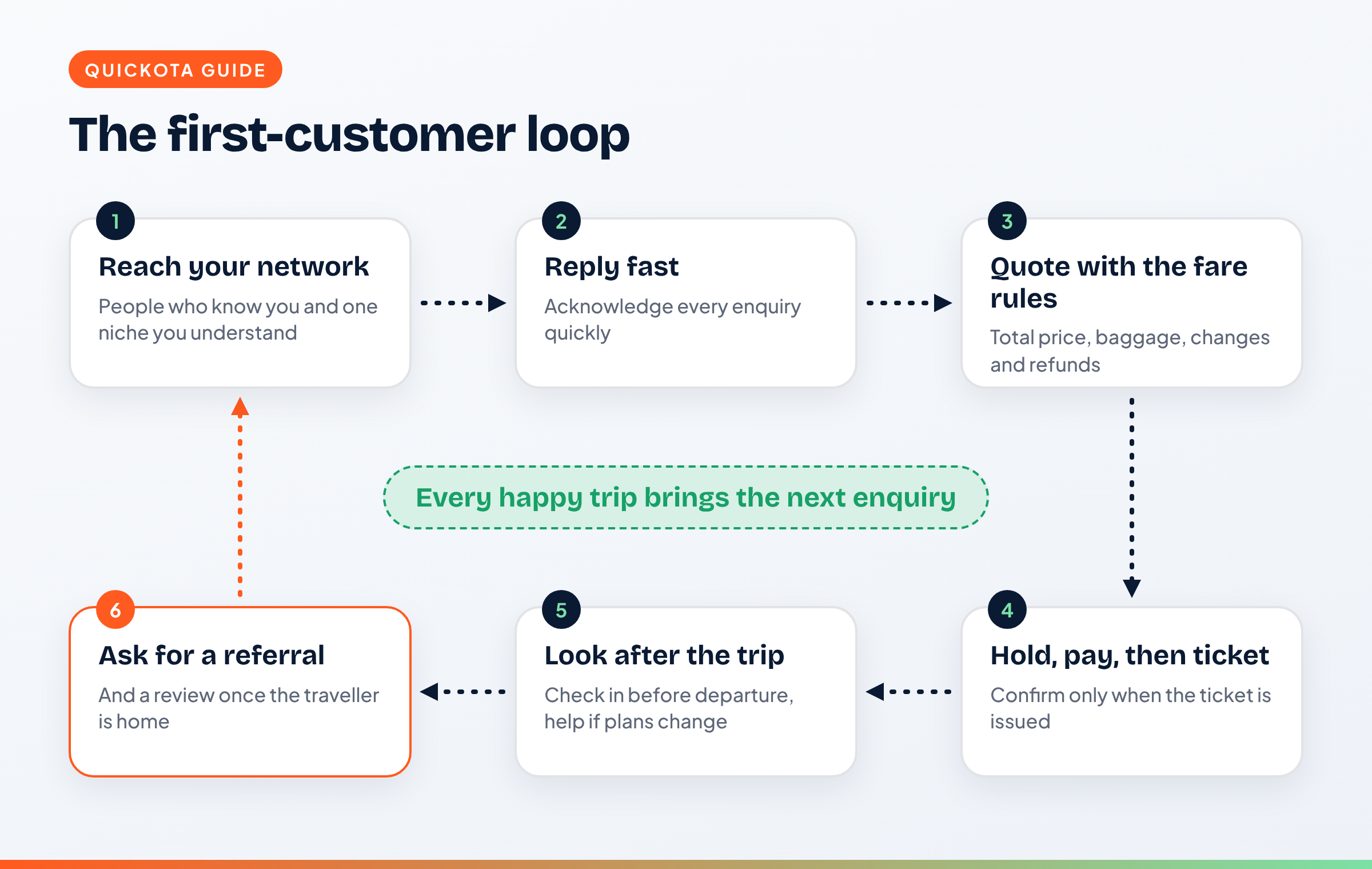
Simple habits that create repeat bookings:
- Keep a customer list with routes, travel seasons and preferences, so you can contact people before they usually travel.
- Ask for a review on your Google Business Profile once the traveller is home and happy.
- Ask for one introduction: "If you know anyone flying this route, I would be glad to help them too."
- Thank people who refer customers to you. A personal thank-you or a small discount on their next booking is enough.
- Handle problems well. A customer whose date change you solved calmly often becomes your most loyal advocate.
How do you know which channels bring bookings?
Record where every enquiry came from and whether it became a booking. A simple spreadsheet with the date, customer, source, route and outcome is enough. After a month you will see which channels bring enquiries, which bring bookings and which only take your time, so you can drop the weak ones and put more time into the strong ones.
Illustrative example (round numbers, not real results):
| Source | Enquiries | Bookings | What it tells you |
|---|---|---|---|
| Personal network | 20 | 8 | Strong trust; ask these travellers for referrals |
| Referrals | 10 | 5 | Your best channel; make it easy for people to recommend you |
| Google Business Profile | 10 | 2 | Growing; add reviews and photos |
| Social media posts | 30 | 1 | Lots of interest, few bookings; check your offer and reply speed |
Review the numbers every month. Change one thing at a time, such as your reply speed, your quote format or a new partnership, and watch what happens.
How can QuickOTA help you serve your first customers?
QuickOTA is a SaaS B2B travel platform where travel agencies search, book and ticket flights in one free panel. In the B2B Panel you can hold a booking while your customer decides, check the fare rules before you quote and set your own markup. QuickOTA issues the ticket for your booking and works with agencies that do not have IATA accreditation.
What helps most in your first months:
- Search and compare fares before you top up, so you can quote first customers before you add money.
- No minimum deposit. Top up your wallet with the amount you need for the booking.
- Clear costs. Service fees are itemised and shown before you book and in your booking details.
- After-sale requests. Request changes, cancellations and refunds from your panel; you see the quote before you accept.
- Built-in customer list and lead capture, so enquiries do not get lost in messages.
When your customer base grows, you can add a white-label booking website and manage your B2B Panel and your website from one account. Flights are live today; hotels, tours, visas and group requests are coming soon.
To join, you need a registered company or a valid travel agency (tourism) licence from your country. B2B Panel access is free and there is no setup fee. You are responsible for meeting your own country's rules for selling travel.
Common mistakes when looking for first customers
- Advertising before you know your customer. Paid ads aimed at "everyone who travels" spend money fast and teach you little.
- Competing only on price. Large online agencies can usually match a low fare. You win on knowledge, speed and trust.
- Slow replies. A customer who waits hours for a quote often books somewhere else.
- Unclear quotes. Hiding baggage limits or change fees wins one booking and loses the customer.
- Selling every destination. A narrow niche makes your marketing easier and your service better.
- Forgetting customers after the trip. Without follow-up, your first customers will not become repeat customers.
FAQs
How does a new travel agency get its first customers?
Start with people who already trust you: family, friends, former colleagues and your community. Tell them personally what you sell, answer enquiries quickly with clear quotes, look after their trips and ask each happy traveller for a review and a referral.
What is the cheapest way to market a new travel agency?
Your personal network, messaging apps, a free Google Business Profile, useful posts that answer your niche's travel questions and partnerships with community groups. These cost time rather than money and build trust that paid advertising cannot.
Should a new travel agency use paid ads?
Not at first. Run small tests only after you know which customers and routes book with you. Ads work best when they scale a channel that already brings bookings.
How can a small travel agency compete with large online travel agencies?
Focus on a niche and on service. Know your customers' routes, explain fare rules clearly, reply quickly and help when plans change. Customers who value advice and support often prefer a specialist they can call.
Do I need a website to get my first travel customers?
Not on day one. A Google Business Profile, a simple page with your services and contact details, and fast replies on messaging apps are enough to start. Add a booking website when enquiries grow.
Does QuickOTA find customers for my travel agency?
No. QuickOTA is a B2B travel platform, not a lead service. It gives your agency the tools to quote, book and ticket flights for your own customers, with free B2B Panel access and no minimum deposit. Finding customers is your agency's work, and this guide shows how to start.
How do I get referrals for my travel agency?
Ask at the right moment: after a trip went well, or after you solved a problem for the traveller. Make it easy with one short request, and thank people who send customers to you.
Related reading
- How to Start an Online Travel Agency (OTA)
- What Should a New Travel Agency Sell First?
- Your First Flight Booking: PNRs, Holds and Ticketing Deadlines
- Airline Fare Rules Explained for New Travel Agents
- Selling Diaspora Flights From Europe
- How to Launch a Flight Booking Website Under Your Own Brand
- B2B Panel