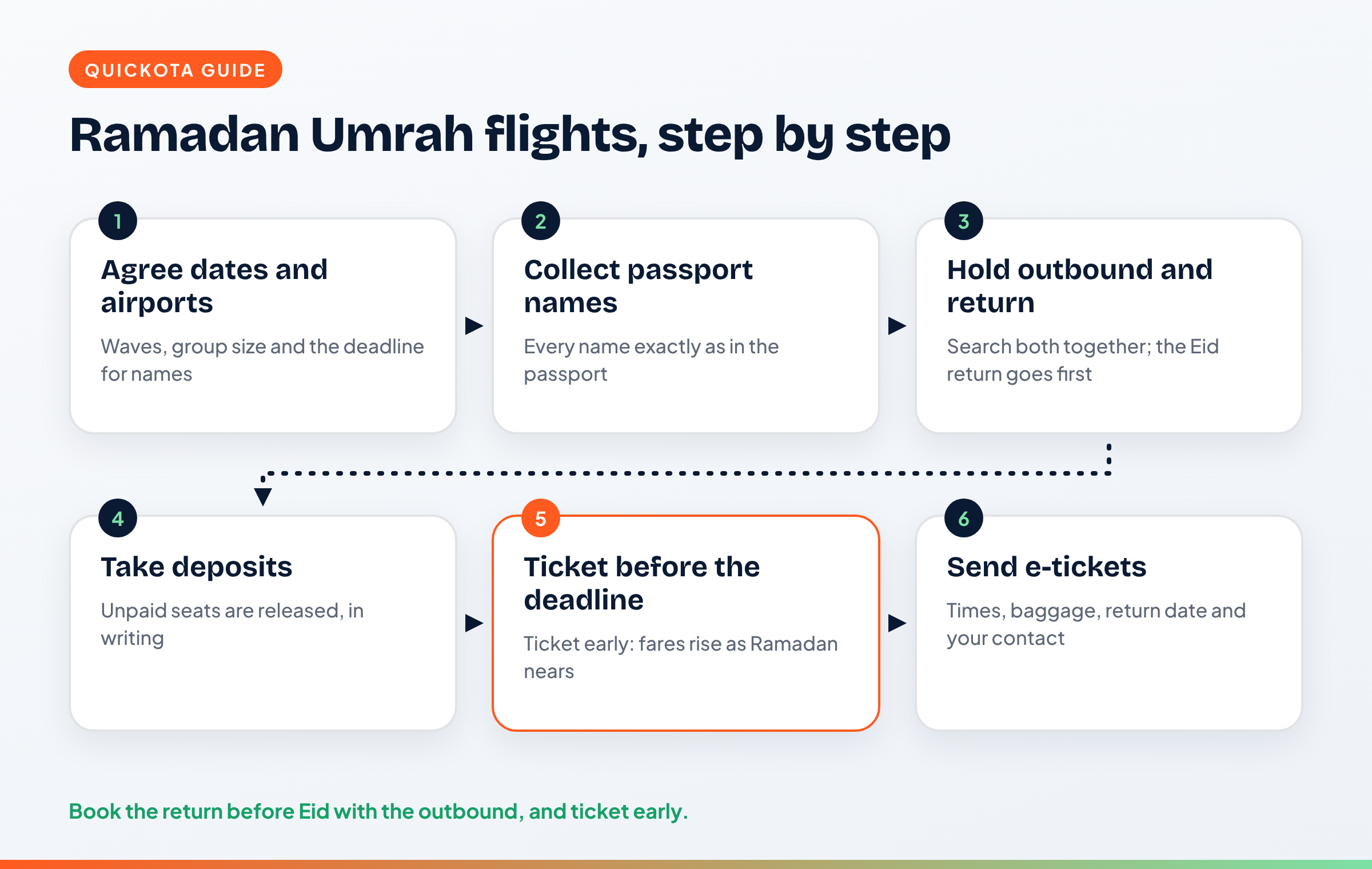
Short answer: Ramadan is the busiest Umrah season, and flights fill in waves: the first days, the last ten nights and the return before Eid. Agencies that sell well plan backwards from Ramadan in weeks: agree dates and airports early, collect passport names, hold seats as soon as plans are firm, take deposits, and ticket well before the ticketing deadline. The return around Eid is the biggest risk, so book it at the same time as the outbound.
This guide is for agencies and Umrah organisers in the Gulf, Jordan, Kuwait and Egypt who sell flights for Ramadan Umrah. It gives you a planning timeline, a booking routine for the busiest weeks and the points to explain to customers. For the basics of selling Umrah flights all year, read Selling Umrah Flights as a Small Travel Agency.
Key takeaways
- Ramadan demand comes in three waves: the start of the month, the last ten nights and the return before Eid.
- Plan backwards in weeks from the start of Ramadan, not from the day customers call.
- Book the return at the same time as the outbound. Eid returns sell out first.
- A hold is not a ticket. Check every ticketing deadline and ticket early in Ramadan.
- Never give visa, permit or entry rules as fact. Send customers to official Saudi sources.
Why are Ramadan Umrah flights different from the rest of the year?
Ramadan Umrah flights are different because demand is concentrated into a few weeks, and many families from the same countries want the same dates. Seats into Saudi Arabia, and especially seats home just before Eid, sell out earlier than at any other time of the year. Fares usually rise as the month gets closer, and short-notice changes are harder to make.
Ramadan moves about eleven days earlier each year because it follows the lunar calendar. The exact start is confirmed by the moon sighting, so build your plan from the official calendar for the current year and keep a day or two of flexibility around the start and the end of the month.
When do customers want to travel during Ramadan?
Customers usually want to travel in three waves: at the start of Ramadan, before the last ten nights, and home before Eid al-Fitr. The last ten nights are the most requested period. Many travellers also want to be home with family for Eid, which makes the return the hardest part of the booking.
What each wave means for you:
| Wave | Who usually travels | What to do |
|---|---|---|
| Start of Ramadan | Families and groups who want the whole month or the first weeks | Book early; these customers often decide first |
| Last ten nights | The largest number of travellers | Hold seats as soon as names are firm; ticket early |
| Return before Eid | Almost everyone who wants Eid at home | Book the return with the outbound; never leave it open |
Demand also depends on where your customers live. Travellers from Saudi Arabia may fly domestically from Riyadh, Dammam or Abha, while customers in the UAE, Kuwait, Jordan and Egypt need international flights. Many search for airlines they know, such as flynas, flyadeal, Saudia or EgyptAir, so tell them early which options you can offer and which dates are still open.
How far ahead should you plan Ramadan Umrah flights?
Plan Ramadan Umrah flights at least three months ahead, and count backwards in weeks from the expected start of the month. Collect names and deposits first, hold seats as soon as plans are firm, and aim to have every ticket issued two to four weeks before Ramadan. Late bookings are still possible, but with fewer choices and higher fares.
A simple timeline you can share with organisers:
| Weeks before Ramadan | What to do |
|---|---|
| 12 to 10 weeks | Agree dates, airports and group size with each organiser; set the deadline for names |
| 10 to 8 weeks | Collect passport names; search fares for the outbound and the return together |
| 8 to 6 weeks | Hold seats for firm travellers; take deposits |
| 6 to 4 weeks | Take final payments; issue tickets well before each ticketing deadline |
| 4 to 2 weeks | Send e-tickets and travel details; handle late changes and late bookings |
| Ramadan | Watch for schedule changes; support travellers; plan the Eid return |
These weeks are a guide: start earlier for a large group.
How do you hold seats and ticket in the busiest weeks?
Hold seats only when the traveller's name and dates are firm, then ticket as soon as you have payment. A hold keeps the booking for a limited time, but it is not a ticket and the fare is not guaranteed until the ticket is issued. In Ramadan, holds can be shorter and fares change quickly, so do not wait for the last day.
A safe routine for Ramadan bookings:
- Search the outbound and the return together. If the Eid return is not available, tell the customer before you hold the outbound.
- Hold with exact passport names. A name mistake in Ramadan is hard to fix, because there may be no seats on the next flight.
- Check the ticketing deadline on every booking. Write it in your planning sheet and in your message to the organiser.
- Take payment before the deadline. Agree that unpaid seats are released, and say this in writing.
- Ticket early. If the fare or seats change before ticketing, the customer pays the new price or loses the seat.
Our guide to PNRs, holds and ticketing deadlines explains these steps in detail.
How should you handle deposits and payments?
Take a deposit when you hold seats and the full payment before ticketing. In Ramadan, fares can rise between the hold and the ticket, so agree in writing what happens if the price changes before payment. Never ticket on credit for a customer you do not know: once the ticket is issued, you have paid the supplier.
Illustrative example (round numbers, not real fares): an organiser in Kuwait books 12 travellers. You agree a deposit of KWD 50 per traveller when seats are held, and the balance ten days before the ticketing deadline. If two travellers do not pay, you release their seats before the deadline instead of ticketing them at your own risk.
Use the currency your customers pay in and show one total per traveller, for example SAR, AED, KWD, JOD or EGP, with the currency code before the amount.
Should you split a large group?
Split a large group when one booking would make the whole group depend on the slowest payer or the last missing name. Smaller bookings of families or sub-groups let you ticket the ready travellers first and keep seats moving. The trade-off is more bookings to manage, so keep one planning sheet with every booking, name, deadline and payment.
When to split:
- Different dates: last-ten-nights families should not wait for whole-month travellers.
- Different payers: one unpaid traveller should not block everyone.
- Different airports: Jeddah and Madinah bookings need separate checks of price and rules.
For large groups, airlines often have a separate group request process with its own deposit and name deadlines. Ask your supplier how it works well before Ramadan.
What should you tell customers before they pay?
Tell customers the exact flight times, checked baggage, the change and refund rules, the return date and the total price, all in writing. In Ramadan, also tell them that changes may not be possible because flights are full, and that fares can change until the ticket is issued. Clear rules prevent most disputes after Eid.
Points to include in every Ramadan quote:
- The return date: say clearly whether it is before or after Eid.
- Changes: "Changes during Ramadan depend on seat availability and may cost a fee plus any fare difference."
- No-shows: on many fares, missing the outbound cancels the return.
- Baggage: what is included, and that airlines set their own rules for extra baggage and items such as water containers.
- Entry and permits: "Please check the official Saudi requirements and permit rules for your passport before you travel."
Our guide to airline fare rules explains how to read the change and refund conditions.
How to plan Ramadan Umrah flights with QuickOTA
In the QuickOTA B2B Panel you search, hold and ticket flights for your customers. You can search and compare fares before you top up your wallet, so you can quote organisers early. Service fees are itemised and shown before you book and in your booking details. When a traveller needs a change or a refund, you request it from your panel and see the quote before you accept.
B2B Panel access is free, with no setup fee and no minimum deposit. QuickOTA does not require IATA accreditation: QuickOTA issues the ticket for your booking. Group requests are coming soon; today you book flights for each family or sub-group in the panel.
Common mistakes with Ramadan Umrah flights
- Booking the outbound and leaving the return open. The Eid return is usually the first to sell out.
- Waiting for the full group before holding any seats. Hold for firm travellers and add the rest later.
- Missing a ticketing deadline. In Ramadan, a released seat may not come back.
- Ticketing before payment. Once the ticket is issued, the money is yours to recover.
- Promising dates before the moon sighting. Keep a day or two of flexibility around the start and the end of Ramadan.
- Giving permit or visa advice as fact. Send customers to official Saudi sources.
FAQs
When should I book Ramadan Umrah flights?
Start planning about three months before Ramadan and aim to have every ticket issued two to four weeks before the month begins. The last ten nights and the return before Eid sell out first, so book those dates as early as you can.
Are Umrah flights more expensive in Ramadan?
Usually, yes. Demand peaks in Ramadan, especially in the last ten nights, so fares tend to rise as the month gets closer. Booking early gives customers more choice.
Should I book the return flight before Eid?
Yes, book the return at the same time as the outbound. Flights home before Eid al-Fitr are among the hardest seats to find, and many travellers want to be home for Eid with their families.
Can I change the dates of a Ramadan Umrah ticket?
It depends on the fare rules and on seat availability. Many fares allow changes for a fee plus any fare difference, but in Ramadan the flights you want may already be full. Explain this to customers before they pay.
Do I need to check visa or permit rules for Ramadan Umrah?
Yes, but not as advice from your agency. Send customers to the official Saudi sources for current visa, entry and permit rules, and follow your own country's rules for selling Umrah travel.
Related reading
- Selling Umrah Flights as a Small Travel Agency
- Your First Flight Booking: PNRs, Holds and Ticketing Deadlines Explained
- Airline Fare Rules Explained for New Travel Agents
- How Flight Changes, Cancellations and Refunds Work on a B2B Platform
- How to Quote Flights to Customers on WhatsApp
- Prepaid Wallet or Credit Line? How B2B Travel Platforms Get Paid