Short answer: You can reserve a flight without paying by placing it on hold. The airline keeps the seats at a price until a ticketing deadline, and the booking has a reference (PNR), but there is no ticket yet. If nobody pays and the ticket is not issued in time, the booking is cancelled. A hold is honest and useful. A "dummy ticket" sold only to show a visa office, and cancelled straight after, is a different thing, and it puts both the traveller and the agency at risk.
This guide is for travel agencies and agents, especially in the Gulf, Egypt, Sudan, North Africa and Iraq, whose customers ask for "a booking without payment" or "a flight reservation for the visa". It explains what a hold really is, what "unconfirmed" means, why holds disappear, and how to answer these requests safely.
Key takeaways
- A hold (a booking with a PNR but no ticket) reserves seats until a ticketing deadline. It is not a ticket.
- Only an issued ticket lets the passenger fly. Before that, the price and the seats can change.
- Holds expire. If the ticket is not issued before the deadline, the airline cancels the booking.
- "Dummy tickets" for visa applications are often cancelled on purpose or not real at all. Selling them can harm your customer and your agency.
- For visa documents, the traveller must follow the embassy's or official visa centre's own requirements.
What does it mean to book a flight without paying?
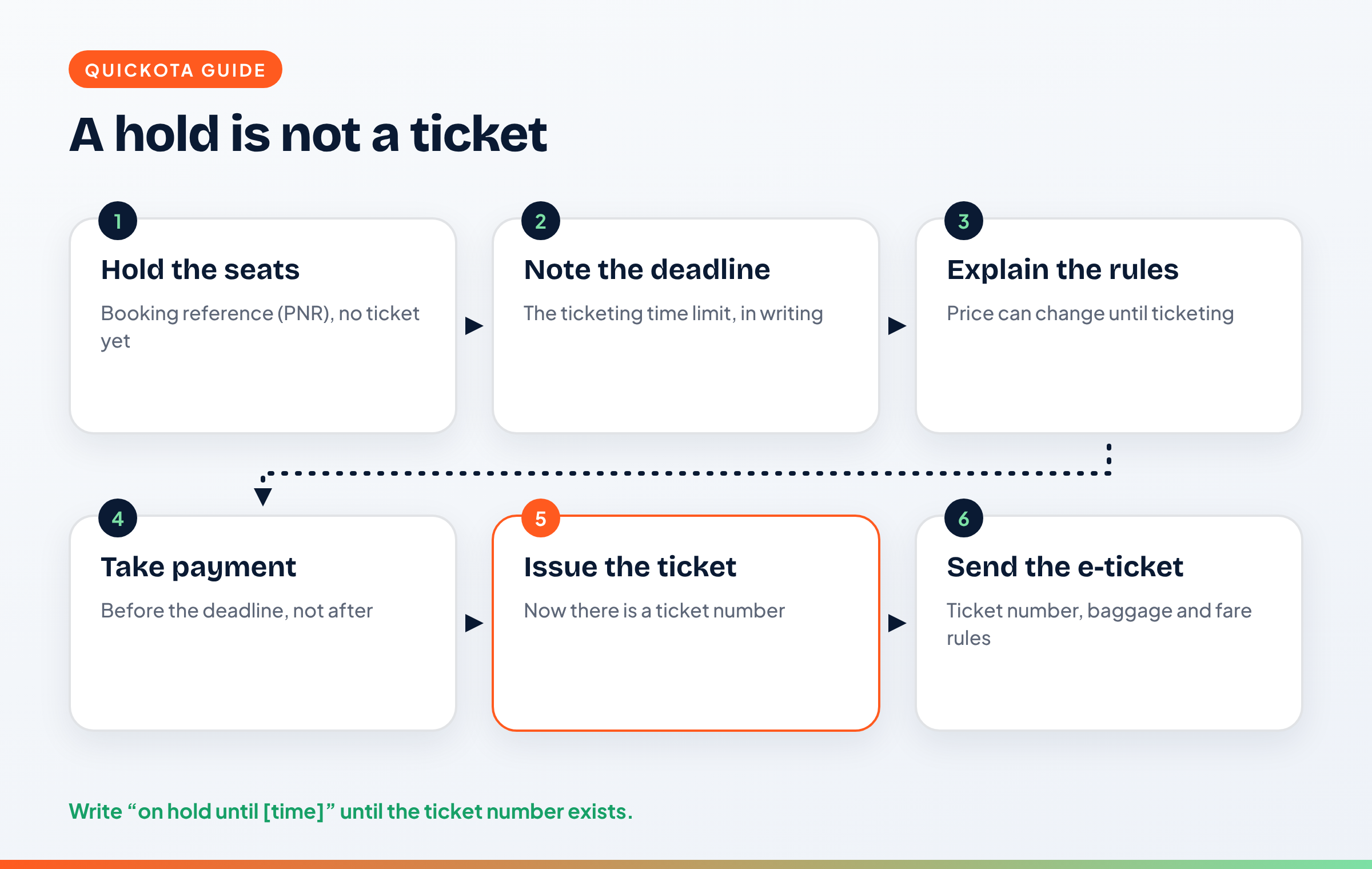
Booking a flight without paying means placing it on hold. You create a booking with the passengers' names, the airline gives it a booking reference, and the seats and the fare are reserved for a limited time. Nothing has been paid and no ticket exists. When the customer pays, you issue the ticket. If they do not, the hold ends.
Customers describe this in many ways: "a temporary booking", "a booking without payment", "a reservation" or "an unconfirmed ticket". In the trade it is simply a held booking, or a PNR without a ticket. Our guide to your first flight booking: PNR, hold and ticketing explains the PNR and the ticket in more detail. This guide focuses on what customers ask for, and on the risky requests.
What is the difference between a booking, a ticket and "confirmed"?
A booking (PNR) reserves seats. A ticket is the paid document, with its own ticket number, that lets the passenger fly. "Confirmed" is used loosely: some people mean the seats are reserved, others mean the ticket is issued. To avoid arguments, use "on hold" until the ticket is issued, and "ticketed" or "issued" after.
| Held booking (PNR) | Issued ticket | |
|---|---|---|
| Has a booking reference | Yes | Yes |
| Has a ticket number | No | Yes |
| Paid | No | Yes |
| Lets the passenger fly | No | Yes |
| Price guaranteed | Not always: fares can change until ticketing | Yes, under the fare rules |
| Ends on its own | Yes, at the ticketing deadline | No; changes and refunds follow the fare rules |
When a customer checks a held booking on an airline's website, they may see the flights and their names. That does not mean they have a ticket. The proof of a ticket is the ticket number on the e-ticket, usually 13 digits.
How long does a flight hold last?
A flight hold lasts until its ticketing deadline, also called the ticketing time limit. The deadline depends on the airline, the fare and how close the departure is. It can be days for a booking made far in advance, or only hours for a flight that leaves soon. Some fares cannot be held at all and must be ticketed straight away.
Always read the deadline on the booking itself, not from memory. Tell the customer the exact time in writing, in their time zone, for example: "Your seats are on hold until 18:00 Riyadh time on Thursday. If payment reaches us before then, we will issue your ticket."
Why do held bookings get cancelled?
Held bookings get cancelled when the ticketing deadline passes without a ticket, and sometimes earlier. Airlines also cancel holds that break their rules, such as duplicate bookings for the same passenger, names that look fake, or many bookings that are never ticketed. Repeated empty holds can also cause problems for the agency that makes them.
Common reasons a hold disappears:
- The deadline passed. The most common reason. Nobody issued the ticket in time.
- Duplicate bookings. The same passenger is held on two or more flights at once, and the airline cancels one or all of them.
- Fare or schedule changes. The airline changes the flight or withdraws the fare before ticketing.
- Wrong or incomplete details. Names that do not match passports, or test-looking names.
- No intention to fly. Airlines and suppliers watch for bookings that are made only to be shown somewhere and then dropped.
This is why a hold is a short step towards a ticket, not a document to keep.
What is a "dummy ticket" for a visa?
A "dummy ticket" is a flight reservation sold to a traveller only to show in a visa application, with no plan to issue a ticket. Some sellers create a real hold and let it expire, some cancel it right after sending it, and some send a document that was never a real booking. Customers search for this as "a flight reservation for the visa" or "a dummy ticket for Schengen".
The risks are real for everyone involved:
- For the traveller: the booking may already be cancelled when the visa office looks at it. A document that does not match a real booking can damage the application, and in some cases more than one application.
- For the agency: making holds you never intend to ticket can break your supplier's or the airline's rules. Sending a document that is not a real booking is misrepresentation, and your agency's name is on it.
- For the trust in your business: a customer refused a visa because of a cancelled booking will blame the agency that sold it.
What the visa office wants is not for us to say. Each embassy or official visa centre sets its own document requirements. Some ask for travel plans, some for a reservation, some for a ticket, and the rules change. Tell your customer to check the embassy's or the official visa centre's own requirements for their passport and destination, and to follow them exactly.
How should an agency answer "I need a booking for my visa"?
Answer honestly: explain the difference between a hold and a ticket, tell the customer how long a hold can last, and send them to the official requirements. If they need a ticket, quote one with its fare rules. If a refundable or changeable fare suits their situation, show them the conditions before they pay. Never sell a booking that you plan to cancel.
A safe reply you can adapt:
Thank you for your message. I can hold seats for you, but a hold is not a ticket: it is reserved only until [deadline], and then the airline cancels it if no ticket is issued. Please check the embassy's or the official visa centre's own requirements to see what flight document they need. If you need a ticket, I can quote fares and show you the change and refund conditions before you pay.
Points to explain to the customer:
- What they get: a held booking with a reference, or an issued ticket with a ticket number.
- How long it lasts: the exact ticketing deadline.
- What happens if plans change: the fare rules for changes and refunds. Our guide to airline fare rules helps you read them.
- Who decides about the visa: the embassy or the official visa centre, not the agency.
How to hold and ticket flights with QuickOTA
In the QuickOTA B2B Panel you search, hold and ticket flights for your customers. You see the fare rules and baggage for each fare before you book, so you can explain them to the customer before they pay. A hold is not a ticket: the booking shows its ticketing deadline, and you issue the ticket from your panel once the customer has paid. Service fees are itemised and shown before you book and in your booking details.
B2B Panel access is free, with no setup fee and no minimum deposit. You pay for bookings from your prepaid wallet. QuickOTA does not require IATA accreditation: QuickOTA issues the ticket for your booking.
Common mistakes with holds and "visa bookings"
- Writing "confirmed" for a hold. Use "on hold until [time]" until the ticket is issued.
- Forgetting the deadline. Set a reminder before every ticketing time limit.
- Holding the same passenger on several flights. Duplicates are often cancelled, sometimes all of them.
- Selling bookings you plan to cancel. It can break supplier and airline rules and harm your customer's application.
- Giving visa advice. Send customers to the embassy's or official visa centre's own requirements instead.
- Taking payment but not ticketing in time. If the hold expires, the price and the seats may be gone.
FAQs
Can I book a flight now and pay later?
Often, yes: an agency can place many fares on hold until a ticketing deadline, then issue the ticket when you pay. Some fares cannot be held, and the deadline can be short for flights that leave soon. The price can change until the ticket is issued.
What is an unconfirmed flight ticket?
People usually mean a held booking: the seats are reserved and there is a booking reference, but no ticket has been issued and nothing is paid. It is not a ticket and it will be cancelled if it is not ticketed before the deadline.
Is a flight reservation enough for a visa application?
It depends on the embassy or visa centre, and their rules can change. Check their own official requirements for your passport and destination, and follow them exactly. An agency cannot promise what a visa office will accept.
What is a dummy ticket?
A dummy ticket is a flight reservation sold only to show in a visa application, with no plan to issue a ticket. It is often cancelled soon after, or it was never a real booking. This can damage the application and puts the agency that sold it at risk.
How do I know if my flight ticket is issued?
An issued ticket has a ticket number, usually 13 digits, shown on the e-ticket receipt. A booking reference alone (a PNR) does not prove that a ticket was issued. Ask your agency for the e-ticket.
Related reading
- Your First Flight Booking: PNR, Hold and Ticketing Explained
- How to Quote Flights to Customers on WhatsApp
- Airline Fare Rules Explained
- How Flight Changes, Cancellations and Refunds Work on a B2B Platform
- Can a Non-IATA Travel Agency Issue Airline Tickets?
- How to Resell Flight Tickets as a Small Travel Agency