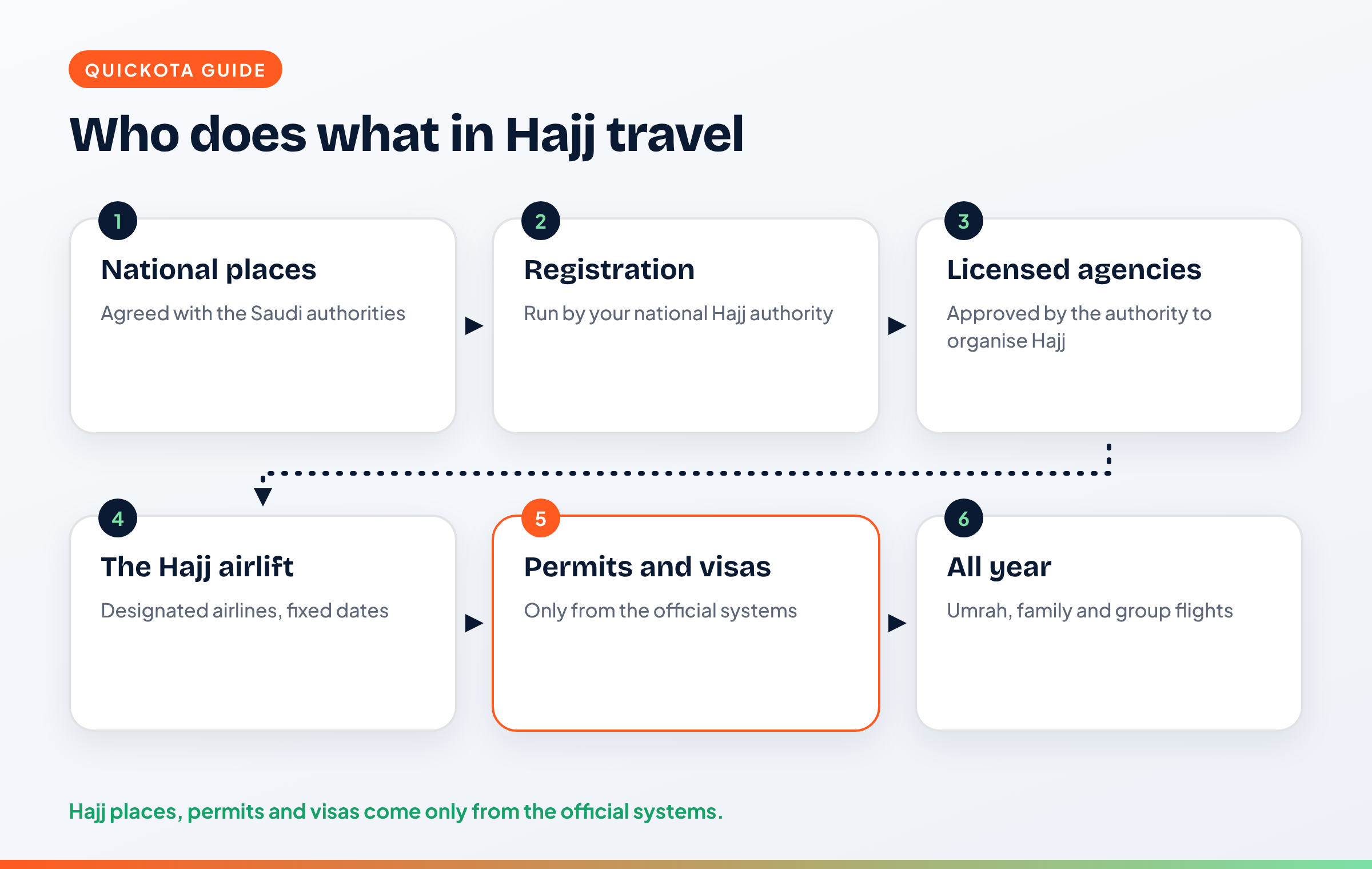
Short answer: Hajj travel is not an open market like ordinary flights. Saudi Arabia sets how many pilgrims come from each country, and in most African countries a national Hajj authority runs registration, often by lottery, licenses the agencies that may organise Hajj, and arranges the Hajj flights with designated airlines. A travel agency can take part only inside that national framework. Outside it, agencies serve pilgrims and their families all year: Umrah, travel around the Hajj season, and group flights.
This guide is for travel agencies, Umrah organisers and licensed Hajj operators in Muslim-majority African countries, from Algeria, Morocco and Tunisia to Nigeria, Senegal, Ghana, Sudan, Somalia, Ethiopia, Kenya and Tanzania. It explains how Hajj travel is organised, what an agency needs to take part, how Hajj flights work, and where agencies earn business before and after the season.
Key takeaways
- Each country's number of Hajj pilgrims is set with the Saudi authorities. Your national Hajj authority announces your country's arrangements.
- Registration, lotteries and licences for Hajj agencies are run by national authorities. Follow your own authority's announcements.
- Hajj flights are usually organised as a national airlift with designated airlines, not sold as ordinary tickets.
- Hajj permits and Hajj visas come only from the official national and Saudi systems.
- Outside the Hajj framework, agencies sell Umrah, family travel and group flights all year.
How is Hajj travel organised?
Hajj travel is organised between Saudi Arabia and each pilgrim's country. The Saudi Ministry of Hajj and Umrah oversees the pilgrimage, and each country receives an agreed number of places. In most African countries a national Hajj authority or ministry then decides who travels, how pilgrims register, which agencies may organise Hajj, and how pilgrims are flown to Saudi Arabia and back.
The details differ from country to country, but the same building blocks appear almost everywhere:
- A national number of places. Your country's places for the season are set with the Saudi authorities and announced by your national authority.
- Registration and selection. Many countries open registration for intending pilgrims, and some hold a lottery when demand is higher than the number of places.
- Licensed organisers. Some places go to the public organisation, and in many countries some go through licensed private agencies or tour operators.
- The Hajj airlift. Pilgrims are flown on designated airlines during a fixed outbound and return period.
- Permits and visas. Pilgrims need the official Hajj permit and visa from the official systems. These cannot be bought from an ordinary travel agency or online shop.
For pilgrims from some countries outside Africa, Saudi Arabia runs the Nusuk Hajj platform, which lists the countries it serves. African pilgrims normally go through their national authority, so always check your own country's arrangements first.
Who runs Hajj in different African countries?
In each country, a national body publishes the official Hajj arrangements, and its own website is the place to check. The examples below are taken from each body's own website. Countries that are not listed also have official arrangements; we only list bodies whose information we could check on their official site.
| Country | Official body | What its own website shows |
|---|---|---|
| Algeria | Office National du Pèlerinage et de la Omra (ONPO) | Registration for the Hajj lottery for the 1448 AH (2027) season, and the Algerian Hajj Portal for pilgrims |
| Nigeria | National Hajj Commission of Nigeria (NAHCON) | Designated airlines approved for the 2027 Hajj, state Muslim pilgrims' welfare boards, and Hajj licensed tour operators |
| Tunisia | Ministry of Religious Affairs | Registration of candidates for the 2027 Hajj season and the Hajj guidance notes |
| Saudi Arabia | Ministry of Hajj and Umrah; Nusuk Hajj platform | The official Saudi Hajj and Umrah information, and the Nusuk Hajj platform with its list of serviced countries |
Our country guides go into more detail for Algeria, Morocco and Tunisia, and Nigeria and West Africa.
Can a travel agency sell Hajj?
A travel agency can sell Hajj only if its country's Hajj framework allows private agencies and the agency holds the licence or accreditation that the national authority requires. In many countries, licensed agencies or tour operators organise part of the national places, and the authority publishes the list of approved agencies. An agency without that approval should not take money for Hajj.
What this means in practice:
- Check your national authority's rules for private Hajj organisers: who can apply, when, and what the conditions are.
- Never promise a Hajj place, permit or visa. These depend on the national selection and the official Saudi systems.
- Warn customers about fraud. National authorities regularly warn pilgrims to deal only with approved agencies. A trustworthy agency repeats that warning.
- Keep Umrah and Hajj separate in your sales and your contracts. Umrah has its own rules and seasons.
You are responsible for meeting your own country's rules for Hajj and for selling travel.
How do Hajj flights work?
Hajj flights usually run as a national airlift. The national authority approves designated airlines, agrees the flights for the season, and schedules pilgrims from departure centres to Jeddah or Madinah during a fixed period before Hajj, with return flights after it. Pilgrims normally fly on the airlift arranged for their country rather than on tickets bought on the open market.
Nigeria is a clear example: NAHCON has published the airlines it approved for the 2027 Hajj, subject to airlift agreements and the requirements of the Nigerian and Saudi aviation authorities. Other countries publish their own arrangements.
Because Hajj seats are planned this way, a licensed agency should:
- Follow the authority's flight programme, including departure centres and dates.
- Plan group sizes and passenger lists early, with every name exactly as in the passport.
- Keep pilgrims informed about flight times, baggage and return dates, in writing.
- Prepare for changes. Airlift schedules can change; contact pilgrims early when they do.
Where do agencies earn business around Hajj?
Agencies earn business around Hajj in the travel that sits outside the national places: Umrah throughout the year, family members who travel at other times, staff and organisers' travel, and group flights for organised groups. The months before and after Hajj are also busy with travel to the Gulf, Eid trips and diaspora visits home.
Practical openings for an African agency:
- Umrah all year, with peaks in Ramadan and school holidays. Our guides to selling Umrah flights and Ramadan Umrah flights cover planning, holds and deadlines.
- Group flights for Umrah groups, associations and, for licensed operators, Hajj groups within the national framework.
- Family and diaspora travel before and after the season.
- Flights for organisers and staff who travel ahead of their groups.
How QuickOTA helps agencies with Hajj and Umrah groups
QuickOTA accepts group requests, including for Hajj groups. A licensed Hajj operator or agency sends a group request to the QuickOTA team with the dates, route and number of passengers, receives a quote, pays in instalments from its prepaid wallet, and manages the passenger list in the panel. Hajj places, permits and Hajj visas still come only from your national Hajj authority and the official Saudi system: QuickOTA does not provide them and does not replace the licensed framework.
For individual travellers, such as Umrah pilgrims, family members and organisers, you search, hold and ticket flights in the QuickOTA B2B Panel and see the fare rules before you book. QuickOTA does not require IATA accreditation: QuickOTA issues the ticket for your booking. B2B Panel access is free, with no setup fee and no minimum deposit. Read more about group requests.
Or get agency access to book individual flights.
Common mistakes agencies make with Hajj
- Promising a Hajj place before the national selection. Places, permits and visas come only from the official systems.
- Taking Hajj payments without the required licence. Check your national authority's rules first.
- Treating Hajj like Umrah. Hajj has a national framework, fixed dates and an airlift; Umrah does not work the same way.
- Starting the passenger list late. Names must match passports exactly, and lists are needed early.
- Not warning customers about fraud. Tell customers to deal only with agencies approved by the national authority.
- Forgetting the return. Return flights after Hajj are part of the plan; tell pilgrims their return details in writing.
FAQs
Who decides how many pilgrims go to Hajj from my country?
Each country's number of places is agreed with the Saudi authorities, and your national Hajj authority announces how those places are shared and how pilgrims register. Follow your national authority's official announcements for your country.
Can any travel agency organise Hajj?
No. In most countries only agencies licensed or accredited by the national Hajj authority can organise Hajj, within the places the authority allocates. Check your national authority's rules and its list of approved agencies.
What is the Hajj airlift?
The Hajj airlift is the national programme of flights that takes pilgrims to Saudi Arabia before Hajj and brings them home after it, on airlines approved by the national authority. Pilgrims normally travel on the flights arranged for their country.
Can QuickOTA provide Hajj visas or permits?
No. Hajj permits and Hajj visas come only from your national Hajj authority and the official Saudi system. QuickOTA accepts group requests from agencies, including licensed operators with Hajj groups, and handles flights and the passenger list in the panel.
When does Hajj 2027 take place?
Hajj takes place in the Islamic month of Dhu al-Hijjah, so its date depends on the Hijri calendar and the moon sighting, and it moves about 11 days earlier each year. Follow the official Saudi and national announcements for the 2027 dates.
Related reading
- Hajj 2027 From Algeria: What Travel Agencies Need to Know
- Hajj From Morocco and Tunisia: A Guide for Travel Agencies
- Hajj From Nigeria and West Africa: A Guide for Travel Agencies
- Group Requests for Travel Agencies
- Selling Umrah Flights as a Small Travel Agency
- Ramadan Umrah Flights: How Agencies Plan Seats, Holds and Ticketing
- Starting a Flight Ticket Business in Africa: A Guide for Non-IATA Agencies
- Your First Flight Booking: PNR, Hold and Ticketing Explained