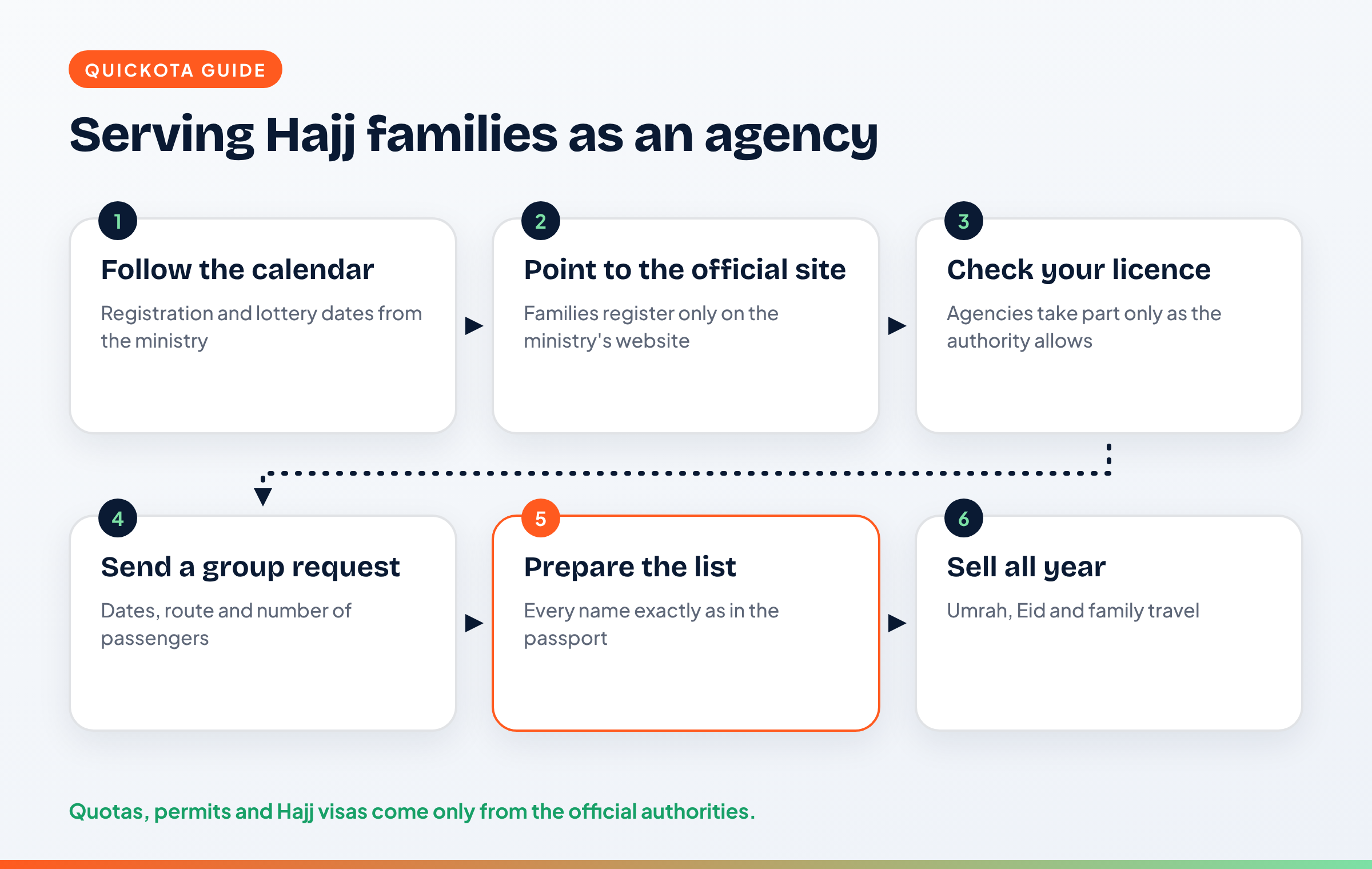
Short answer: In Morocco and Tunisia, Hajj is organised by the state. Pilgrims register on the official ministry website, and in Morocco places are given out by a lottery. Quotas, permits and Hajj visas come only from the national Hajj authority and the official Saudi system. Travel agencies can take part only in the way the authorities allow, but they can serve pilgrims and their families all year with Umrah, family travel and group trips.
This guide is for travel agencies in Morocco and Tunisia, and for agencies in France and the rest of Europe that serve Moroccan and Tunisian families. It explains, in plain words, how the official Hajj process works in each country, what that means for your agency, and where the year-round business is. It is not legal advice: always check the current rules with the official authority.
Key takeaways
- Hajj places in Morocco and Tunisia are managed by the state, through the official ministry website.
- In Morocco, registration is followed by a lottery, with one list for pilgrims supervised by the ministry and one for pilgrims travelling with travel agencies.
- In Tunisia, applications are made on the Ministry of Religious Affairs' Hajj portal.
- Quotas, permits and Hajj visas come only from the national Hajj authority and the official Saudi system. No supplier can sell them.
- The steady business for most agencies is Umrah, family travel and group trips, before and after the Hajj season.
Who organises Hajj in Morocco and Tunisia?
In both countries, Hajj is organised by the government. In Morocco, the Ministry of Habous and Islamic Affairs runs registration and the lottery through its official website. In Tunisia, the Ministry of Religious Affairs runs Hajj applications through its own Hajj portal. Saudi Arabia gives each country its quota of pilgrims, and the national authority shares the places out.
This matters for agencies because Hajj is not an open market. A traveller cannot simply buy a "Hajj ticket" from any agency. Their place depends on the national process, and their permit and visa depend on the official Saudi system. Your role as an agency depends on what your own authority allows.
How does Hajj registration and the lottery work in Morocco?
In Morocco, people who want to perform Hajj register online on the Ministry of Habous and Islamic Affairs' website, within a set period. The ministry then holds a lottery to choose the pilgrims. For the 1448 AH / 2027 season, registration ran from 8 to 19 December 2025, and the lottery took place from 2 to 13 March 2026.
What agencies should know about the Moroccan process:
- Two lists. Registration has one list for pilgrims travelling under the ministry's supervision and one for pilgrims travelling with travel agencies.
- The lottery decides. Places are given by the draw, not by who books first. The ministry publishes the final list and a waiting list after the draw.
- Dates are official only. Each season's registration and draw dates are announced by the ministry. Do not promise dates to customers before the ministry announces them.
- Conditions are set by the ministry. Who may register, and what documents are needed, are published on the ministry's website for each season.
People search for "الحج من المغرب بدون قرعة" (Hajj from Morocco without the lottery). The honest answer for your customers is to follow the official process. An agency that promises a Hajj place outside the official system is a warning sign.
How does Hajj registration work in Tunisia?
In Tunisia, Hajj applications are made on the Ministry of Religious Affairs' Hajj portal. The portal opens for a registration period each season and then closes. For the 1448 AH / 2027 season, the portal states that registration has ended. The ministry announces the next season's process on its official channels.
What agencies should know about the Tunisian process:
- Apply on the official portal. Applications go through the ministry's Hajj portal, not through private websites.
- Watch the official calendar. Registration opens and closes on dates the ministry sets.
- Check the role of agencies. Ask the ministry whether, and how, licensed travel agencies take part in the coming season. Do not assume the rules are the same as in Morocco or Algeria.
Morocco and Tunisia compared
The two systems are both run by the state, but they are not the same. Use this table as a starting point, and always confirm the current season's rules with the official authority.
| Morocco | Tunisia | |
|---|---|---|
| Authority | Ministry of Habous and Islamic Affairs | Ministry of Religious Affairs |
| Where pilgrims apply | Online, on the ministry's website | On the ministry's Hajj portal |
| How places are given | Lottery after registration | Through the ministry's process |
| 1448 AH / 2027 season | Registration 8–19 December 2025; lottery 2–13 March 2026 | Registration has ended, according to the portal |
| Travel agencies | A separate list for pilgrims travelling with travel agencies | Check with the ministry for the current season |
| Quotas, permits, Hajj visas | National authority and the official Saudi system only | National authority and the official Saudi system only |
What can a travel agency sell around Hajj?
A travel agency can serve Hajj families in many ways that do not depend on a Hajj place. Before Hajj, families need advice, documents and travel to the airport city. After Hajj, many families travel to welcome pilgrims home or to visit relatives for Eid al-Adha. Outside the Hajj season, Umrah is the year-round business.
Practical ways to serve Hajj families:
- Umrah all year. Umrah has no national lottery in most countries and runs for most of the year. See our guides to selling Umrah flights and Ramadan Umrah flights.
- Group travel. Organised groups, for Umrah or for licensed Hajj operators, need seats held together, names collected early and payments planned.
- Diaspora families. Moroccan and Tunisian families in France, Belgium, Spain and Italy travel home for Eid and the summer. See selling diaspora flights from Europe.
- Clear information. Tell customers how the official process works, and send them to the ministry's website for registration.
How should licensed Hajj agencies plan group flights?
Licensed agencies that take Hajj pilgrims should plan group flights early, with the official calendar in mind. Hajj travel is concentrated into a few weeks, so seats on the routes to Saudi Arabia fill quickly. Collect each pilgrim's name exactly as in the passport, agree payment stages with the group, and keep the passenger list up to date.
A simple planning routine:
- Wait for the official list. Plan group travel around the pilgrims the authority has confirmed.
- Ask for a group quote early. Give the route, dates and the number of passengers.
- Collect names and documents. Every name exactly as in the passport.
- Plan payments in stages. Agree deposits and final payments with the group.
- Keep the list current. Replace pilgrims from the waiting list as the authority allows.
- Plan the return. The return after Hajj is as busy as the outward journey.
How to plan group travel with QuickOTA
QuickOTA accepts group requests, including for Hajj groups. Your agency sends a group request to the QuickOTA team with the dates, route and number of passengers, and receives a quote. You pay in instalments from your prepaid wallet and manage the passenger list in the panel. Hajj quotas, permits and Hajj visas still come only from the national Hajj authority and the official Saudi system: QuickOTA does not provide them and does not replace the licensed framework.
For individual travellers, you search, hold and ticket flights in the QuickOTA B2B Panel. QuickOTA does not require IATA accreditation, and B2B Panel access is free. To join, you need a registered company or a valid travel agency (tourism) licence from your country. Read more about group requests.
Not a QuickOTA agency yet? Get agency access.
Common mistakes agencies make around Hajj
- Promising a Hajj place. Places come from the official process, not from an agency.
- Using unofficial websites for registration. Send customers only to the ministry's official website or portal.
- Copying another country's rules. Morocco, Tunisia and Algeria each have their own system.
- Quoting before the official list. Plan group travel once the authority has confirmed the pilgrims.
- Forgetting the return. Return travel after Hajj is busy; plan it with the outward journey.
- Missing the Umrah season. Most of the year's religious travel business is Umrah.
FAQs
Can a travel agency sell Hajj places in Morocco or Tunisia?
Hajj places are managed by the state through the official ministry process. In Morocco, pilgrims register online and places are given by lottery, with a list for pilgrims travelling with travel agencies. In Tunisia, check with the Ministry of Religious Affairs how agencies take part in the current season.
When is the Hajj lottery in Morocco?
For the 1448 AH / 2027 season, the Ministry of Habous and Islamic Affairs held the lottery from 2 to 13 March 2026, after online registration from 8 to 19 December 2025. Dates for the next season are announced by the ministry.
Is Hajj registration for 2027 still open in Tunisia?
No. The Ministry of Religious Affairs' Hajj portal states that registration for the 1448 AH / 2027 season has ended. Follow the ministry's official channels for the next season.
Does QuickOTA provide Hajj quotas, permits or visas?
No. Hajj quotas, permits and Hajj visas come only from the national Hajj authority and the official Saudi system. QuickOTA accepts group requests for group travel, including Hajj groups, and agencies book flights in the B2B Panel.
What can my agency sell to Hajj families all year?
Umrah, family travel for Eid, diaspora trips home and organised group travel. Plan these around the Hajj season, when routes to Saudi Arabia are busiest.
Related reading
- Hajj Flights for Travel Agencies in Africa
- Hajj 2027 From Algeria: A Guide for Travel Agencies
- Selling Umrah Flights as a Small Travel Agency
- Ramadan Umrah Flights: How Agencies Plan Seats, Holds and Ticketing
- Selling Diaspora Flights From Europe
- Your First Flight Booking: PNR, Hold and Ticketing Explained
- Group requests