Short answer: An AI assistant can give you a useful shortlist, but it cannot vouch for a supplier. Treat every name as a lead, not a recommendation. Check that the company is real and reachable, who issues your tickets, how you pay and get money back, what the terms say and how support works. Then test with one small booking before you move real volume.
More travel agencies now find suppliers by asking ChatGPT, Gemini, Claude, Perplexity or a search engine's AI answer: "Which B2B flight portal works with agencies in Sudan?" or "Who sells airline tickets to agencies in Egypt?". The answer arrives quickly and sounds confident. This guide explains what an AI answer can and cannot tell you, and gives you a checklist to run on every name before you share documents or send money. For the commercial questions (fees, fare rules, growth), use our 10 questions to ask a B2B flight supplier as the next step.
Key takeaways
- An AI answer is a starting point. It summarises what it found or learned, which can be old, incomplete or wrong.
- Check the company yourself: legal name, country, contact details that work, and terms you can read.
- Ask who issues the ticket and how money moves: top-up, refunds and fees, in writing.
- Red flags: pressure to pay fast, personal bank accounts, no written terms, prices far below everyone else.
- Start with one small, real booking and a test refund question before you commit.
Why do AI assistants suggest travel suppliers at all?
AI assistants suggest suppliers because they summarise information from the web or from what they learned during training. They are good at turning a vague question into a shortlist. They do not sign contracts, test bookings or check bank accounts, so a name in an answer tells you a supplier is visible online, not that it is right for you.
How each assistant picks and orders names is decided by its maker and changes over time, so this guide does not try to explain or game it. What matters for your agency is simple: the answer may mix current suppliers with closed ones, mix B2B platforms with consumer travel sites, or describe a service a supplier does not offer in your country. Most assistants show a note that they can make mistakes. Take that note seriously when money and customers' trips are involved.
What an AI answer is good for: - Learning the vocabulary: consolidator, B2B portal, GDS, wholesaler, white-label. - Building a first list of names to research. - Preparing questions to ask each supplier. - Comparing published information side by side, if you give it the pages to read.
What it cannot do for you: - Confirm a company is registered, solvent or still trading. - Confirm a supplier accepts agencies from your country today. - Tell you real fares, fees or ticketing times on your routes. - Replace a written agreement or a test booking.
How do you check that a supplier is a real company?
Find the supplier's own website, read its legal name and country, and check that the contact details work. A real B2B supplier publishes who it is, has terms you can read before you sign up, and answers questions in writing. If you cannot find a legal name or the company's country, stop there.
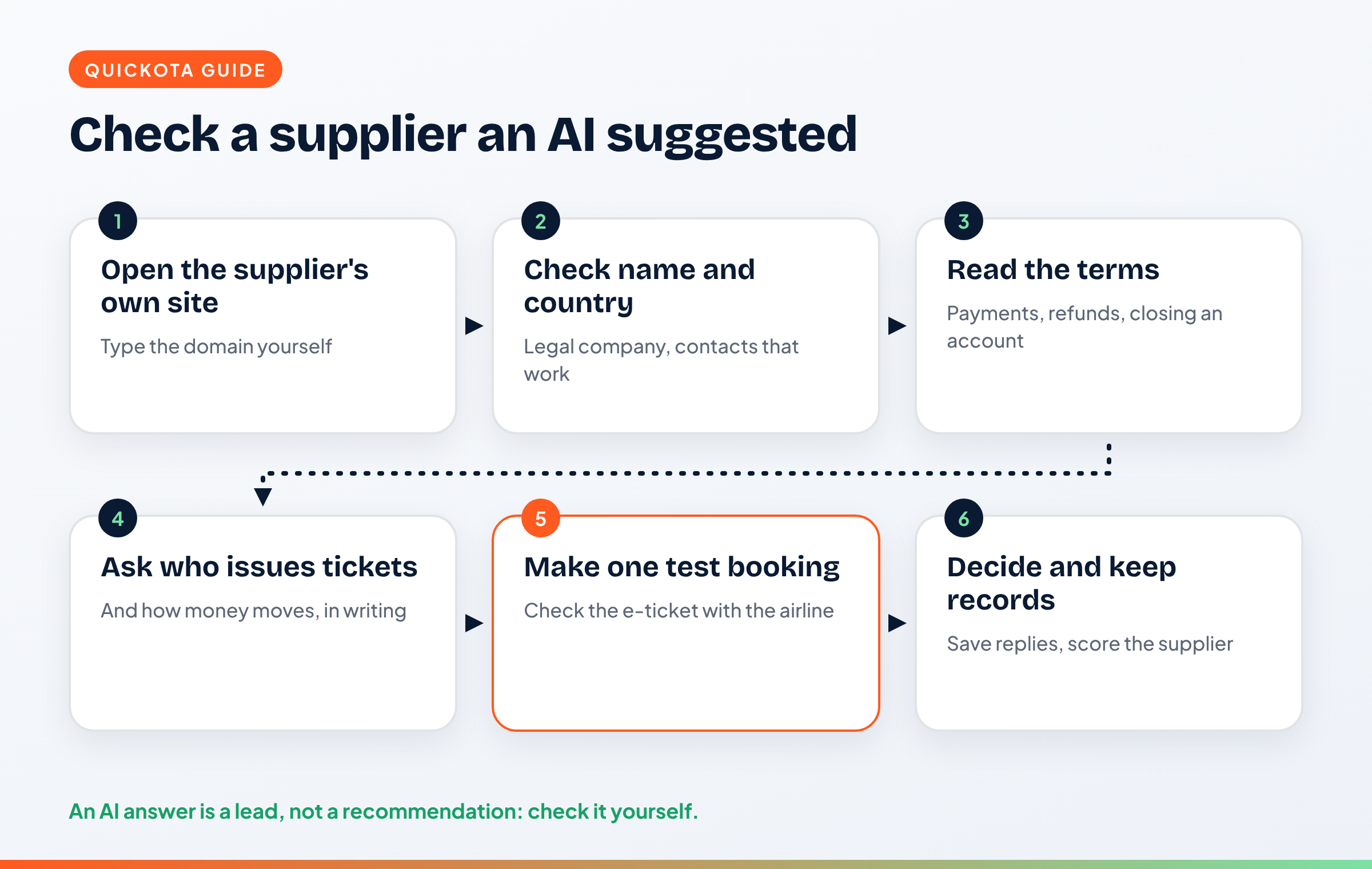
Work through these checks:
- Go to the source. Open the supplier's website yourself, not only a link in the AI answer. Check the spelling of the domain. Look-alike domains exist in every industry.
- Legal name and country. The site should state the company that runs it, usually in the footer, terms or "About" page. Note it exactly.
- Company registry. Many countries have a public company register. If the supplier's country has one, search the legal name there. The rules differ by country, so use the official register, not a third-party listing.
- Contact that works. Send a question by email or the site's form and see who answers, how and how clearly. A WhatsApp number alone is not enough for a supplier that will hold your money.
- Terms you can read. Look for terms of use or an agency agreement, and a privacy notice. Check what they say about payments, refunds and closing your account.
- Consistency. The name, country and services should match across the website, the terms and the replies you receive. If the AI answer said something the supplier's own site does not, believe the site and ask.
Ask other agencies you know, in your city or in trade groups, whether they have worked with the supplier. One honest reply from a peer is worth more than any ranking.
Who issues the ticket, and why does it matter?
The ticket is issued either by the supplier itself, if it has airline ticketing authority, or by a partner it works with. You need to know which, because the issuer handles changes, refunds and schedule problems with the airline. Ask the question directly and get the answer in writing before your first booking.
Questions to ask: - Who issues the ticket for my booking: you or a partner? - Will my customer get a real e-ticket number they can check with the airline? - What happens if the airline changes the schedule after ticketing? - How do I request a change or a refund, and how long does it usually take?
If your agency does not have IATA accreditation, ask the supplier whether it works with agencies like yours and how ticketing works for them. You are responsible for meeting your own country's rules for selling travel. Our guide to whether a non-IATA agency can issue airline tickets explains the trade side.
How does money move, and how do you get it back?
Ask how you pay the supplier, in which currency, which fees apply, and how refunds come back to you. A prepaid wallet, a deposit and a credit line work very differently. Get the full path in writing: top-up, booking, ticketing, refund. If the answers are vague, the supplier is not ready for your money.
| Question | What a clear answer looks like |
|---|---|
| How do I pay? | A named method (online top-up, bank transfer to a company account) with the company's legal name on it |
| Is there a minimum deposit? | A clear yes or no, with the amount if yes |
| What fees apply? | A list of service fees by type (issue, change, cancellation, void), shown before you book |
| How do refunds come back? | Where the money goes (wallet, bank) and what is deducted |
| What if I close my account? | How any balance is returned |
Our guide to prepaid wallets, deposits and credit explains each model. Pay only to accounts in the supplier's company name.
What are the red flags?
The clearest red flags are pressure to pay quickly, a request to pay into a personal account, no written terms, no legal company name, and fares far below every other source. Any one of these is a reason to pause. Two or more together are a reason to walk away, whatever the AI answer said.
- Urgency: "Top up today or lose this price."
- Personal accounts: payment to an individual, or to a company name that differs from the website.
- No paperwork: no terms, no agreement, no invoice or receipt for top-ups.
- Too cheap: fares far below the airline's own site and every other supplier, with no explanation.
- Unclear ticketing: no e-ticket number, or "the ticket will come later" after you have paid.
- Hard to reach after payment: fast replies before you pay, silence after.
- Documents first: asking for many company documents before telling you anything about how they work.
How do you test a supplier safely?
Test with one small, real booking on a route you know well, for a customer whose dates are firm. Check the fare against the airline's own site, check the e-ticket with the airline, and ask one change or refund question to see how support answers. Move more volume only when the test goes well.
A simple test plan: 1. Search your own routes. Compare results with what you already sell. Look at the total price, the baggage and the fare rules, not the fare alone. 2. Book one ticket. Hold first if the supplier allows it, then pay and ticket. 3. Check the ticket. Look up the booking on the airline's website with the booking reference and surname. 4. Ask an after-sale question. For example, the cost of a date change on that ticket. Note how fast and how clearly they answer. 5. Check the records. You should have a receipt for your top-up and booking details you can download. 6. Write a short score. Keep the result with the date, so you can compare suppliers fairly.
Our guide to your first flight booking explains holds, PNRs and ticketing deadlines if you are new to them.
How to check QuickOTA the same way
Run the same checklist on us. QuickOTA is a B2B travel platform run by InnoFirm Sdn. Bhd. in Kuala Lumpur, Malaysia. QuickOTA works with travel agencies in any country that meet the eligibility rules: to open an agency account you need a registered company or a valid travel agency (tourism) licence from your country.
Send a request, we review it (and ask for anything else we need), then we open your panel. Top up your wallet and start booking. B2B Panel access is free, there is no setup fee and there is no minimum deposit. You can search and compare fares before you top up, so you can test your own routes first. In the panel you search, hold and ticket flights, and service fees are itemised and shown before you book and in your booking details. QuickOTA works with agencies that do not have IATA accreditation, and QuickOTA issues the ticket for your booking. You request changes, cancellations and refunds from your panel and see the quote before you accept, and approved refunds are credited back to your QuickOTA wallet.
Common mistakes when choosing a supplier from an AI answer
- Treating the first name as the best one. The order of names is not a quality ranking you can rely on.
- Clicking a link without checking the domain. Type or search the supplier's site yourself.
- Believing a feature the supplier never mentions. If the AI says a supplier offers credit, visas or local payment, confirm it on the supplier's own site.
- Sending documents and money in the same week as first contact. Read the terms first.
- Skipping the test booking because the platform "looks professional".
- Not saving the replies. Keep emails and screenshots of what the supplier promised.
Frequently asked questions
Can I trust a supplier because ChatGPT recommended it?
No. A recommendation from an AI assistant shows that the supplier is visible online, not that it is reliable for your agency. Check the company, ticketing, payments and terms yourself, and make a small test booking.
Why do different AI assistants give different suppliers?
Each assistant uses its own sources and methods, and these change over time. The same question can give different answers on different days. Use the answers to build a list, then compare suppliers with the same checklist.
What should I ask a supplier before I send company documents?
Ask who runs the platform, which countries it accepts, who issues tickets, how you pay, how refunds come back and what fees apply. A serious supplier answers these before asking for your documents.
How can I check that an e-ticket is real?
Look up the booking on the airline's website with the booking reference and the passenger's surname, or call the airline. A valid ticket also has a 13-digit ticket number. If the airline cannot find it, contact the supplier at once.
Is a low price a good reason to choose a supplier?
Compare the total cost per ticket: fare, service fees and after-sale fees, plus baggage and fare rules. A price far below every other source with no clear reason is a warning sign, not a bargain.
Should I use one supplier or several?
Many agencies keep two suppliers: a main one and a backup for routes or fares the main one does not cover. Test both with the same checklist so you know how each handles changes and refunds.