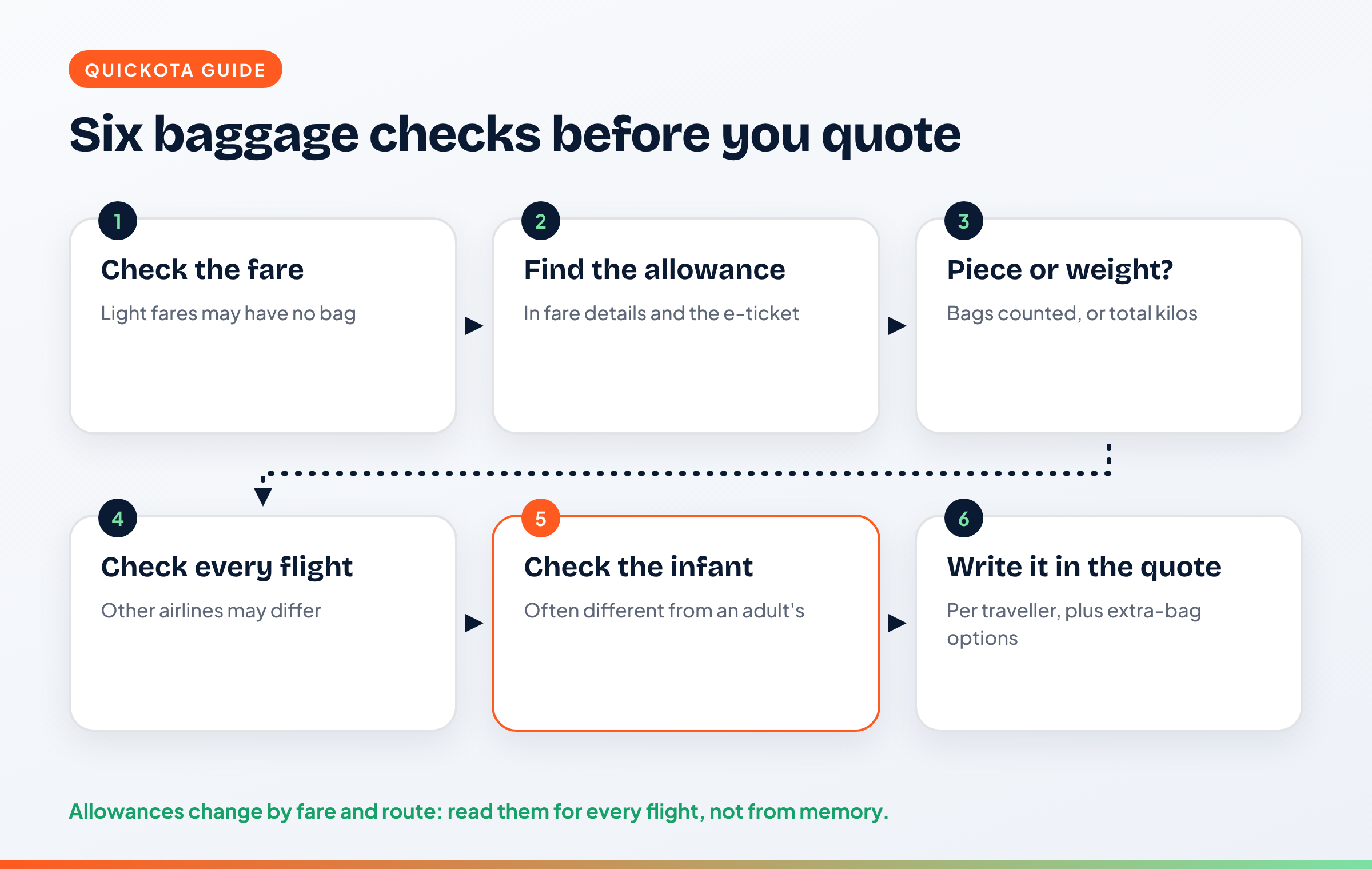
Short answer: Checked baggage belongs to the fare, not to the airline in general. Before you quote, check three things for each fare: whether a checked bag is included at all, whether the allowance is counted in pieces or in kilograms, and whether every flight in the journey follows the same rule. Then write the allowance in plain words in your quote, per traveller, and tell the customer how to add more before travel.
Customers often search for an airline's baggage rule by name, for example "وزن الشنطة الخطوط السعودية" or "وزن الشنطة مصر للطيران". The honest answer is that it depends on the fare they buy. This guide shows agents in the Gulf, Egypt, Sudan, Iraq, the Levant and North Africa how to read the allowance and explain it, without promising anything the ticket does not include.
Key takeaways
- The allowance comes with the fare. Two passengers on the same flight can have different baggage.
- Some airlines count pieces (each bag has a weight limit), others count total kilograms. Say which one in your quote.
- Light or basic fares on many airlines include no checked bag. Never assume a bag is included.
- On connecting journeys with different airlines, the allowance can change between flights. Check every flight.
- Infants have their own allowance, often smaller than an adult's. Check it separately.
Why does checked baggage cause so many complaints?
Baggage causes complaints because customers remember the airline name and the price, not the fare they chose. A traveller who flew last year with two bags expects the same this year, even if the new ticket is a lighter fare. Most baggage disputes start with a quote that left the allowance out or described it loosely.
Common reasons a customer arrives at the airport surprised:
- The fare had no checked bag, and the quote did not say so.
- The customer heard "30 kilos" and packed three bags, but the allowance was one piece.
- One flight in the journey was on another airline with a different rule.
- The infant's allowance was assumed to be the same as an adult's.
- The customer planned to carry extra items, such as gifts or Zamzam water, without checking the airline's rules.
One clear line in the quote prevents each of these. For the other fare conditions, read airline fare rules explained.
What is the difference between the piece concept and the weight concept?
Under the piece concept, the fare allows a number of bags, and each bag has its own maximum weight and size. Under the weight concept, the fare allows a total number of kilograms, sometimes with a limit on the number of pieces. Customers mix these up, so name the concept in every quote.
Two airline examples, quoted from their official pages at the time of writing:
- EgyptAir (piece concept): on international routes, the Economy Class number of pieces is "according to fare rules", with a maximum weight per piece of 23 kg. The number of bags depends on the fare; the weight limit applies to each bag.
- Air Arabia (weight concept): passengers "can select checked baggage weight while booking or modifying your flight (20 Kg, 30 Kg or 40 Kg limited to the number of pieces allowed)". The page adds that "the exact piece allowance is displayed during the booking process when selecting your checked-in baggage option."
How to say it to a customer:
| Concept | What the customer should hear |
|---|---|
| Piece | "You can check [number] bags. Each bag can weigh up to [weight]." |
| Weight | "You can check up to [weight] in total, in no more than [number] bags." |
Allowances change by route and fare. Always read the allowance for the fare you are selling, not from memory.
Which fares include a checked bag and which do not?
Many airlines sell the same seat in fare families or brands, from a light fare with cabin baggage only to fuller fares with checked bags and more flexibility. Low-cost airlines often sell the bag separately. The fare name alone does not tell you the allowance, so check the baggage shown for each fare before you quote.
What to look for:
- Light, basic or "cabin only" fares: often no checked bag. Say "no checked bag included" in the quote, in those words.
- Middle fares: usually include a checked allowance and some flexibility.
- Fuller fares: usually include more baggage and better change and refund conditions.
- Low-cost airlines: the bag may be chosen and paid for during booking, as on Air Arabia, where the weight is selected while booking.
When a customer asks about flynas, flyadeal, flydubai, Saudia or another airline by name, give the allowance for the fare you are quoting. If you send two options, show the baggage difference next to the price difference: a lower fare without a bag may cost more once the customer adds one. Our WhatsApp quote guide shows how to lay out the options.
Where does the allowance show on the booking and the e-ticket?
The allowance shows with the fare when you search, in the booking or fare details after you book, and on the e-ticket, usually in a baggage column for each flight. It is often written as a short code: a number of pieces (for example "1PC") or a weight (for example "30K"). Read it for every flight, not just the first.
Illustrative example of what you might see on an e-ticket for a two-flight journey:
| Flight | Baggage shown | What it means |
|---|---|---|
| Flight 1 | 1PC | One checked bag, within that airline's weight limit per piece |
| Flight 2 | 30K | Up to 30 kg in total |
If the flights show different allowances, tell the customer which one is smaller. Before you send the e-ticket, compare it with your quote, and correct any difference with the customer before they travel.
What happens on connecting journeys with different airlines?
When a journey uses more than one airline, the allowance can differ between flights. One airline may count pieces and the other kilograms, and a separately bought onward ticket follows its own rules. Check the allowance on every flight, and tell the customer which one is smaller.
EgyptAir's baggage page states this directly: "If your booking includes flights Codeshare flights or interline flights operated by other airlines, your baggage allowance may differ from the EGYPTAIR allowances above." Other airlines publish similar notes.
Practical points for agents:
- One ticket, two airlines: read the allowance shown for each flight. Do not copy the first flight's allowance for the whole journey.
- Two separate tickets: each ticket has its own allowance, and bags may not be checked through to the final destination. The customer may need to collect and check in again. Say this clearly.
- Customers from Sudan, Iraq or Yemen connecting through Cairo, Jeddah, Riyadh or Dubai: this is where mixed allowances are common. Check each flight in the itinerary.
Never give advice on transit visas or entry rules. If the customer must collect bags during a connection, send them to the official government sources for that country.
What baggage do infants get?
Infants (usually under two years old, without their own seat) often have a smaller checked allowance than adults, sometimes with a stroller or extra cabin item allowed. Rules differ by airline and route, so check the infant line separately and write it in the quote. Parents assume the baby's bag is the same as theirs.
Two examples from official pages, at the time of writing:
- EgyptAir: on international routes (all classes, except to and from the USA and Canada), an infant gets "1 piece" with a maximum weight of 10 kg, plus "1 fold-up collapsible stroller".
- Air Arabia: an infant under two is "entitled to one additional standard-sized hand baggage weighing up to 3 Kgs for items the infant may require during the flight". This is a cabin item, not a checked bag.
For any other airline, check the infant allowance shown for the fare, or the airline's own baggage page.
How should customers buy extra or prepaid baggage?
If the customer needs more than the fare includes, the usual options are a fuller fare that includes more baggage, or prepaid extra baggage bought from the airline before travel. Paying at the airport is often more expensive. Explain the options before ticketing, because a fare change after ticketing may cost more.
Air Arabia, for example, states that passengers can pre-book checked baggage "online", or by "contacting our call center, visiting our sales offices or travel partners", and that "excess baggage fees will apply for every kilogram beyond the purchased allowance". Other airlines have their own ways to add bags, usually through "manage booking" on their website.
What to tell the customer:
- What is included now, per traveller.
- That extra baggage is bought from the airline or chosen as part of a fuller fare.
- That excess baggage fees are set by the airline, so check its rules and options before the customer travels.
Do not quote extra-baggage prices from memory. They change by route, date and airline.
What about Zamzam water and special items?
Zamzam water, gifts, large boxes and other special items follow the airline's own rules, which can be separate from the normal allowance. Some airlines publish specific rules for Zamzam water on Umrah and Hajj routes. Ask the customer what they plan to carry, and send them to the airline's official baggage page for the rule.
This guide does not state any airline's Zamzam rule. If you sell Umrah trips, keep the official baggage link for each airline you sell and read it again each season. See also selling Umrah flights.
A WhatsApp baggage message you can adapt
Put the baggage in the quote, and repeat it when you send the e-ticket. Use the same words every time. The message below is illustrative: replace the brackets with what the fare shows.
Baggage for your trip 🧳 Fare: [fare name] Checked baggage: [1 bag up to 23 kg] per adult Infant: [1 bag up to 10 kg + 1 folding stroller] Cabin bag: [as shown by the airline] Flight 2 ([airline]): [same / different: 20 kg in total] Need more? Extra baggage is bought from the airline before travel. Check the airline's excess baggage rules before you go. Special items (Zamzam water, large boxes): please check the airline's own baggage rules.
Keep it on one screen. If a fare has no checked bag, write "No checked bag included" as its own line.
How to quote baggage clearly with QuickOTA
QuickOTA is a B2B travel platform. In the QuickOTA B2B Panel you search, hold and ticket flights, and you check the fare rules before you book, so you can write the conditions into your quote. Service fees are itemised and shown before you book and in your booking details. You request changes, cancellations and refunds from your panel and see the quote before you accept.
QuickOTA does not require IATA accreditation: QuickOTA issues the ticket for your booking. B2B Panel access is free, with no setup fee and no minimum deposit. You are responsible for meeting your own country's rules for selling travel.
Common baggage mistakes agents make
- Quoting the airline, not the fare. "Saudia gives two bags" is not a fact; the fare decides.
- Writing "30 kg" without saying pieces or total. The customer will read it as total weight.
- Checking only the first flight on a journey with two airlines or two tickets.
- Forgetting the infant line, or assuming it matches the adult allowance.
- Sending a light fare without saying "no checked bag". It is the most common baggage complaint.
- Quoting extra-baggage prices from memory. Send the customer to the airline, or check at the time.
Frequently asked questions
How much baggage do I get with Saudia, flynas or EgyptAir?
It depends on the fare, the route and the class, not just the airline. Check the allowance shown for the fare you are booking, and the airline's own baggage page. At the time of writing, EgyptAir's page shows Economy pieces "according to fare rules", each up to 23 kg, on international routes.
What does "1PC" or "30K" mean on a ticket?
"PC" usually means pieces, so "1PC" is one checked bag within the airline's weight limit per piece. "K" usually means kilograms, so "30K" is up to 30 kg in total. Check the airline's rules for size and piece limits.
Does a light fare include a checked bag?
Often not. Many light, basic or cabin-only fares include only a cabin bag. Read the baggage shown for the fare, and write "no checked bag included" in your quote if that is the case.
Can my customer add a bag after the ticket is issued?
Usually yes, by buying extra baggage from the airline, often through its "manage booking" page or call centre, before travel. Prices and options are set by the airline. Changing to a fuller fare after ticketing is a change, with its own rules.
Can customers carry Zamzam water?
That depends on the airline's own rules. Send the customer to the airline's official baggage page, and check it again before each Umrah or Hajj season.