Short answer: Around Hajj, the flight market to Saudi Arabia changes shape. Umrah travel from abroad stops for a period before Hajj and starts again after it, Hajj airlifts fill Jeddah and Madinah, and families travel for Eid al-Adha. Agencies that sell well plan for each phase: they close Umrah sales on time, book ordinary travellers early, ticket before deadlines and book the return with the outbound.
This guide is for agencies and Umrah organisers in Muslim-majority African countries, and African agencies in the Gulf, who sell ordinary flights around Hajj. For how Hajj itself is organised, read Hajj Flights for Travel Agencies in Africa. For Ramadan, the other big Umrah peak, read Ramadan Umrah Flights.
Key takeaways
- Umrah from abroad pauses before Hajj and restarts after it. Take the dates only from the official Saudi calendar for the season you are selling.
- Hajj pilgrims usually fly on their country's Hajj airlift. Your business is everyone else: late Umrah travellers, families, workers, students and organisers.
- Jeddah (JED) and Madinah (MED) are busiest just before Hajj and again in the return wave after it. Book ordinary travellers early.
- Book the return with the outbound, check every ticketing deadline and send names exactly as in the passport.
- QuickOTA does not sell Hajj places, permits or Hajj visas. Those come only from national Hajj authorities and the official Saudi system.
What happens to flight demand around Hajj?
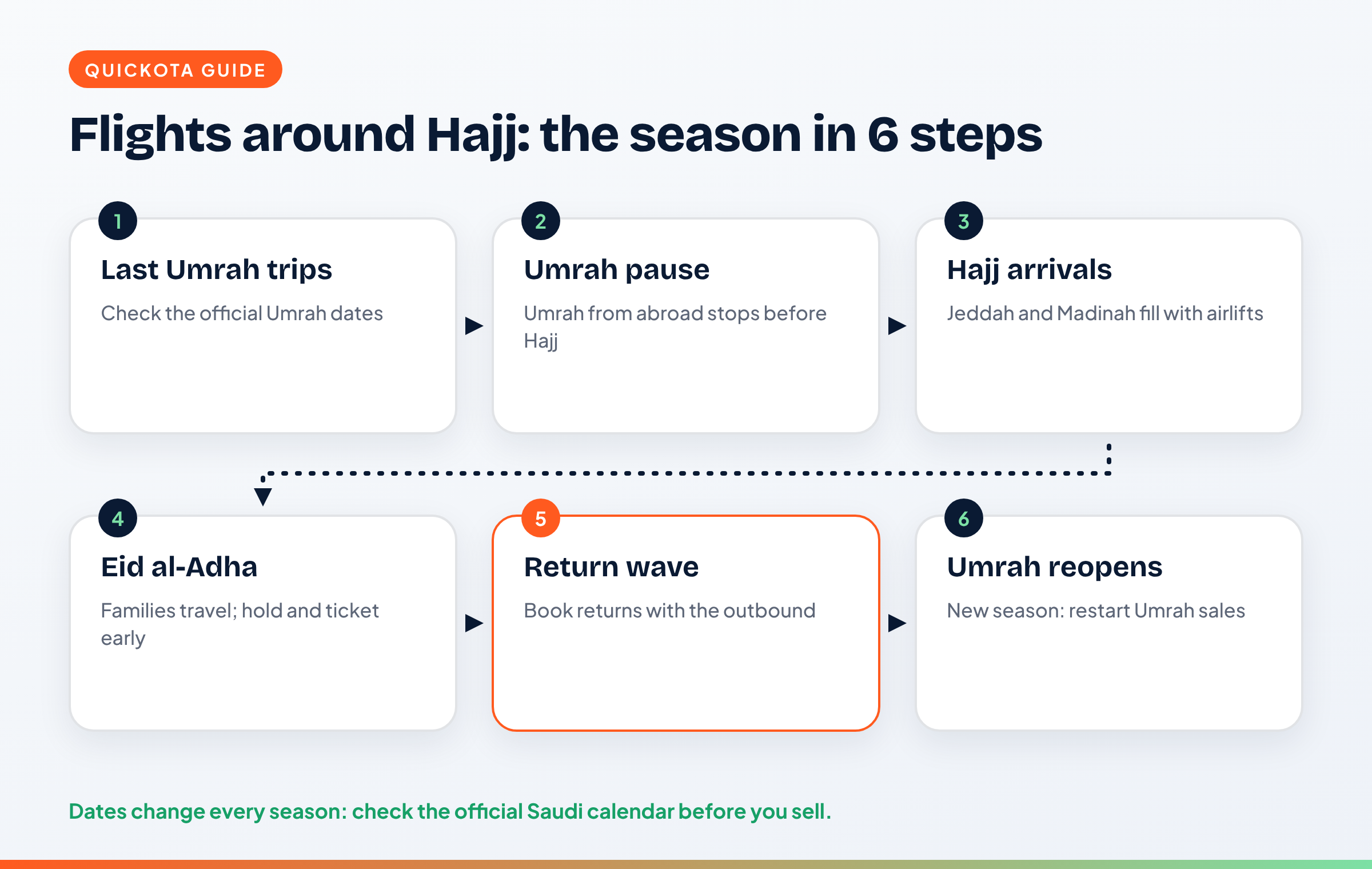
Around Hajj, demand moves in phases. Umrah travel from abroad winds down after Ramadan and stops for a period before Hajj. Hajj flights then fill the main pilgrim airports, Eid al-Adha brings family travel, and a return wave follows. After Hajj, a new Umrah season opens and Umrah demand builds again.
Each phase asks for something different:
| Phase | What usually happens | What you do |
|---|---|---|
| After Ramadan | The last Umrah travellers fly in and out | Sell only trips that fit the official Umrah dates; book returns early |
| Umrah pause | Umrah travel from abroad stops | Stop selling Umrah trips; sell family, work and other travel |
| Hajj arrivals | Hajj airlifts fill Jeddah and Madinah | Book ordinary travellers early, expect fewer seats |
| Eid al-Adha | Families in the Gulf and abroad travel for the holiday | Hold early, ticket early, confirm returns |
| Return wave | Pilgrims and Eid travellers fly home | Protect your customers' return seats |
| Umrah reopens | A new Umrah season starts | Restart Umrah sales from the new official calendar |
When does Umrah pause before Hajj, and when does it restart?
Saudi Arabia publishes an Umrah season calendar every year with the last date to issue Umrah visas, the last entry date and the last departure date before Hajj. A new season opens a few days after Hajj. These are official rules, so quote them only from the Saudi source for the named season, never from memory.
The latest complete cycle is the 1447 AH / 2026 season. The Ministry of Hajj and Umrah's Umrah calendar listed:
- Last date to issue Umrah visas: 1 Shawwal 1447 AH (20 March 2026)
- Last date for Umrah performers to enter the Kingdom: 15 Shawwal 1447 AH (3 April 2026)
- Last date for Umrah performers to leave the Kingdom: 1 Dhu al-Qi'dah 1447 AH (18 April 2026)
The Ministry of Interior's Hajj announcement of 13 April 2026, published by the Saudi Press Agency, gave the same departure date for Umrah visa holders. It also said Umrah permits through the Nusuk platform were suspended from 18 April to 31 May 2026 for citizens, GCC nationals, residents and holders of other visas, and that from 18 April only Hajj visa holders could enter or stay in Makkah.
The Supreme Court announced that the Day of Arafah in 1447 AH was Tuesday 26 May 2026, with Eid al-Adha on Wednesday 27 May. The 1448 AH Umrah season then opened: Umrah visas and entry from 14 Dhu al-Hijjah 1447 AH (31 May 2026), and Makkah entry and Umrah permits through Nusuk from 15 Dhu al-Hijjah (1 June 2026).
For the coming 1448 AH / 2027 cycle, the Ministry's calendar already gives the last Umrah dates before Hajj: last visa issue 1 Shawwal 1448 AH (9 March 2027), last entry 15 Shawwal (23 March 2027) and last departure 30 Shawwal (7 April 2027). At the time of writing, the 1448 AH Hajj dates and the reopening date after Hajj 2027 had not been announced. Follow the official announcements, and check whether the dates change before you sell.
How does demand for Jeddah and Madinah behave?
Jeddah (King Abdulaziz International Airport, JED) and Madinah (Prince Mohammad bin Abdulaziz International Airport, MED) carry most pilgrim traffic. Before Hajj, airlift flights take a large share of airport and airline capacity. After Hajj, the same airports handle pilgrims flying home. Ordinary travellers can still fly, but with fewer choices.
For the 1447 AH season, the Saudi Press Agency reported six main airports prepared for pilgrims, including Jeddah and Madinah, with dedicated Hajj terminals. Hajj flights are not ordinary tickets, but they use the same airports, and often the same airlines, as your customers.
What this usually means for you:
- Fewer seats and higher fares on many dates into Jeddah and Madinah in the weeks before Hajj, and out of them after it.
- Schedule changes are more likely when airlines move aircraft to Hajj flying. Check bookings again before departure.
- Alternative airports such as Riyadh or Dammam may suit customers not going to Makkah or Madinah.
- One-way peaks. Flights into Saudi Arabia are fuller before Hajj, and flights home after it.
Customers often search for airlines they know, such as Saudia, flynas, flyadeal, EgyptAir or Ethiopian Airlines. Check current routes on the airline's own website.
Who still needs flights during the Hajj season?
Most Hajj pilgrims from African countries travel on their national Hajj airlift, so they are not ordinary ticket sales. The demand you can serve comes from everyone else: Umrah travellers before the pause, families travelling for Eid al-Adha, workers, students and organisers.
Typical customers in this season:
- Late Umrah travellers after Ramadan, whose whole trip must fit the official Umrah dates.
- Families of workers in Saudi Arabia and the Gulf who fly home for Eid al-Adha, or fly relatives out to visit.
- Diaspora families in Europe and the Gulf who visit home in Africa around Eid.
- Licensed operators' staff and organisers, only within their national Hajj authority's rules. For groups, use a group request (see below).
- New-season Umrah travellers who want to fly as soon as Umrah reopens.
Be clear with every customer that you sell flights, not Hajj. If someone asks you for a Hajj place, permit or visa, send them to your national Hajj authority.
How should you hold and ticket in the busiest weeks?
Hold seats only when names and dates are firm, write down every ticketing deadline and ticket as soon as you have payment. Around Hajj, holds can be shorter and fares can change between the hold and the ticket. A hold is not a ticket, and the price is not guaranteed until the ticket is issued.
A routine that works in this season:
- Search the outbound and the return together. If the return is not available, say so before you hold anything.
- Hold with names exactly as in the passport. In a full season, a name mistake can cost the seat.
- Write the deadline in your message to the customer, and agree that unpaid seats are released.
- Ticket early. Do not wait for the last hour of a deadline in Hajj season.
- Re-check bookings a week before departure and again the day before, for schedule changes.
Our guide to PNRs, holds and ticketing deadlines explains each step.
Which fare rules matter most around Hajj?
The rules that matter most are changes, refunds, no-shows and baggage. In a full season, a change may not be possible even when the fare allows it, because there are no seats. Read the fare rules before you quote, and put the change and refund conditions in writing for every customer.
Points to check on every fare:
- Changes: usually a fee plus any fare difference, and only if seats are available.
- Refunds: many cheaper fares are not refundable.
- No-shows: on many fares, missing the outbound cancels the return.
- Baggage: the allowance in the fare, and that airlines set their own rules for extra bags and items such as Zamzam water.
- Dates and documents: a late Umrah traveller's return must fit the official Umrah dates. Do not advise on this yourself; send customers to the official Saudi sources.
Read more in Airline Fare Rules Explained.
How do you handle group requests in Hajj season?
Handle groups early and separately from individual bookings. Families flying home for Eid, an Umrah group for the new season, or a licensed operator's Hajj group within its national framework all need dates, numbers and a name deadline agreed early. Ask for a group quote well before the season.
Illustrative example (round numbers, no prices): an agency in East Africa has 40 customers who want to fly out after Umrah reopens, and 10 family members in Jeddah who want to fly home for Eid al-Adha. It sends one group request for the 40, with dates and the airport it prefers, and books the 10 family members as individual bookings, two or three families per booking. Each booking is held and ticketed when that family pays, so one late payer does not block the rest.
Keep one planning sheet with every booking, name, deadline and payment.
What should you tell customers, and when?
Tell customers early, in writing, what the season means for their trip: the official Umrah dates if they travel for Umrah, that seats around Eid are limited, that fares can change until ticketing, and their exact return date. Then confirm each step: hold, payment, ticket and any schedule change.
Messages you can adapt (illustrative):
"Umrah travel from abroad stops before Hajj. Please check the official Saudi Umrah dates for this season. Your return must fit them."
"Seats home for Eid al-Adha are limited. I can hold these seats until [time] once I have every name exactly as in the passport. The price is not guaranteed until the ticket is issued."
Never write "confirmed" before the ticket is issued, never promise a Hajj place or permit, and never give visa or entry rules as fact. Our guide to quoting flights on WhatsApp has a full quote template.
How to sell flights around Hajj with QuickOTA
QuickOTA is a B2B travel platform. In the QuickOTA B2B Panel you search, hold and ticket flights, and you see the fare rules before you book. Service fees are itemised and shown before you book and in your booking details. You request changes, cancellations and refunds from your panel and see the quote before you accept.
For groups, including Umrah groups and licensed operators' Hajj groups, you send a group request to the QuickOTA team, receive a quote, pay in instalments from your wallet and manage the passenger list in the panel. QuickOTA does not sell Hajj places, quotas, permits or Hajj visas; those come only from your national Hajj authority and the official Saudi system.
QuickOTA does not require IATA accreditation: QuickOTA issues the ticket for your booking. B2B Panel access is free, with no setup fee and no minimum deposit. You are responsible for meeting your own country's rules for selling travel.
Common mistakes agencies make around Hajj
- Selling Umrah trips that do not fit the official dates. Check the current season's calendar before you quote.
- Using last year's dates. The Hijri calendar moves about 11 days earlier each year.
- Leaving the return open. Seats home after Eid and after Hajj sell out first.
- Holding without exact passport names. A name error in a full season can cost the seat.
- Ticketing on the last day of the deadline. Fares and seats change quickly in this season.
- Talking about Hajj places, permits or visas as if you can sell them. Send customers to the national Hajj authority.
Frequently asked questions
When does Umrah stop before Hajj?
It depends on the season. For 1447 AH / 2026, the Saudi Umrah calendar gave 3 April 2026 as the last entry date and 18 April 2026 as the last departure date for Umrah performers. For 1448 AH / 2027 it gives 23 March and 7 April 2027. Always check the official calendar.
When does Umrah start again after Hajj?
After Hajj 1447 AH / 2026, the new Umrah season opened for visas and entry on 31 May 2026, with Makkah entry and Umrah permits through Nusuk from 1 June 2026. The date after Hajj 2027 had not been announced at the time of writing.
Can I sell flights to Jeddah during the Hajj season?
You can sell flights to ordinary travellers within your own country's rules for selling travel, but seats are fewer and fares often higher just before Hajj. In 1447 AH / 2026, the Saudi authorities allowed only Hajj visa holders into Makkah from 18 April, so send customers to the official sources for the current season.
Why are flights home after Hajj so hard to find?
After Hajj, pilgrims and Eid travellers fly home over the same weeks, often from Jeddah and Madinah. Book your customers' return at the same time as their outbound.
Can QuickOTA provide Hajj visas or Hajj places?
No. Hajj places, permits and Hajj visas come only from national Hajj authorities and the official Saudi system. QuickOTA accepts group requests, including Hajj groups from licensed operators, and agencies book flights in the panel.