Short answer: Group air ticket booking means asking an airline, or a supplier that handles groups, to price one set of seats for many travellers on the same flights. Instead of a fare per seat from the normal search, you get a group offer with its own conditions: an offer validity, a deposit, a deadline for the name list, a final payment date and rules on releasing seats. Each airline sets its own minimum group size and terms.
This guide is for agencies with a large enquiry, such as an Umrah group, a wedding party, a school trip or a football club, who want to understand airline group fares before they quote. It covers the stages, the rules that catch agencies out, collecting money and when individual bookings are better. It does not describe any one airline's policy, because those differ and change.
Key takeaways
- A group fare is a separate offer for a block of seats, not a discount you apply in the normal search.
- The usual stages are request, offer, deposit, name list, final payment and ticketing, each with its own date.
- Group seats come with release and attrition rules. Read them before you take money from travellers.
- Group fares are not always cheaper. Compare the offer with individual fares on the same dates.
- For Hajj, quotas, permits and visas come only from national Hajj authorities and the official Saudi system.
What is group air ticket booking, and how is it different from booking seats one by one?
Group air ticket booking is a request for a block of seats on the same flights, priced and managed as one deal. When you book seats one by one, each traveller gets the fare the search shows at that moment. With a larger party, each booking takes a seat from the cheapest fare class, so the last travellers may pay more or find the flight full. A group booking fixes a price and a number of seats for the whole party, under the conditions in the offer.
What does "group fare" mean?
A group fare is a price an airline offers for a set number of passengers who travel together on the same flights and dates. It is usually managed outside the public fares in a normal search, with its own rules on deposits, names, changes and refunds.
Each airline decides how many passengers make a group, and some count children and infants differently. Check the airline's group policy, or ask your supplier, before you promise anything.
Are group fares always cheaper than individual fares?
No. A group fare can be lower than the fares left in the search, especially on busy dates, but it can also be higher than a promotion that happens to be available. Its main value is often certainty: a fixed price and a fixed number of seats for months, while individual fares move with demand.
So when a customer asks about a group booking flight discount, do not promise one. Compare the offer with individual fares on the same flights, including the deposit and conditions. On quiet dates, individual fares can win; on peak dates, a group offer may be the only way to keep everyone on one flight.
How do you book group flight tickets step by step?
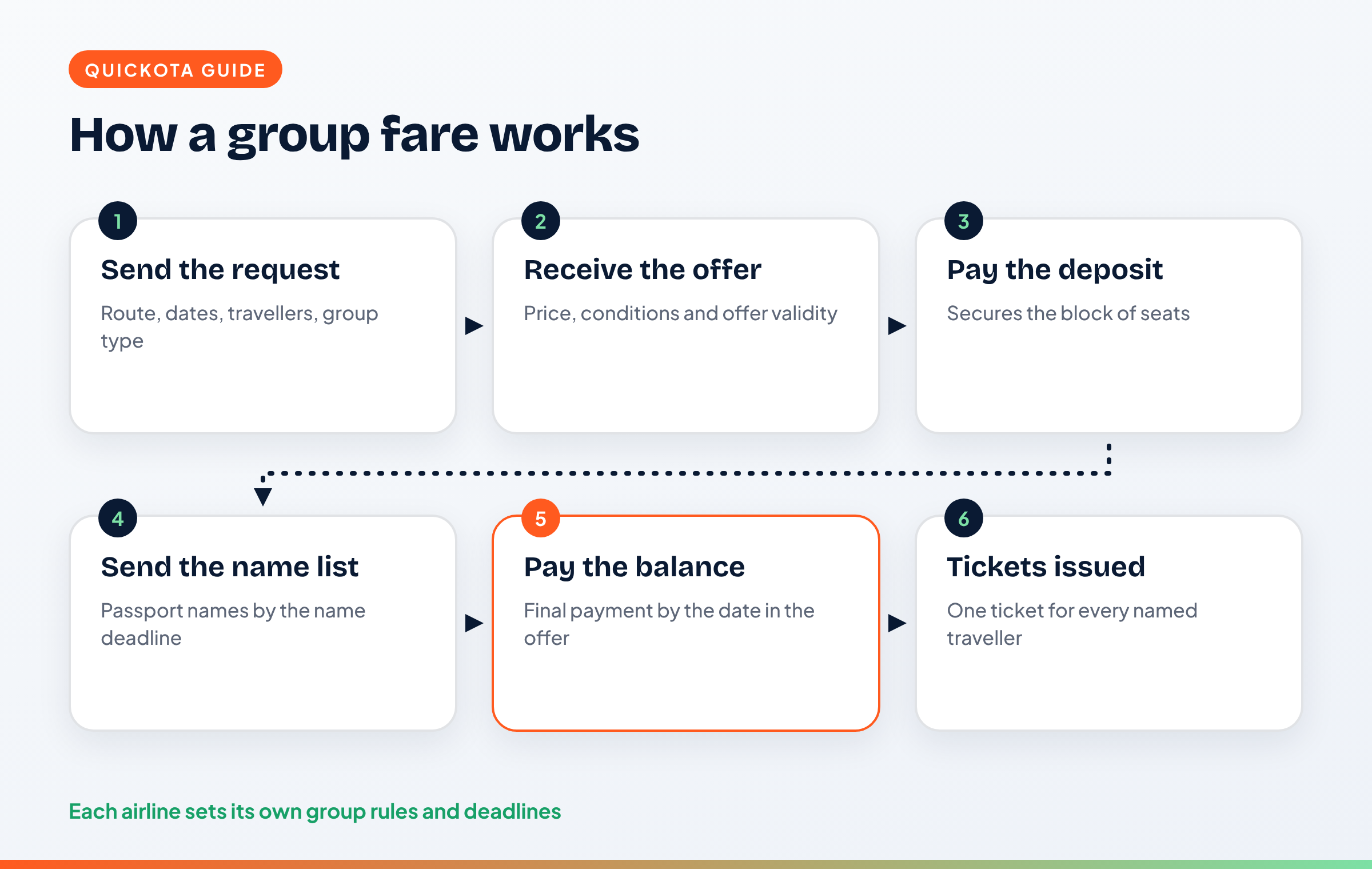
Most group bookings move through six stages, each with a date you must meet. The exact rules differ by airline:
- Request. You send the route, dates, flight preferences, number of adults, children and infants, and the type of group.
- Offer. You receive a price per person, the conditions and how long the offer is valid. After that, the price or the seats may change.
- Deposit. You accept the offer and pay a deposit to secure the seats. Ask whether it is refundable and in which cases.
- Name list. You send the travellers' names, spelled as in their passports. Many airlines let you send names later than the deposit, up to a deadline.
- Final payment. You pay the balance by the date in the offer.
- Ticketing. Tickets are issued for every named traveller. Our glossary entry on the ticketing time limit explains how deadlines work on a held booking.
Put every date from the offer into one planning sheet on the day you accept it.
What happens if travellers drop out of the group?
The group becomes smaller than the seats you agreed. Many airlines let you release some seats without penalty up to a date, often called the attrition or seat release deadline. After it, empty seats may still have to be paid for, or their deposit kept. The rules are in the offer, and they vary.
How to protect your agency:
- Read the release rule before you accept: how many seats you can give back, by when, and at what cost.
- Ask for a realistic number. Ask your supplier whether adding seats later is possible for that airline.
- Match your customer terms to the airline's. If a dropped seat costs the deposit, your contract with the organiser should say who pays.
- Confirm the count in writing with the organiser before each release date.
Can you change names on a group booking?
It depends on the airline and the stage. Before the name list deadline, you can usually add or replace names freely. After names are sent, or after tickets are issued, a name change may carry a fee, be limited to a number of passengers, or not be allowed at all.
Ask at the request stage how late you can send names and whether a replacement traveller is possible after ticketing. Collect names in one list, with surname and given names in separate columns, and check each against the passport copy.
How do baggage and seating work for groups?
Baggage follows the conditions in the offer, which may differ from an individual fare in the same cabin. A group booking does not guarantee seats together; many airlines assign seats close to departure.
Before you quote, check the checked baggage per person, whether extra bags can be added and by when, the airline's rules for special items such as sports equipment or Zamzam water, and how it handles seat requests for families and travellers who need help. Tell the organiser in writing what is included, and do not promise that the whole group will sit together.
What kinds of groups do agencies sell?
Each type of group behaves differently on names, payments and dates, so the pattern tells you which conditions to ask for.
| Group type | What usually matters most |
|---|---|
| Umrah groups | Peak dates in Ramadan and school holidays; return dates; baggage on the way home |
| Hajj groups | Only within the national Hajj authority's framework; quotas, permits and Hajj visas come only from that authority and the official Saudi system |
| Weddings and family events | Mixed ages and infants; late names; travellers paying separately |
| Students and schools | Fixed term dates; parental payments; a teacher as group leader |
| Corporate and MICE | Invoicing to one company; late name changes; flexible dates for some staff |
| Sports and events | Fixed event dates; equipment; demand around the event. See our events calendar |
For Umrah, our guide to selling Umrah flights as a small travel agency covers fare rules and pricing per traveller. For Hajj, read Hajj flights for travel agencies in Africa, and check the Saudi Arabia visa page for which visa types the service covers. A Saudi tourist visa allows Umrah, not Hajj.
When should you request group fares for peak seasons?
Request group fares well before the season, because group seats on popular dates are limited. Work backwards from the travel date, leaving time for the offer, deposit, names, payments and ticketing. The bigger the group and the busier the date, the earlier you start.
| Season | Why it is busy | Planning point |
|---|---|---|
| Ramadan | Umrah demand, especially the last ten nights | Ask before the new year's Ramadan calendar fills; see Ramadan Umrah flights |
| Hajj season | Hajj airlifts and Eid al-Adha travel to and from Saudi Arabia | Ordinary groups compete for fewer seats; see selling flights around the Hajj season |
| Eid holidays | Families travel home or on holiday | Return dates sell first; ask for both directions together |
| Summer and school holidays | Families, students and diaspora travel | Dates are fixed by school calendars, so request early |
The Islamic calendar moves earlier each year, so take the dates from the current year's official calendar.
How do you collect money from many travellers?
Collect money in instalments that end before each of the airline's payment dates, not on them. Ask for a first payment that covers the deposit and a second that covers the balance, each due a week or more before the airline's date. Remove unpaid travellers before the release date, not after.
Illustrative example (round numbers, no real fares): a wedding party of 30 accepts an offer with a deposit date in March and final payment in May. The agency asks each family for a first instalment two weeks before the deposit date and the rest three weeks before final payment. Two families miss the second date, so the agency releases their seats in time, within the offer's rules.
Keep one ledger of names, amounts and dates, send receipts, and agree in your terms what happens to money paid by someone who drops out. Our guide to quoting flights on WhatsApp has wording you can adapt for reminders. For how agencies pay suppliers, see prepaid wallet or credit line?
Booking seats one by one vs a group request
| Booking seats one by one | Group request | |
|---|---|---|
| Price | Search fare at the moment of each booking | One offer for the group, valid until a date |
| Seats | Taken as you book; later seats may cost more | A block set aside for the party |
| Names | Needed for every booking | Often sent later, by a name deadline |
| Payment | Full fare at ticketing | Deposit, then final payment |
| Dropping out | Each booking follows its own fare rules | Release or attrition rules for the group |
| Best for | Small parties, flexible dates, cheap promotions | Larger parties, fixed or peak dates |
When is booking individually better?
Booking individually is often better when the party is small, the dates are quiet, or the travellers are not sure they will go. If the search shows enough seats at a good fare, separate bookings avoid deposits and release penalties. They also suit travellers flying from different cities or on different dates. A held booking can keep seats while the customer decides; our guide to flight holds and why "dummy tickets" are risky explains what a hold does and does not do.
Common mistakes with group fares
- Accepting an offer without reading the release rule. Find out what an empty seat costs before you take deposits.
- Collecting payments on the airline's own deadline. Collect earlier.
- Sending names that do not match passports. Check every name before the name list deadline.
- Promising a discount. A group fare is not always cheaper than the fares in the search.
- Talking about Hajj places or permits as if you can sell them. Send customers to the national Hajj authority.
How group requests work in QuickOTA
In QuickOTA, you send a group request in the B2B Panel with the trip details, and the QuickOTA team sends you a quote. When you accept, you pay a deposit and then instalments from your prepaid wallet, on the plan shown in the quote. You manage the passenger list in the panel, and the tickets, vouchers, itinerary and invoice are delivered there. We accept group requests for Hajj and Umrah groups; Hajj quotas, permits and visas still come only from national authorities and the Saudi system.
To open an agency account you need a registered company or a valid travel agency (tourism) licence from your country. B2B Panel access is free. Read more about the service on our group requests page.
Frequently asked questions
What is a group fare in air travel?
A price an airline offers for a number of passengers travelling together on the same flights. You request it rather than find it in a search, and it has its own deposit, name list, payment and release rules.
How many passengers do I need for a group booking?
It depends on the airline, which sets its own minimum and rules for counting children and infants. Check its group policy or ask your supplier.
Can I add names to a group booking later?
Often, yes, up to the name list deadline in the offer. After that, or after ticketing, changes may cost a fee or not be allowed.
What are the benefits of group flight booking for agencies?
One price for the party, seats set aside before every name is known, and payment in stages. The trade-off is a set of deadlines and release rules.
Can a travel agency book Hajj group flights?
Only within the framework of its national Hajj authority. Hajj quotas, permits and Hajj visas come only from that authority and the official Saudi system. QuickOTA accepts group requests for Hajj and Umrah groups, but does not provide Hajj places, permits or visas.