Short answer: A host agency lets you sell travel under its accreditations and supplier contracts, and you share the commission with it. A B2B travel portal lets your own registered business book and ticket flights for your own customers, at prices you set yourself. Choose a host if you are starting from home without a company. Choose a B2B portal when you run a registered agency and want to control your pricing, your brand and your customers.
This guide is for independent travel agents, home-based advisers and small agencies in the US, the UK, Canada and Europe, including agencies serving diaspora communities. It explains how the two models work, compares them side by side, and shows when each one fits, or when it makes sense to use both.
Key takeaways
- A host agency is a partner you work under; a B2B portal is a supplier your own business buys from.
- With a host, the host usually holds the accreditations and supplier contracts, and you split commission.
- With a B2B portal, you set your own markup, keep your own customers and run your own brand.
- Hosts suit home-based agents starting out; B2B portals suit registered agencies that sell a lot of flights.
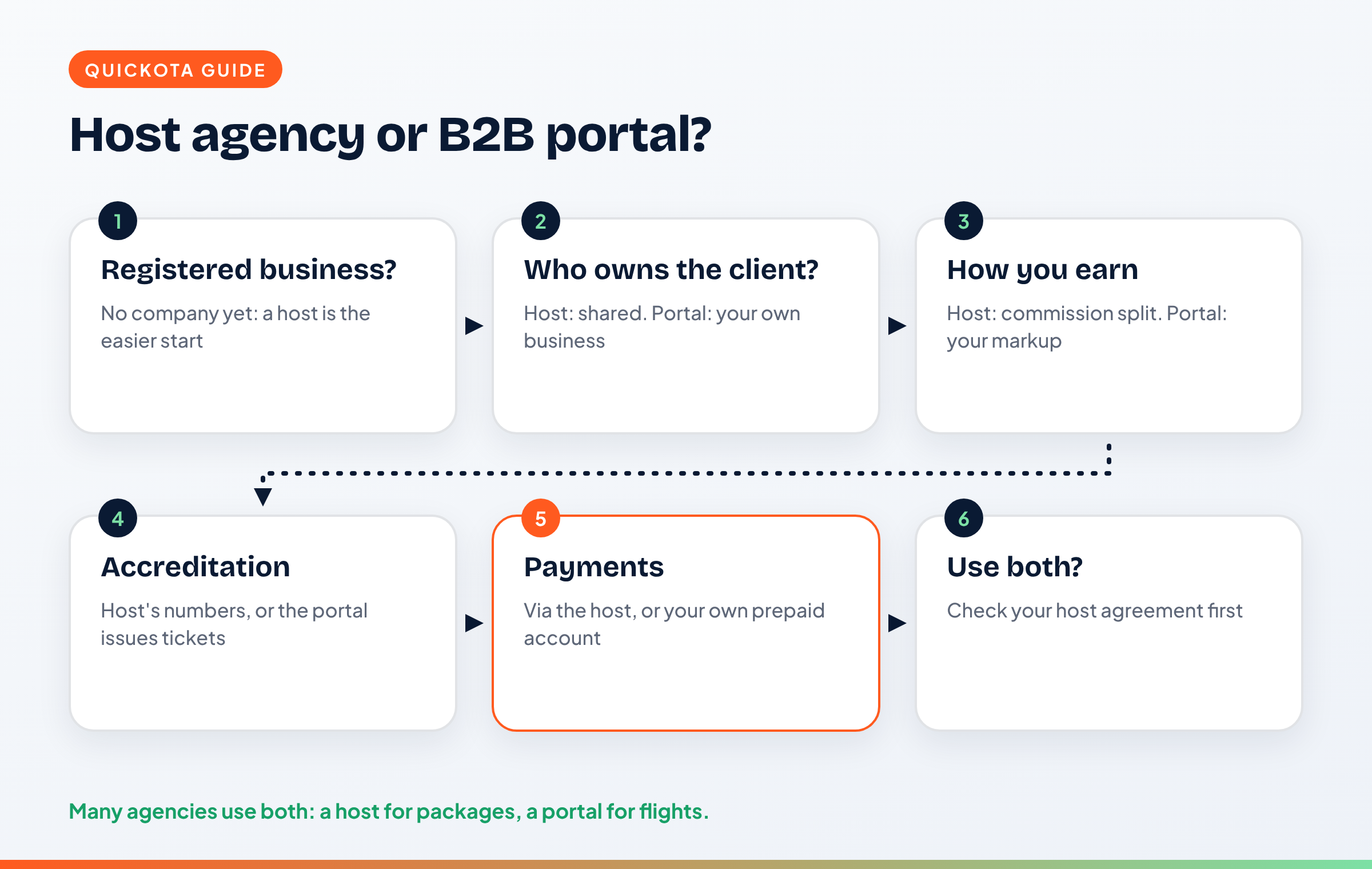
- Many agencies use both: a host for cruises and packages, a B2B portal for flights.
What is a host agency?
A host agency is an established travel agency that lets independent agents sell travel under its accreditations, supplier contracts and booking tools. The independent agent finds and serves the customers; the host handles much of the back office. When a booking earns commission, the supplier usually pays the host, and the host passes an agreed share to the agent.
What a host usually provides:
- Accreditations and supplier access. You sell under the host's industry numbers and contracts instead of applying for your own.
- Booking tools and support. Access to the host's systems, plus help desks for tricky bookings.
- Training and community. Many hosts run onboarding for new agents.
- Commission handling. The host collects commission from suppliers and pays you your share.
What you give in return is part of your earnings and some control. The host's rules apply to how you sell, and the host often has a say in which suppliers you use. Commission splits and any fees vary widely between hosts, so read the agreement before you join.
What is a B2B travel portal, in this comparison?
In this comparison, a B2B travel portal is a supplier your own registered business buys from. You log in, search fares, hold and ticket flights for your customers, and pay the portal from your own account. You decide the selling price, you invoice your customer in your own name, and the customer relationship is yours.
The key difference is the direction of the relationship. With a host, you work under someone else's business. With a portal, the portal works for your business. For a fuller explanation of how portals work and what to look for, read What Is a B2B Travel Portal?
Host agency vs B2B portal: side-by-side comparison
The two models differ most on who owns the customer, who sets the price and how you earn. A host gives you structure and someone else's credentials in exchange for a share of your earnings. A B2B portal gives you control of pricing and branding but expects you to run a registered business and handle your own customer service.
| Host agency | B2B travel portal | |
|---|---|---|
| Who owns the client | You serve the client, but bookings sit under the host's business | Your own business and customer records |
| Branding | Usually the host's name in the background, sometimes yours in front | Your brand on quotes, invoices and messages |
| Pricing control | Mostly the supplier's price; earnings come from commission | You add your own markup or service fee |
| Earnings model | Commission split with the host, sometimes with fees | Your margin between the portal price and your selling price |
| Accreditation | You use the host's | The portal or its ticketing partner issues the ticket; check what the portal requires |
| Payments | Often handled through the host or supplier | You pay the portal; you collect from your customer |
| Training | Often included | Usually product help only; you bring trade knowledge |
| Best for | New, home-based agents without a company | Registered agencies selling flights regularly |
When does a host agency make sense?
A host agency makes sense when you are starting out, work from home and do not yet have a registered travel business. It lets you sell quickly without building supplier relationships yourself, and gives you training and support while you learn. It suits agents who mainly sell leisure products where commission is still common, such as cruises and packages.
Signs a host is the better first step:
- You have no registered company yet, or you are testing travel as a side business.
- You want training and a community to ask questions.
- You sell mostly commissionable products, such as cruises, tours and resort packages.
- You prefer not to handle supplier payments and back-office work yourself.
Before you join, check your own state's or country's rules for selling travel. Some places have specific requirements for sellers of travel, and the host's set-up does not always cover everything for you.
When does a B2B portal make sense?
A B2B portal makes sense when you run a registered agency, sell flights often and want to set your own prices. Flight commission is limited on many routes, so agencies that sell mostly air tickets usually earn through a markup or service fee instead. A portal lets you add that margin, keep your brand on every quote and own every customer relationship.
This is common for:
- Diaspora community agencies in the US, the UK, Canada and Europe that sell flights home to Africa, the Middle East, South Asia or the Balkans. Customers come back every year, so owning the relationship matters. Our guide to selling diaspora flights from Europe covers that business in detail.
- Agencies outside the US and the UK, where the host-agency model is less common and small agencies usually buy from B2B portals and consolidators.
- Growing agencies that want to quote in their own name, with their own fees, and see every booking in one place.
Can you use a host agency and a B2B portal together?
Yes, many agencies use both, if their host agreement allows it. A common split is the host for cruises, tours and commissionable packages, and a B2B portal for flights, where your own markup works better than a small commission. Keep the two clearly separate in your records so you always know which supplier holds each booking.
Before you combine them:
- Read your host agreement. Some hosts require you to book certain products only through them.
- Separate your bookings. Note the supplier on every customer file.
- Price consistently. Customers should not see two different fee policies from you.
- Check after-sale. Changes and refunds go back through whichever supplier made the booking.
How to use QuickOTA as your flight supplier
QuickOTA is a B2B travel platform for registered travel businesses. In the QuickOTA B2B Panel you search, hold and ticket flights for your customers, see the fare rules and baggage before you book, and add your own markup. QuickOTA does not require IATA accreditation: QuickOTA issues the ticket for your booking. You pay from a prepaid wallet with no minimum deposit, and B2B Panel access is free.
To open an account you need a registered company or a valid travel agency licence from your country. If you are an individual agent without a registered business, QuickOTA cannot open an account for you yet; a host agency may be the better place to start, and you are welcome to apply once your business is registered. Visas for selected destinations and group requests are also available in the panel.
Common mistakes when choosing between a host and a portal
- Choosing on commission split alone. Look at the whole picture: client ownership, pricing control, support and fees.
- Assuming flights pay good commission. On many routes they do not; plan to earn from a service fee or markup.
- Ignoring local rules. Check your state's or country's rules for selling travel before you start, whichever model you choose.
- Mixing suppliers without records. If you use both, note which supplier holds every booking.
- Applying to a portal before registering. Most B2B portals, QuickOTA included, need a registered business or licence.
Frequently asked questions
What is a host agency for travel agents?
A host agency is an established agency that lets independent agents sell travel under its accreditations, supplier contracts and tools. The agent serves the customers, the host handles much of the back office, and commission is shared between them under an agreement.
Is a host agency or a B2B portal better for a new travel agent?
It depends on your set-up. A host usually suits a new, home-based agent without a registered company. A B2B portal suits a registered agency that sells flights often and wants to set its own prices and keep its own brand.
What do travel agents use to book flights?
Agents book flights through airline systems, consolidators, host agencies or B2B travel portals. Small and new agencies often use a B2B portal, which lets them search, hold and ticket flights without their own airline accreditation, depending on the portal.
Can I use QuickOTA without a registered company?
Not at the moment. QuickOTA needs a registered company or a valid travel agency licence from your country. Individual agents can start with a host agency and apply once their business is registered.
Can I work with a host agency and a B2B portal at the same time?
Often yes, if your host agreement allows it. Many agencies book cruises and packages through a host and flights through a B2B portal. Keep records of which supplier holds each booking.