Short answer: Some do, but most small agencies cannot live on airline commission. Many airlines pay little or no base commission on many fares, so agencies earn mainly in two other ways: a markup they add on top of the fare they pay, and a service fee they charge for booking and after-sale work. A good pricing habit is simple: know your full cost, add a margin that covers your time and risk, and show the customer one clear total.
This guide is for owners of new and small travel agencies who ask, "How do I actually make money on a flight ticket?" It explains commission, markup and service fees, shows an illustrative worked example, and covers the mistakes that quietly eat margin.
Key takeaways
- Airline commission exists, but on many fares it is small or zero, so do not build your business on it.
- Most small agencies earn through a markup on the fare plus a service fee.
- Your cost is more than the fare: include supplier service fees, payment costs and after-sale time.
- Charge separately for changes and refunds; they take the most time.
- Quote the customer one total price and keep your breakdown private.
Do airlines still pay commission to travel agents?
Airlines still pay commission in some markets and on some fares, but for many fares the base commission is small or zero. Where commission exists, it is usually paid to accredited agencies or through incentive deals tied to volume. For a new agency without IATA accreditation, commission is rarely a reliable income, so plan your margin as if it were zero.
That is why the question "how much commission do airlines pay travel agents?" has no single answer. It depends on the airline, the market, the fare type and the agency's contract. Some fares are sold as net fares: the supplier gives you a price with no commission inside it, and you set your own selling price above it. Others are published fares: the public price, sometimes with a small commission or incentive for the seller.
For a small agency, the practical rule is: treat any commission as a bonus, not as your business model.
What is a markup on a flight ticket?
A markup is the amount you add on top of what the ticket costs you. If your supplier's price for a ticket is your cost, your selling price is cost plus markup. The markup pays for your time, your office, your marketing and your risk. Unlike commission, you control it, so it is the main lever a small agency has.
There are two common ways to set a markup:
- A fixed amount per ticket. Simple and predictable. It works well for cheap short-haul tickets, where a percentage would be tiny.
- A percentage of the fare. Grows with the ticket price. It works well for long-haul and business-class tickets, but can look expensive on high fares if it is too large.
Many agencies combine both: a minimum fixed amount, or a percentage with a floor. Whatever you choose, apply it consistently, so two customers on the same flight do not get very different prices from you.
Our free markup calculator helps you test a fixed or percentage markup before you quote.
What is a service fee, and how is it different from a markup?
A service fee is a separate charge for your work, shown or agreed with the customer, while a markup is usually built into the ticket price. Many agencies use both: a modest markup on the fare, and a clear service fee for booking, for changes, and for refunds. Service fees are easier to explain when the customer asks why your price differs from the airline website.
Common service fees for agencies:
| Fee | When you charge it | Why it matters |
|---|---|---|
| Booking fee | Every new ticket | Covers searching, quoting and ticketing time |
| Change fee | Date or route change | Changes take time even when the airline fee is small |
| Refund handling fee | Refund requests | Refunds can take weeks of follow-up |
| Group handling fee | Group bookings | Name lists, deposits and deadlines need extra work |
| Urgent service fee | Same-day or out-of-hours requests | Covers your availability |
Check your own country's rules on how fees must be shown to consumers. This guide does not give tax or legal advice.
What does a flight ticket really cost your agency?
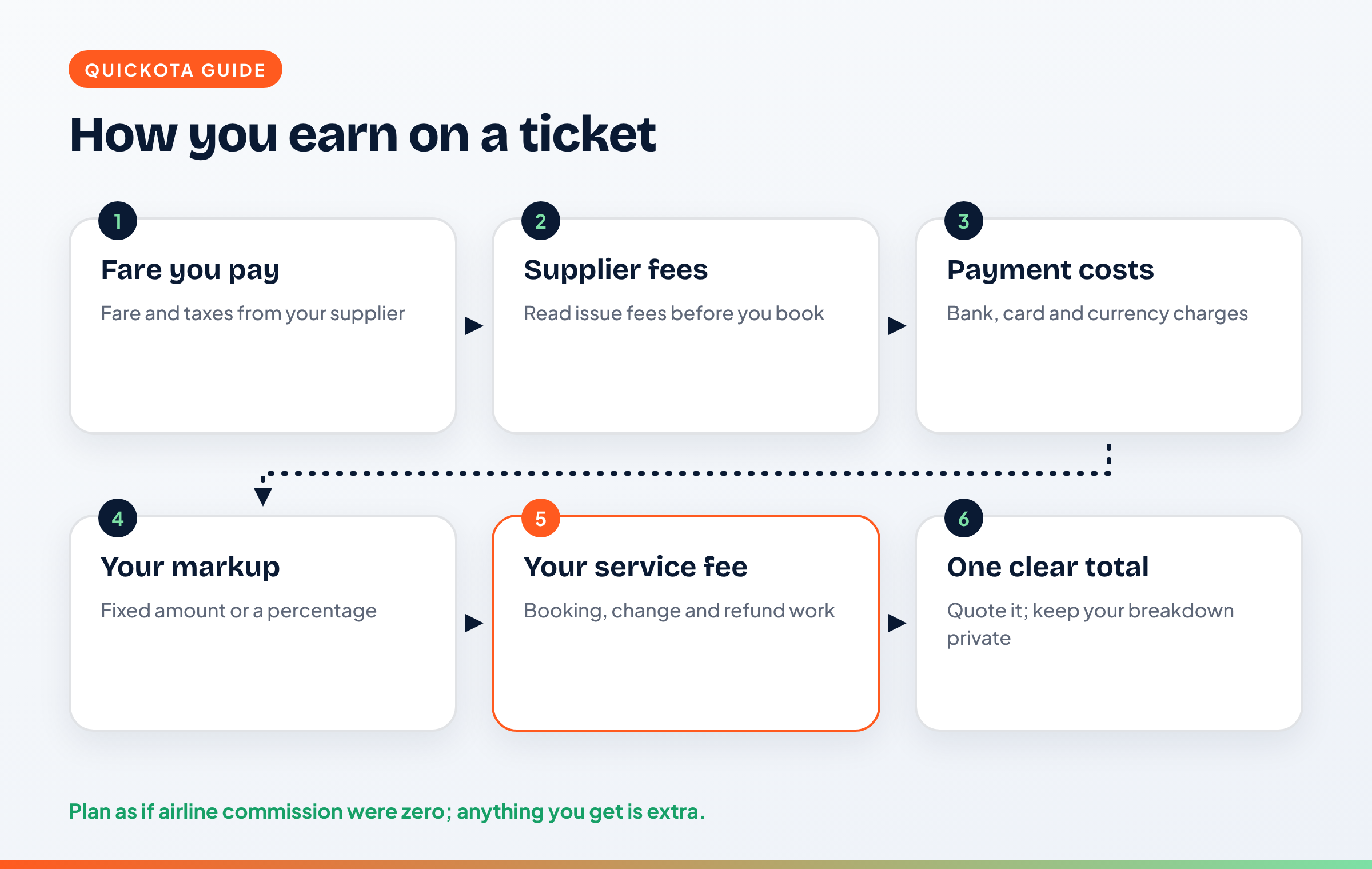
Your real cost is more than the fare on the screen. Add the supplier's service fees, the cost of receiving money from the customer (bank charges, card or wallet fees, currency conversion) and the time you spend on the booking and its after-sale. If your markup does not cover all of these, you lose money on tickets that look profitable.
A simple cost checklist per ticket:
- Fare and taxes from your supplier.
- Supplier service fees, for example issue fees. Read them before you book.
- Payment costs: what your bank or payment provider charges when the customer pays you.
- Currency risk: if you quote in local currency and pay your supplier in another, leave a buffer.
- After-sale time: changes, schedule changes and refunds. Charge for them separately.
An illustrative pricing example
Illustrative example (round, made-up numbers, not real fares): your agency books a return ticket. The fare and taxes cost you 400. The supplier shows an issue fee of 10. Your bank charges about 5 when the customer pays you.
- Your cost: 400 + 10 + 5 = 415
- Your markup: a fixed 25 per ticket
- Your booking service fee: 10
- Price to the customer: 450
- Your gross margin: 35 per ticket
If the customer later changes the date, you charge the airline's change fee and fare difference (from the fare rules) plus your change fee, for example 15. You do not take the change on for free, because it uses your time.
Now compare a percentage markup of 5% on the same ticket: 5% of 400 is 20, a little less than the fixed 25. On a long-haul ticket costing 1,200, 5% gives 60. This is why many agencies use a fixed minimum plus a percentage on expensive tickets.
How do you show the price to the customer?
Show the customer one clear total for all passengers, with what is included: baggage, the change and refund rules, and how long the price is valid. Keep your cost and margin private. If the customer compares you with the airline website, explain what you add: help with choosing the right fare, holding the seat, and handling changes and refunds.
Tips:
- Quote totals, not per-person prices, unless the customer asks.
- Name your after-sale fees in advance, so a change later is not a surprise.
- Do not promise a fare is fixed until the ticket is issued.
Our guide to quoting flights on WhatsApp gives a template you can copy, and airline fare rules explained shows how to read the change and refund conditions you will charge for.
Credit, prepaid wallet and your margin
How you pay your supplier also affects your margin. On credit, you can sell before you pay, but credit usually needs guarantees and history. With a prepaid wallet, you pay first and must manage your cash, but there is no credit risk and no interest. For a new agency, the key is to collect payment from the customer before you ticket.
We compare both models in detail in prepaid wallet vs credit in B2B travel.
How pricing works with QuickOTA
In the QuickOTA B2B Panel you search, hold and ticket flights, and you see the fare rules and baggage before you book. Service fees are itemised and shown before you book and in your booking details, so you know your full supplier cost before you add your margin. We don't add hidden markups to supplier prices. You decide your own selling price when you quote your customer.
You pay for bookings from a prepaid wallet, with no minimum deposit: top up the amount you need for the booking. B2B Panel access is free and there is no setup fee. QuickOTA does not require IATA accreditation: QuickOTA issues the ticket for your booking. When a customer wants a change or refund, you request it from the panel and see the quote before you accept, so you can add your own fee before you confirm with the customer.
Common pricing mistakes
- Counting on commission. Plan as if commission were zero; anything you receive is extra.
- Forgetting payment costs. Card, bank and currency charges can take most of a small markup.
- Free after-sale work. Changes and refunds take time; charge a fee for them.
- Inconsistent markups. Different prices for the same flight lose customers' trust.
- Showing your cost. Keep your breakdown private and quote one total.
- Promising fixed prices. Fares can change until the ticket is issued.
Frequently asked questions
Do travel agents get commission on flights?
Sometimes. Some airlines pay commission or incentives on some fares and markets, often to accredited agencies or through volume deals. On many fares the base commission is small or zero, so most small agencies earn through a markup and service fees instead.
How much commission do airlines pay travel agents?
There is no single figure. It depends on the airline, the market, the fare type and the agency's agreement. Many fares pay little or no base commission. Ask your supplier what applies to the fares you sell, and price as if commission were zero.
How much should a travel agency add to a flight ticket?
Enough to cover your full cost and time: supplier fees, payment costs and after-sale work, plus a margin. Many agencies use a fixed amount on cheap tickets and a percentage, with a minimum, on expensive ones. Test your numbers with a markup calculator.
Is a service fee better than a markup?
They do different jobs. A markup is built into the ticket price; a service fee is a visible charge for your work. Many agencies use a small markup plus clear fees for booking, changes and refunds, because fees are easier to explain to customers.
Can a small agency earn on flights without IATA accreditation?
Yes, by working with a supplier that issues the ticket for you and adding your own markup and fees. QuickOTA does not require IATA accreditation: QuickOTA issues the ticket for your booking. You are responsible for meeting your own country's rules for selling travel.