Short answer: B2B rates, meaning trade rates, are prices a supplier gives to travel businesses, not to the public. A B2B rate is usually a net rate: what your agency pays before you add anything. The price your customer pays is the selling rate, which you set by adding your markup and any service fee. B2B rates are kept behind a login because many suppliers do not allow agencies to publish them.
Suppliers use many words for price: B2B, net, gross, commissionable, sell, public, rack. This guide explains that trade vocabulary across flights, hotels, visas, tours and transfers, and shows how to turn a B2B rate into a quote. For flight-specific earnings, see our guide to commission, markup and service fees on flights.
Key takeaways
- "B2B rate" means a trade price for agencies. In most cases it is a net rate, with no commission inside it.
- A gross or commissionable rate is a public-level price that pays the agency a commission back.
- The selling rate is your decision: B2B cost plus your markup plus any service fee.
- B2B rates sit behind a login because many supplier contracts forbid showing them to travellers.
- Compare rates on total cost and conditions, not on the headline number alone.
What does "B2B rates" mean in travel?
In travel, "B2B rates" means the prices one business charges another, for example a supplier charging a travel agency. B2B stands for business to business. The rate is only for registered trade buyers, and the agency resells to its own customer.
"B2B price" means the same thing. When a portal says "log in to see B2B rates", it means you must be an approved trade account before prices appear. The opposite is a B2C rate (business to consumer), also called the public, retail or rack rate. See what a B2B travel portal is.
B2B vs B2C travel: who sees which price?
In B2C travel, the seller deals with the traveller and shows the price openly. In B2B travel, the supplier deals with agencies, and agencies deal with travellers. So there are two prices for the same product: the trade price the agency pays, and the price the agency charges. Only the agency sees both.
The chain is usually: the supplier (airline, hotel, visa processor, tour operator or transfer company), sometimes a wholesaler or B2B platform in the middle, then your agency, then the traveller. The traveller compares your total with the public price online, so your advice, documents and after-sale help must justify the difference.
Net rate vs gross rate vs sell rate: what is the difference?
A net rate is what you pay the supplier, with nothing added for you. A gross rate (also called a commissionable rate) is a higher price that already contains the agency's commission: you sell at the gross figure and keep or receive the commission. A sell rate is the price the customer pays, either set by you or recommended by the supplier.
- Net rate vs commissionable rate. On a net rate, your income is whatever you add on top. On a commissionable rate, your income is the percentage the supplier lets you keep. Our glossary explains the net fare for air tickets.
- Net rate vs sell rate. Some suppliers give you a net rate and a recommended sell rate, sometimes called a minimum selling price. If your contract has one, check whether you are allowed to sell below it.
- Net rate vs gross rate in money terms. Illustrative: a tour costs USD 100 net (illustrative). The same tour on a gross basis is USD 115 (illustrative), with a USD 15 commission for the agency. Sold at 115, both earn the agency 15. The difference is who sets the final price.
What is a markup, and where does the service fee fit?
A markup is the amount you add to a net rate to make your selling price. A service fee is a separate charge for your work, which you can show to the customer as its own line. A supplier may also charge you its own service fee, which is part of your cost, not your income.
The glossary entry on markup covers the maths of markup and margin, and the free markup calculator lets you test fixed and percentage markups before you quote.
Terms at a glance: a comparison table
| Term | Also called | Who sees it | How the agency earns | Typical products |
|---|---|---|---|---|
| B2B rate | Trade rate, agent rate, B2B price | Approved agencies only | Depends: usually a markup on top | Flights, hotels, visas, tours, transfers |
| B2C rate | Public, retail or rack rate | Everyone | Not the agency's price; it is the comparison point | All |
| Net rate | Net price, net fare | Contracted agencies | Your own markup and fees | Flights, hotels, tours, transfers |
| Gross rate | Commissionable rate | Agencies, sometimes public | Commission paid or kept by the agency | Hotels, tours, some fares |
| Sell rate | Selling price, recommended retail | Your customer | It is your income source | All |
| Markup | Mark-up, margin added | Agency only | Difference between net and sell | All net products |
| Service fee | Booking fee, handling fee | Shown or agreed with the customer | A visible charge for your work | All, often visas and changes |
Why are B2B rates not shown publicly?
B2B rates are kept behind a password because the supplier does not want travellers to see trade prices. Many suppliers' terms say agencies must not publish net or B2B rates, or must not sell below a minimum price.
That is why portals approve you before showing prices. On your own website and social media, do not post screenshots that show a B2B rate, and do not advertise below a minimum price your contract sets.
Rate parity is a related idea, mostly in hotels. It means a property offers the same public price for the same room and dates on every public channel. A B2B rate is a trade price, so it can be lower, but many hotels expect agencies to keep that gap private. Rules on parity differ by supplier and country, so read your own contract.
How do B2B rates work for hotels, visas, tours and transfers?
- B2B hotel rates. Hotels sell to agencies through bedbanks, wholesalers and direct contracts, usually as a net rate per room per night. Conditions matter as much as the price: board basis, the cancellation deadline, whether the rate is non-refundable and whether city taxes are paid at the hotel.
- B2B visa price. A visa supplier's B2B price often combines the official fee and the supplier's processing charge into one figure. Your agency then adds its own fee for document checking and follow-up. The official part is set by the destination country, so it can change. See adding visa services to a travel agency.
- Tours and activities. Tour operators often publish a gross price with a commission, or give agencies a net price to package.
- Transfers. Often a net price per vehicle, not per person, so check vehicle size and waiting time.
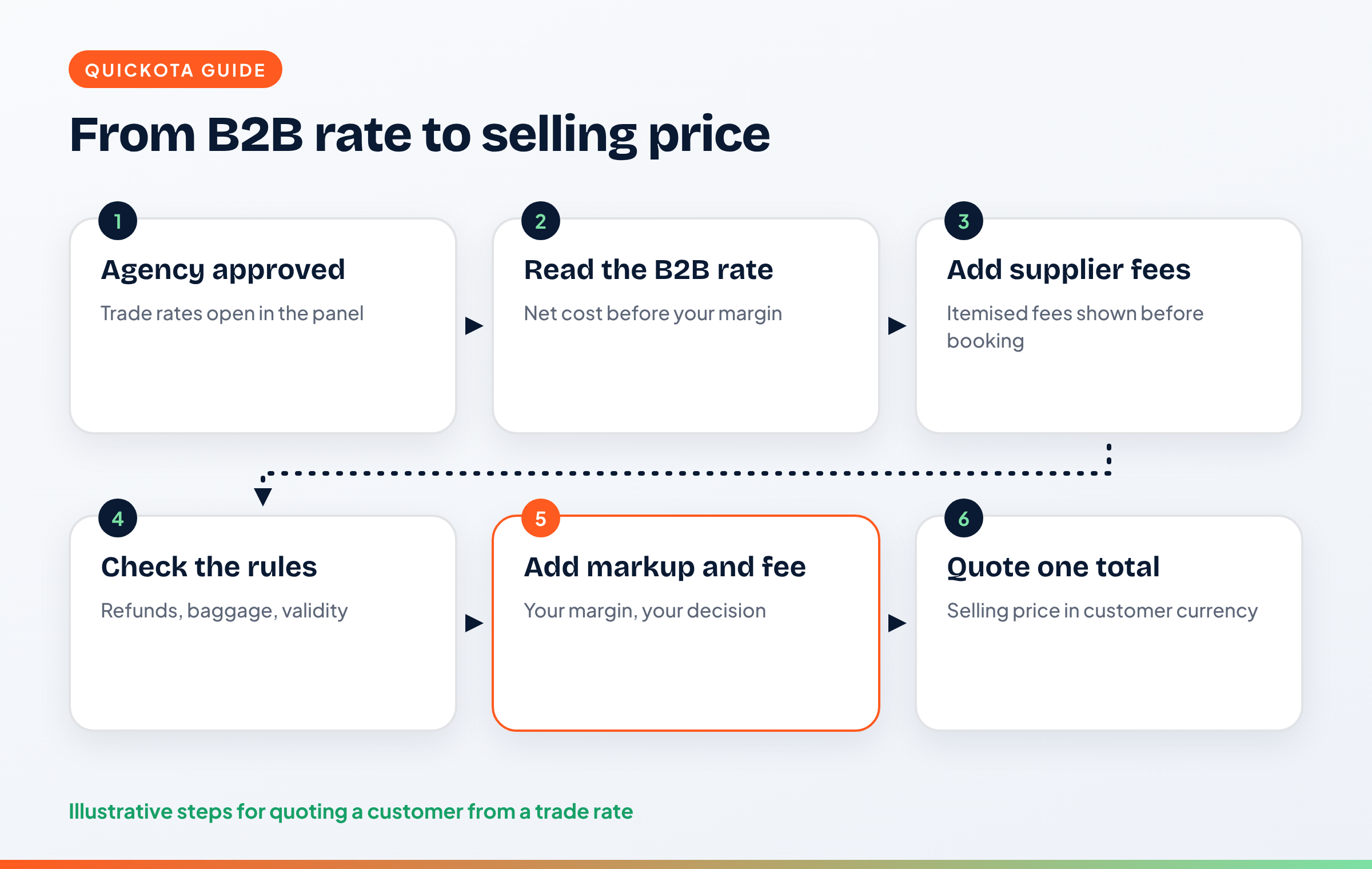
How do you quote a customer from a B2B rate?
Start from your full cost, not the headline B2B rate. Add any supplier fees and payment costs, check the conditions, then add your markup and service fee. Quote one total, with what is included and how long the price is valid.
Illustrative example (made-up numbers, not real prices): a customer wants a return flight and a tourist visa.
| Line | Amount |
|---|---|
| Flight B2B rate incl. taxes | USD 400 (illustrative) |
| Supplier issue fee | USD 8 (illustrative) |
| Visa B2B price | USD 90 (illustrative) |
| Your cost | USD 498 |
| Your markup on the flight | USD 25 (illustrative) |
| Your visa service fee | USD 20 (illustrative) |
| Selling price | USD 543 |
The customer sees USD 543, with baggage, the fare's change and refund conditions, and the visa processing time as an estimate. Your income is USD 45 before payment and staff costs. For a message template, see how to quote flights on WhatsApp.
What about currency and exchange rates?
Many B2B rates are shown in US dollars or the supplier's currency, while your customer pays in local money. Your rate and your bank's rate can differ, so build a small buffer into the conversion and name the currency on every quote.
Illustrative: if the cost above is USD 498 and you assume 1 USD = 10 local units (illustrative), the cost is 4,980 local units. If your bank later converts at 10.3, the same cost becomes 5,129, and most of a small markup is gone.
Why is the cheapest B2B rate not always the best one to sell?
A lower B2B rate can come with stricter rules: no refund, no free date change, no checked bag, or a supplier who is hard to reach after booking. If plans change, it can cost you more than it saved. Before choosing between two rates, check:
- Refund and change rules. What does a change cost, and is any part refundable?
- Baggage and inclusions. Is the bag, the meal or the breakfast included, or extra?
- Payment and validity. How long is the rate held, and when must you pay?
- Supplier support. Who answers if a flight is changed or a hotel overbooks?
- Total fees. Supplier service fees can make a lower rate the more expensive one.
How B2B rates work in QuickOTA
QuickOTA is a B2B travel platform. B2B Panel access is free and there is no setup fee. Send a partnership request, we review it, then we open your panel. Rates are shown in the B2B Panel after your agency is approved, not on the website, and you can search and compare fares before you top up.
You set your own markups and decide your own selling price. Service fees are itemised and shown before you book and in your booking details, and we don't add hidden markups to supplier prices. Flights are live, and visas for approved agencies are in the panel at B2B rates. You can also book hotels and tours in the panel.
You pay from a prepaid wallet. There is no credit line, and there is no minimum deposit: top up the amount you need for the booking. See the B2B Panel and pricing for more.
Common mistakes with B2B rates
- Treating the B2B rate as your cost. Add supplier fees and payment costs first.
- Publishing trade prices. Screenshots and low adverts can break supplier terms.
- Ignoring the conditions. A non-refundable rate needs a clear warning to the customer.
Frequently asked questions
What is the meaning of B2B rates?
B2B rates are trade prices that suppliers give to travel businesses, not to the public. They are usually net: the agency pays the B2B rate and adds its own markup and fees to set the price for its customer.
What is the difference between a net rate and a gross rate?
A net rate has no commission inside it; you earn by adding your own amount. A gross or commissionable rate already includes the agency's commission, so you sell at that price and keep or receive the commission. Check which one your supplier gives you before quoting.
Why can't I see B2B rates on a supplier's website?
Because the rates are for approved trade accounts only. Suppliers hide them behind a login, and many contracts say agencies must not publish them to travellers. You usually need to register, be approved and log in before prices appear.
What does B2B visa price mean?
It is the price a visa supplier charges an agency for a visa, often combining the official fee and a processing charge. Your agency adds its own service fee. Official fees and rules come from the destination country, so check the official source.
Does QuickOTA show its B2B rates publicly?
No. Rates are shown in the QuickOTA B2B Panel after your agency is approved, not on the website. B2B Panel access is free. Flights, hotels, tours, visas and group requests are all in the panel.