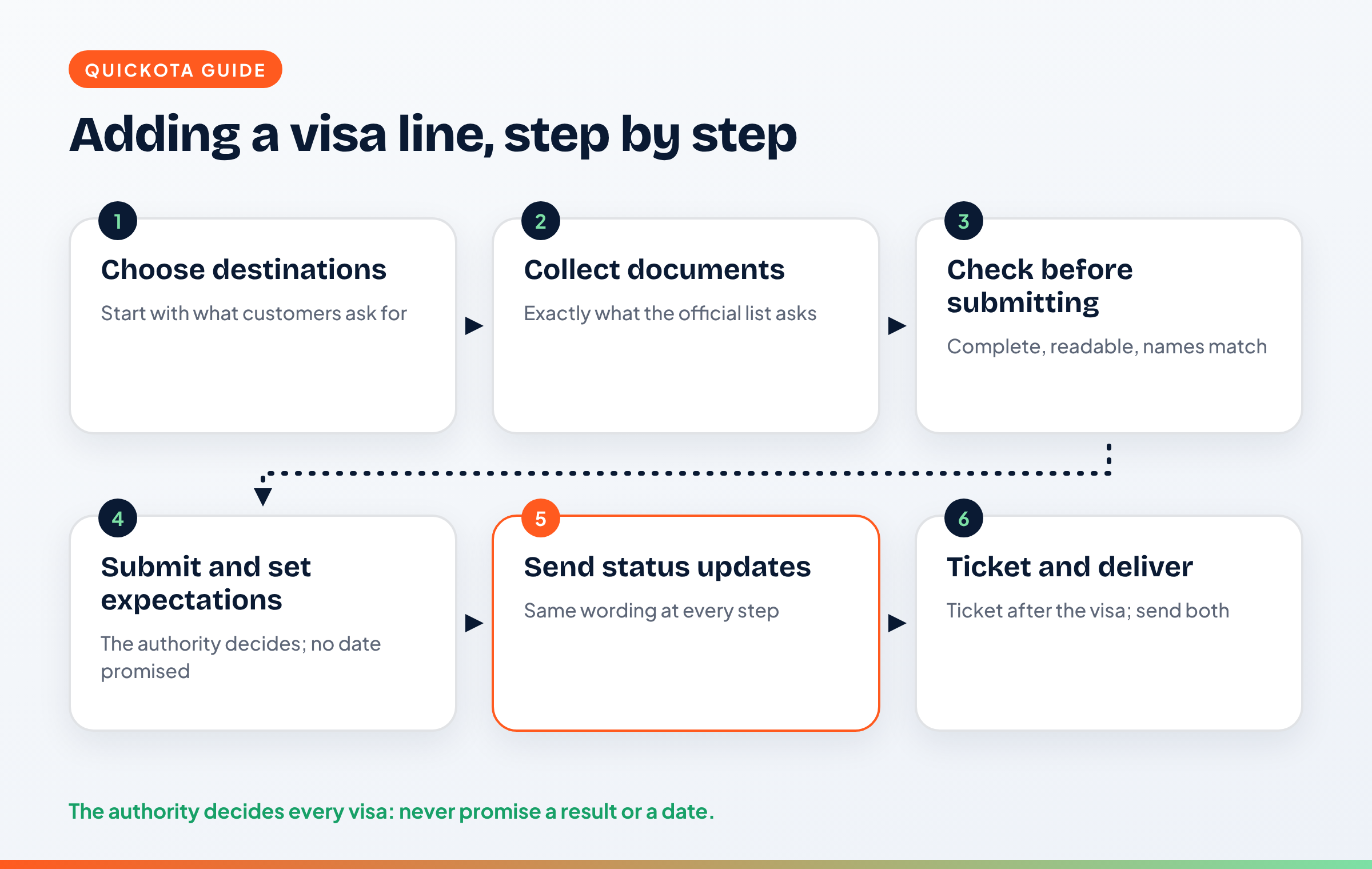
Short answer: An agency adds visas by starting with the destinations its flight customers already ask about, ordering through a B2B visa supplier, and running the same routine every time: collect what the official list for that visa asks for, check it before you submit, tell the customer that the authority decides, and send status updates. Price it as your cost plus a clear agency margin, and ticket the flight only when it is safe to.
This guide is for travel agencies and agents in the Gulf, East and Southern Africa and North Africa that already sell flights and want to sell visas too. It is about running a visa line as part of the business: the process, the customer conversation and the money. It does not give the rules for any visa. Those are on our visa pages for agencies and on each destination's official government site.
Key takeaways
- Start with two or three destinations your flight customers already ask about, not a long list.
- Use one document routine for every visa: collect what the official list for that visa asks for, then check it before you submit.
- Never promise approval or a date. The destination's authority decides, and processing time is outside your control.
- Price each visa as your cost plus a clear agency margin, and quote one total per traveller.
- Pair the visa with the flight: hold the seats, watch the deadline, and ticket a non-refundable fare only after the visa is issued.
Why should a flight agency add visas?
Adding visas makes sense when your flight customers already ask for them. A customer who needs a visa for a trip often wants the flight from the same agency, so the visa brings the booking to you instead of to a competitor. It also gives you a reason to talk to the customer before travel, which builds trust and repeat sales.
Agencies we hear from in Ethiopia, South Africa and Saudi Arabia ask about one thing more than any other: a reliable B2B source for the visas their customers want, with the UAE at the top of the list. The demand comes first, from customers planning holidays, family visits or business trips; the supplier comes second.
A visa line uses the same customers, the same WhatsApp conversations and often the same trip. Our guide on what a new travel agency should sell first explains why flights usually come first and visas follow once your after-sale work runs smoothly.
Which visa destinations should you offer first?
Offer first the destinations your customers already ask about. Look back at the last few months of enquiries and quotes: which trips needed a visa, and where did customers go elsewhere for it? Start with two or three of those, learn the process well, then add more. A short list you run well beats a long list you run badly.
A simple way to choose:
- List your flight enquiries by destination. Note which ones the customer said needed a visa.
- Mark the ones you lost. If a customer bought the flight elsewhere because of the visa, that destination is a strong candidate.
- Check your supplier offers it at B2B rates for agencies, with a clear document list for each visa.
- Read the destination page before you advertise it.
Illustrative examples of how agencies might choose:
- An agency in Addis Ababa whose customers ask about Dubai shopping and family trips starts with the UAE, then looks at Turkey.
- An agency in Johannesburg with holiday and business customers looks at the UAE and Kenya.
- An agency in Jeddah or Riyadh whose customers take short holidays looks at Egypt, Turkey and nearby Gulf destinations.
These are examples of demand, not advice on who needs which visa. Each customer's case depends on their nationality, residence and trip, and only the official rules decide it.
How do you collect documents without giving visa advice?
Collect exactly what the official list for that visa asks for, and nothing from memory. Open the current list for the visa each time you take an order, send it to the customer in writing, and tick off each item as it arrives. Your job is to gather and check, not to decide what the rules are.
A document routine that works for every destination:
- Open the current list every time. Lists change. Do not reuse last month's message or a list a colleague saved.
- Send the list in writing. One message per customer, with every item numbered, so nothing is lost in a long chat.
- Ask for clear files. Flat, well-lit scans or photos with all four corners visible. Ask again if a file is blurred or cut off.
- One folder per applicant. For a family, keep each traveller's files separate and named clearly.
If a customer asks whether they need a visa, or which one, send them to the destination's official site and our visa pages. Do not answer from experience. A wrong answer can cost the customer the trip.
What should you check before you submit?
Before you submit, check that every item on the official list is there, that every detail matches the passport, and that the travel dates match the flight you are holding. Most delays and rejected submissions start with a small error that a second look would have caught. Build the check into the routine, not into your memory.
A five-point check before each submission:
| Check | What to look at |
|---|---|
| Complete | Every item on the official list is collected, for every applicant |
| Readable | Each file is clear, complete and the right way up |
| Names and numbers | Names, passport numbers and dates match the passport letter by letter |
| Dates | The travel dates on the application match the flight you hold |
| Second pair of eyes | A colleague checks the file, or you check it again after a break |
Names matter most. Arabic, Amharic and other names can be spelt in Latin letters in several ways; copy them from the passport, never from a chat message.
How do you set expectations with the customer?
Tell the customer three things before you take payment: the destination's authority decides every application, the processing time is not in your control, and you will prepare a complete application and keep them informed. Say it in writing, in plain words. Customers accept uncertainty much better when they hear about it before they pay, not after.
Words that work:
- "We prepare and submit a complete application. The decision is made by the authorities of [destination]."
- "We cannot promise a date. We will update you as soon as the status changes."
- "Please do not book non-refundable hotels or tickets elsewhere until the visa is issued."
Avoid "approved for sure", "ready in two days" or anything that sounds like a promise of the result or the timing.
How do you keep customers updated on status?
Send a short update at each step: documents received, application submitted, status changed, visa issued. Use the same wording every time, so the customer knows what each message means. A customer who hears nothing for days starts calling, and a busy agency loses hours answering "any news?" messages.
Illustrative status messages (replace the brackets; no dates or promises):
Documents received for [name]. We are checking them now and will tell you if anything is missing.
Application submitted for [name] on [date]. The decision is made by the authorities of [destination]. We will message you when the status changes.
Visa issued for [name]. Your flight is now being ticketed. You will receive the visa and e-ticket together.
How should you price a visa service?
Price each visa as your cost from the supplier plus an agency margin that covers your time, document checks and follow-up. Quote one total per traveller, say what is included, and keep the same method for every destination. Customers compare, so a clear price with no surprises at the end does more for repeat sales than a low headline.
Points to decide once and write down:
- Your margin method. A fixed service amount per visa, or a percentage of the cost. Pick one and use it consistently.
- What the price includes. For example the document check, submission and status updates until the visa is issued.
- Visa plus flight. Quote the visa and the flight as one trip, with each part on its own line.
Our markup calculator helps you set a margin that keeps your profit on each sale.
How do you pair the visa with the flight?
Hold the flight with the exact passport names, note the ticketing deadline, and ticket a non-refundable fare only after the visa is issued, where the timing allows. If the visa takes longer or is refused, an unticketed hold costs the customer nothing, while a ticketed non-refundable fare can cost them a great deal.
What this looks like in practice:
- Quote the flight and the visa together so the customer sees the whole trip. Our WhatsApp quote guide shows how to lay out a flight quote.
- Hold the seats once the customer decides and has sent the documents.
- Watch the deadline. A hold expires at the ticketing deadline. If the visa is not issued in time, tell the customer and agree whether to let the hold go, hold again later, or choose a fare that is easier to change. Read flight holds and ticketing deadlines before you rely on a hold.
- Ticket after the visa is issued, then send the visa and the e-ticket in one message.
- If the customer insists on ticketing early, explain the fare's change and refund rules in writing first. Our guide to refunds and date changes explains what to check.
Never issue or sell a "dummy ticket" to support a visa application.
How should you store customer documents and records?
Treat passport copies as private. Collect them in a one-to-one chat or by email, never in a group, store them in one protected place, and delete what you no longer need. Keep a simple record of each order, so anyone in your team can answer the customer.
A record for each visa order:
- Customer name and contact, applicant names as in the passport
- Destination and the flight booking reference it belongs to
- Date documents were complete, date submitted, current status
- Amount charged and the cost
- Notes of what you told the customer, including the expectation message
Limit who in your team can open the files. You are responsible for meeting your own country's rules for selling travel and for looking after your customers' personal data.
How to add visas with QuickOTA
QuickOTA is a B2B travel platform. Visas for UAE (Dubai), Saudi Arabia, Qatar, Kuwait, Bahrain, Oman, Jordan, Lebanon, Egypt, Iraq, Azerbaijan, Georgia, Turkey, Malaysia, Thailand, Indonesia (including Bali), Singapore, Kenya (eTA) and Cuba are in the QuickOTA B2B Panel for approved travel agencies, at B2B rates. Prices are not published on the website. QuickOTA arranges Cuba visas through a partner; it is not a Cuban consulate.
You order visas in the same panel where you search, hold and ticket flights. QuickOTA is not an embassy and does not decide visa applications. B2B Panel access is free, with no setup fee and no minimum deposit, and QuickOTA does not require IATA accreditation. To get access, send a partnership request with "Visa" ticked: we review it, ask for anything else we need, then open your panel. You need a registered company or a valid travel agency (tourism) licence from your country. See visas for agencies for the destination pages.
Common mistakes when adding visas to an agency
- Starting with too many destinations. Begin with the two or three your customers ask about.
- Answering visa questions from memory, or reusing an old document list. Open the current official list for every order.
- Promising approval or a date. The authority decides, and timing is outside your control.
- Ticketing a non-refundable fare before the visa is issued. Hold first, ticket after.
- Keeping passport copies in group chats. Use private channels and delete what you no longer need.
Frequently asked questions
How does a travel agency start selling visas?
Pick the destinations your flight customers already ask about, find a B2B supplier that offers them to agencies, and set up one routine: collect what the official list asks for, check it, submit, update the customer, then ticket the flight. Start small and add destinations once the routine works.
Where can my agency find a B2B visa supplier?
Look for a supplier that works only with agencies, shows a clear document list for each visa and lets you follow each order. QuickOTA offers visas for approved travel agencies in its B2B Panel at B2B rates. Send a partnership request to get access.
Should I tell customers which visa they need?
No. Send them to the destination's official government site and our visa pages. Your role is to collect and check what the official list asks for and submit a complete application.
Should I book the flight before the visa is issued?
Hold the flight with the exact passport names and watch the ticketing deadline. Where the timing allows, ticket a non-refundable fare only after the visa is issued, so a delay or refusal does not cost the customer the ticket.
Can travellers order visas from QuickOTA directly?
No. QuickOTA works only with travel agencies. Travellers should contact a travel agency or apply through the destination's official channel.