Short answer: For flights, take full payment before you issue the ticket, and set your own payment cut-off before the airline's ticketing deadline. Use deposits for trips paid in stages, such as groups and packages, with a written schedule. Confirm every transfer has arrived before you ticket, give a receipt for every payment, and refund only on written rules you agreed at the start.
New agencies lose money on payments more often than on prices: a ticket issued before the transfer arrived, a deposit with no written terms, or a refund promised before the airline approved it. This guide is a simple payment routine for a new agency. It covers what to ask for and when, how to handle bank transfers, cash and cards, what to put in writing, and how to handle refunds without losing money or customers. Rules on invoices, tax and consumer refunds differ by country, so check your own country's rules for selling travel.
Key takeaways
- Airline tickets are paid in full before ticketing. A held seat is not a sold seat.
- Set your own payment cut-off a few hours before the airline's ticketing deadline.
- Ticket only when money has arrived in your account, not when a customer sends a screenshot.
- Write your payment and refund terms once, send them with every quote, and keep the customer's "OK".
- Refund what the airline refunds, minus the fees you explained in advance, to the person who paid.
When should you ask for full payment, and when for a deposit?
Ask for full payment before ticketing on flights, because you usually pay your supplier in full when the ticket is issued and the fare is not fixed until then. Use a deposit only for products paid in stages: group trips, packages, or services booked months ahead, with the balance due on a fixed date.
| What you sell | Usual payment pattern | Why |
|---|---|---|
| Single flight ticket | Full payment before ticketing | You pay the supplier in full at ticketing; the fare can change until then |
| Family booking on one PNR | Full payment for everyone before ticketing | All names are usually ticketed together |
| Group trip (Umrah, wedding, study tour) | Deposit, then instalments, then final balance | Quotes and payment schedules run over weeks or months |
| Package (flights plus hotel or tour) | Deposit to confirm, balance before final documents | Parts are paid at different times |
| Visa service | Payment before you submit the application | Fees are usually not returned once an application is submitted |
How much deposit? There is no single rule. Base it on what you must pay your own suppliers and when, plus what you would lose if the customer cancels. Write the amount, the due dates and what happens if a date is missed.
How do you set a payment cut-off before the ticketing deadline?
Every held booking has a ticketing deadline set by the fare. Set your own payment cut-off earlier, so you have time to confirm the money and issue the ticket. If the customer has not paid by your cut-off, release the seats or extend the hold only if the fare allows it.
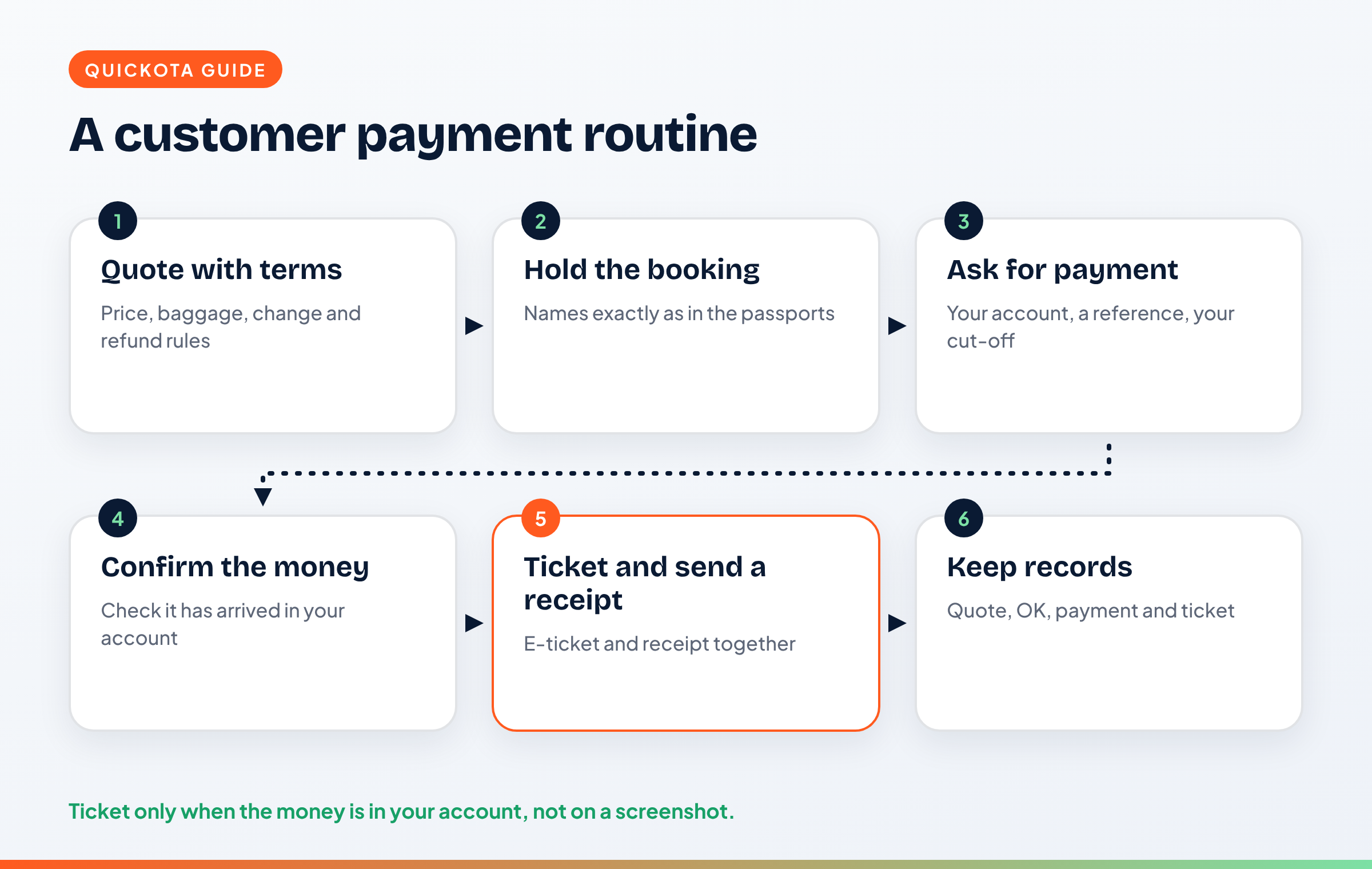
A simple routine: 1. Quote with terms. Total price, what is included, baggage, the change and refund rules, and your payment cut-off. 2. Hold with the names exactly as in the passports. 3. Ask for payment with clear instructions: amount, currency, your company's account name, the reference to use and the cut-off time. 4. Confirm the money in your own bank or payment account. 5. Issue the ticket and send the e-ticket with a receipt. 6. Keep records of the quote, the customer's agreement, the payment and the ticket.
Illustrative example: a hold has a ticketing deadline of 18:00 tomorrow. You set your cut-off at 12:00 tomorrow. The customer pays at 11:30, you see the money at 12:15, and you ticket by 13:00. If the customer pays at 17:30, you may not have time to confirm it.
Our guide to PNRs, holds and ticketing deadlines explains holds in more detail.
How do you take bank transfers safely?
Ask customers to pay into an account in your agency's name, with a reference you give them, such as the booking reference or the customer's surname. Ticket only after the money shows in your account. A screenshot or a transfer slip shows that a payment was sent, not that it arrived.
Good habits: - One account, your company's name. It looks professional and keeps records clean. - A clear reference. Ask for the booking reference or the lead passenger's surname in the transfer note. - Check the amount and currency. Bank charges or exchange can make the amount that arrives smaller than the amount sent. Say who pays the bank charges. - Allow for timing. Transfers between banks or countries can take longer than the customer expects. Ask international customers to pay earlier. - Watch for scams. Be careful with overpayments followed by a request to "send back the difference", and with changes of payer at the last minute.
What about cash, cards and mobile payments?
Accept the methods your customers already use, but give a receipt for every payment and know the risks of each. Cash needs a signed or printed receipt. Card payments are convenient but can be disputed later. Mobile wallets and transfer apps are common in many markets, so check the money has arrived before you ticket.
| Method | Good for | Watch out for |
|---|---|---|
| Bank transfer | Most bookings | Time to arrive, bank charges, fake screenshots |
| Cash at the office | Walk-in customers | Receipts, safe storage, counting in front of the customer |
| Card (in person or online) | Online sales and larger amounts | Provider fees and disputes (chargebacks) after travel |
| Mobile wallet or payment app | Customers who do not use banks | Limits, fees, and confirming the money arrived |
Whatever the method, record who paid, how much, when, and for which booking. If your country requires invoices or tax on travel services, follow those rules for every payment.
What should your payment and refund terms say?
Your terms should say how much the customer pays and when, what happens if they pay late, how changes and cancellations work, and how refunds are calculated and paid. Keep them short, in plain language, and send them with every quote. Ask the customer to reply "OK" before you hold or ticket.
Cover these points: - Payment: full payment before ticketing for flights; deposit and due dates for groups and packages. - Late payment: the hold is released and the price may change. - Changes: possible only if the fare rules allow; the customer pays the airline's fee, any fare difference and your service fee. - Cancellations and refunds: the refund depends on the fare rules; you refund what the airline refunds, minus the fees stated. - No-shows: on many fares a missed flight can mean no refund and can cancel the return. - Timing: refunds are paid after the airline or supplier returns the money. - Who receives the refund: the person who paid, by the same method where possible.
Illustrative message to send with a quote:
Total for 2 adults: [amount]. Includes [baggage]. Changes: [rule]. Refund: [rule]. Please pay by [time, day] to [company name, account]. Reference: [booking ref]. I issue the tickets when the payment arrives.
How do you handle a flight refund for a customer?
Check the fare rules first, ask your supplier for a refund quote, and tell the customer the expected amount and timing before you promise anything. Refund the customer after your supplier credits you, minus the fees you explained at the start. Keep the airline's or supplier's refund note as your record.
Step by step: 1. Read the fare rules for the ticket: refundable, partly refundable or non-refundable. 2. Request a refund quote from your supplier and wait for the figure. 3. Tell the customer the amount they will receive, the deductions and roughly when. 4. Submit the refund once the customer agrees. 5. Pay the customer when your supplier has credited you, and send a short note with the figures.
Taxes and fees on a ticket follow their own rules. Some may be returned even on a non-refundable fare. Ask your supplier rather than guessing. Our guides to flight changes, cancellations and refunds and airline refunds and date changes on Gulf and Egyptian airlines go further.
How to manage payments with QuickOTA
QuickOTA is a B2B travel platform. You pay for bookings from a prepaid wallet, which can be topped up online or by bank deposit, with a transaction ledger and low-balance alerts. There is no minimum deposit: top up your wallet with the amount you need for the booking. You can search and compare fares before you top up, so you can quote first and top up when the customer pays.
In the B2B Panel you search, hold and ticket flights, and service fees are itemised and shown before you book and in your booking details. You request changes, cancellations and refunds from your panel and see the quote before you accept. Approved refunds are credited back to your QuickOTA wallet. For groups, send group requests and get a quote from our team, then pay in instalments from your wallet and manage the passenger list in the panel. B2B Panel access is free, with no setup fee. To open an agency account you need a registered company or a valid travel agency (tourism) licence from your country.
Common mistakes with customer payments
- Ticketing on a screenshot. Wait until the money is in your account.
- No written terms. Disputes start when the customer remembers a different promise.
- Taking payment on the deadline day. Set your own cut-off earlier.
- Mixing personal and business money. Use an account in your agency's name.
- Promising a refund amount before the airline confirms it. Give the figure only after the refund quote.
- Refunding before your supplier credits you. You may end up paying twice.
Frequently asked questions
Should a travel agency take a deposit for flight tickets?
For a single flight, usually no: ask for full payment before ticketing, because you pay your supplier in full when the ticket is issued. Deposits suit group trips and packages paid in stages, with the balance due on fixed dates.
Can I hold a flight without the customer paying?
Usually yes, until the ticketing deadline that the fare sets. A hold is not a ticket, and the fare can change before ticketing. Set your own payment cut-off before the deadline.
What if a customer's bank transfer arrives late?
If the money arrives after the deadline, the hold may have expired and the fare may have changed. Requote the booking, explain the new price, and refund or apply the payment as your terms say.
How long do flight refunds take?
It depends on the airline, the fare and the supplier. Tell the customer you will pay their refund once your supplier credits you, and give an estimate only from your supplier's information.
Can I charge a fee for handling a refund or a change?
Many agencies charge a service fee for changes and refunds. State it in your terms and in the quote before booking, and make sure it follows your country's rules.
Should I accept card payments as a new agency?
Cards are convenient for online sales, but providers charge fees and customers can dispute payments. Start with methods you can confirm easily, and add cards when you sell online.