Short answer: How do airline consolidators work? A consolidator buys access to airline fares at trade level, through contracts, negotiated deals or its own ticketing authority, and sells those seats to travel agencies. You book through it, it issues the ticket under its own accreditation, and you resell at your own price. You pay it by deposit, prepaid balance or credit, and it handles voids, reissues and refunds with the airline for you.
Many agencies buy from a consolidator every day without seeing the chain behind the ticket. This guide explains how its fares are made, who issues your ticket, how money moves, what happens after the sale and how to check a ticket. For the short definition, see our glossary entry on consolidators.
Key takeaways
- A consolidator sells flights to the trade only. It earns from its margin or its fees.
- Consolidator fares are usually net fares from airline contracts or negotiated deals.
- The ticket is issued under the consolidator's ticketing authority. You still own the customer.
- Deposit, prepaid balance and credit each put your cash at risk in a different way.
- A real ticket has a ticket number you can check with the airline. A screenshot is not proof.
What does an airline consolidator do?
An airline consolidator does four jobs for agencies: it gives access to fares, issues tickets, takes payment and handles changes and refunds with the airline. In return, it adds a margin or a fee. Agencies use one so they do not need their own airline contracts or ticketing set-up.
You will also hear "air ticket consolidators", "wholesale airline ticket consolidators" and "flight ticket wholesalers". In most markets these names mean the same kind of business. Some work in many countries; others serve one city or one community, such as diaspora routes from Europe.
How do airline consolidators work, step by step?
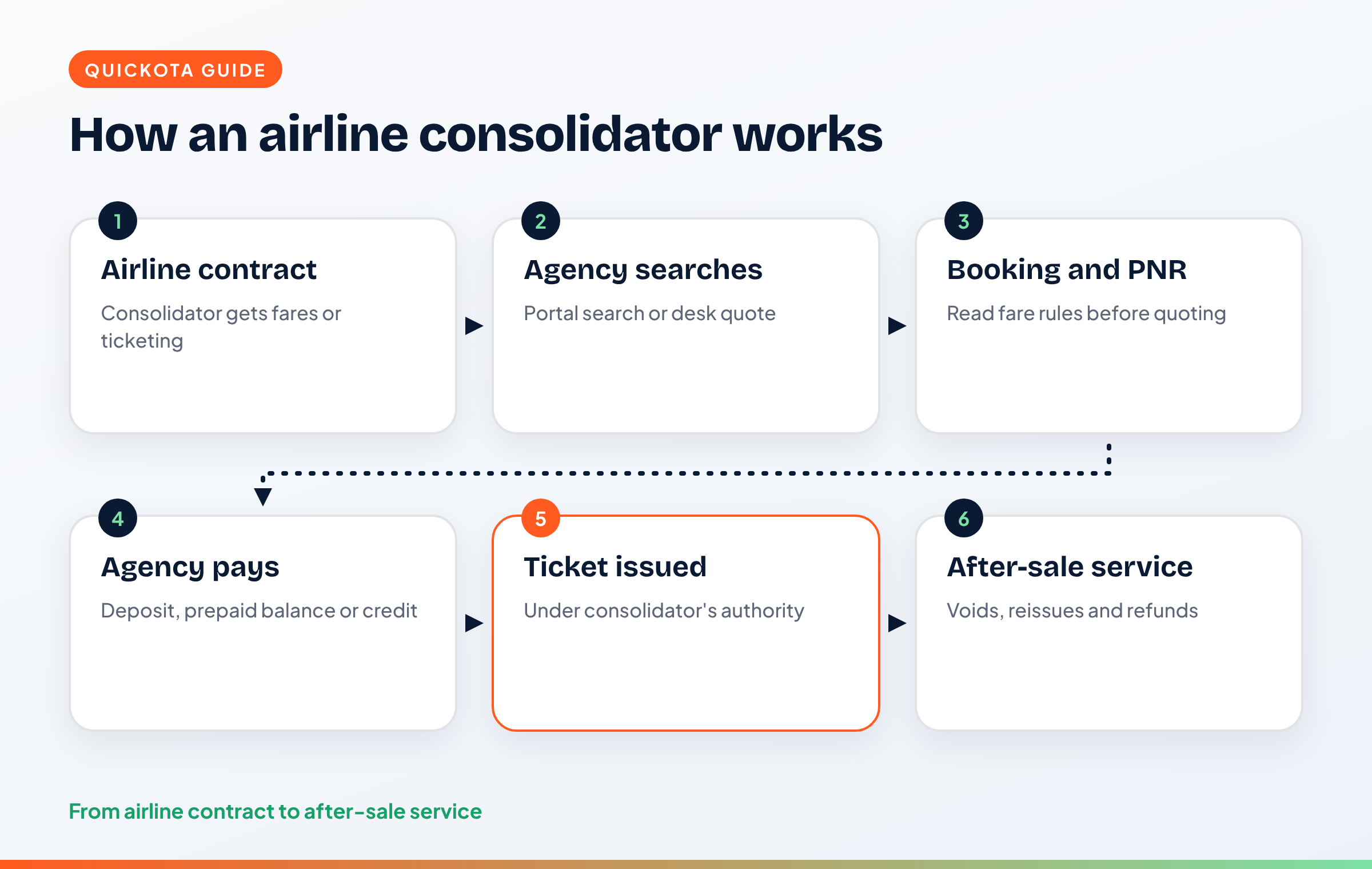
The steps are the same by phone, message or online portal:
- The airline and the consolidator agree terms for fares, ticketing rights or both.
- The consolidator loads its fares into its booking system or sends price lists.
- You search or ask its desk for a quote when a customer asks for a flight.
- You book, which creates a PNR, and read the fare rules before you quote.
- You pay the consolidator before the ticketing deadline.
- The consolidator issues the ticket and you send the e-ticket to your customer.
- After the sale, changes and refunds go back through the consolidator.
Note the two contracts: airline with consolidator, and consolidator with your agency. Usually your agency has no direct airline contract for that ticket.
Where do consolidator fares come from?
Consolidator fares are fares an airline gives the trade through a consolidator, usually at a net price with no commission. The consolidator adds its margin, and you add yours. So a "consolidator fare" simply means a trade fare that reaches you through a middle company, not the public price.
Agencies see two broad kinds of fare:
- Published fares are the public fares the airline files. Every seller sees the same base price, with a small airline commission or none.
- Contracted or negotiated fares are agreed between the airline and a seller, often for volume on certain routes or seasons, and are not shown to the public. With no commission built in, this is a net fare.
Why would an airline offer a lower price? In general terms, the consolidator brings sales from many small agencies the airline could not reach one by one, and may help fill seats in a quiet season.
For your agency, this means two things. Contracted fares come with rules on who can buy them, for which dates, and whether you may show the net price. And not every consolidator fare is cheaper: on some days the published fare wins, so compare before you quote.
Who issues the ticket when you book through a consolidator?
The consolidator issues the ticket under its own ticketing authority, not your agency. In many markets it holds IATA accreditation and reports sales through the BSP, which settles money between accredited agents and airlines. Some issue under a direct airline agreement instead.
What this means in practice:
- The ticket is the airline's. The number is normally 13 digits, and the first three are usually the airline's code.
- The issuing office is the consolidator's, not your agency's, and it answers to the airline for that sale.
- The customer is still yours. You quote, take payment and look after the traveller.
So the consolidator's accreditation, airline relationships and after-sale team stand behind every ticket you sell. For agencies without accreditation, see can a non-IATA travel agency issue airline tickets?
How do you pay a consolidator: deposit, prepaid or credit?
Consolidators use three main payment models: a fixed deposit, a prepaid balance you top up, or credit you settle by an agreed date. Many start new agencies on deposit or prepaid and offer credit only later.
| Model | How it works | What it means for your cash | What to ask |
|---|---|---|---|
| Deposit | You pay a fixed sum that stays with the consolidator as security, and you may book against it | Money is locked up even when you are not selling | Is it refundable, and how fast, if you stop? |
| Prepaid balance (wallet) | You top up; each ticket is paid from the balance | You only send what you need, but you must top up before ticketing | Is there a minimum top-up? How quickly is a transfer credited? |
| Credit | You book now and settle weekly, fortnightly or monthly | Helps cash flow, but debt builds fast in busy seasons | What is the limit, what security is needed and what happens if you pay late? |
Always ask for a statement that matches every ticket to a payment. For a fuller comparison, read credit line or prepaid wallet?
What happens after the sale: voids, reissues and refunds?
After ticketing, every change goes through the consolidator, because the ticket sits in its system. It checks the fare rules, quotes you the cost and then acts. You cannot void or reissue a ticket another office issued.
- Void: cancelling soon after issue, usually the same day. Each consolidator sets its own cut-off. See void.
- Reissue: a new date or route, usually for a change fee, any fare difference and the consolidator's service fee.
- Refund: the airline approves the amount, then it comes back to you through the consolidator, which can take time.
- Schedule change: the consolidator should tell you, so you can offer the customer options.
Ask how you send requests and where refund money goes. See flight changes, cancellations and refunds for detail.
How do travel agencies earn money with a consolidator?
You earn the difference between your price to the customer and your cost from the consolidator. On a net fare that is your markup, and some agencies add a service fee. Airline commission on consolidator fares is usually small or not offered.
Illustrative example (round numbers, not real fares): the consolidator charges you 400. You add a markup of 30 and a booking fee of 10, so the customer pays 440. A later date change carries the airline and consolidator charges, plus any handling fee of yours.
Count every consolidator fee in your real cost, because a thin margin can vanish after one surprise charge. For how commission, markup and fees fit together, read do travel agents get commission on flights?
Consolidator, B2B portal or GDS: what is the difference?
A consolidator is a business that sells and tickets flights for the trade. A B2B portal is an online tool to search, book and pay, and many consolidators offer one. A GDS is a booking system used directly by agencies with their own ticketing set-up.
| Consolidator (desk or phone) | B2B portal | GDS | |
|---|---|---|---|
| What it is | A trade seller with a ticketing desk | Online booking tool for agencies | Global booking system used by ticketing offices |
| Who issues the ticket | The consolidator | The portal's ticketing company | The agency, if it holds ticketing authority |
| Skills you need | Basic route and fare knowledge | Basic web use and fare rules | Formal training in commands or the GDS interface |
| Speed of quotes | Depends on desk hours | Instant search | Instant search |
| Best for | Special or group fares, complex trips | Daily bookings across many airlines | Accredited agencies with volume |
Many agencies mix them: a portal for daily trips, a consolidator desk for a hard itinerary. On GDS training, read do you need to learn Amadeus or Galileo? On direct airline accounts, see airline agent portals vs a B2B portal.
Are airline ticket consolidators legit?
Yes. Consolidators are a normal, long-standing part of the airline trade. But the word proves nothing: some sellers use it without any ticketing authority. Judge each one by its tickets and its company.
To check a ticket:
- Ask for the e-ticket receipt, not a screenshot. It should show the ticket number, passenger name and flights. See e-ticket.
- Find the booking on the airline's own website or app with the airline's booking reference and the surname. This reference can differ from the consolidator's own.
- Look for the ticket number there. A booking without one may be only a hold.
To check the company, see how to choose a B2B flight supplier, and for a supplier in another country, choosing a UAE ticket wholesaler.
Red flags with flight ticket wholesalers
Be careful when a seller cannot show how its tickets are issued. Watch for:
- Tickets you cannot find on the airline's site, or "tickets" sent as edited PDFs or images.
- Fares that make no sense for the route and season, with no rules attached.
- A hold presented as a ticket. The customer arrives at the airport and the booking has expired.
- No written after-sale process. Refunds are "being processed" for months with no reference.
- Payment requests to personal accounts or to a company with a different name.
- No answer to a simple question: "Under whose ticketing authority will this be issued?"
Two or more of these? Stop booking there until you have clear answers in writing.
How QuickOTA fits
QuickOTA is a B2B travel platform by InnoFirm Sdn. Bhd., Kuala Lumpur. You search, hold and ticket flights in the B2B Panel, which shows flight content from multiple suppliers, including GDS and consolidator sources, and QuickOTA issues the ticket for your booking. QuickOTA does not require IATA accreditation. You are responsible for meeting your own country's rules for selling travel.
Payment is by prepaid wallet only, with no credit and no minimum deposit. Service fees are itemised and shown before you book and in your booking details. Request changes, cancellations and refunds from your panel; you see the quote before you accept. Approved refunds are credited back to your QuickOTA wallet.
B2B Panel access is free, with no setup fee. Visas for 19 destinations and group requests are live, and you can also book hotels and tours in the panel. You need a registered company or a valid travel agency (tourism) licence from your country. See the B2B Panel page, or the Middle East page for Gulf agencies.
Frequently asked questions
What is the meaning of consolidator fares?
It is an airline fare sold to agencies through a consolidator, usually at a net trade price from a contract or negotiated deal, not the public fare. You add your own markup, and the fare may carry its own sale rules.
Are consolidator tickets the same as tickets bought from the airline?
Yes, once issued. It carries an airline ticket number and the passenger flies on it in the same way. The difference is that the consolidator handles changes and refunds, so your agency is the customer's first contact.
What does an airline consolidator for travel agents need from my agency?
Each sets its own rules. Most ask for company or licence details, contacts and a payment method; some want trading history before credit. Get the list in writing.
Can I void or reissue a consolidator ticket myself?
Usually not. Only the issuing office can void or reissue it, so you ask the consolidator. Check its void cut-off and how it quotes a change before you accept.
Is QuickOTA an airline consolidator?
QuickOTA is a B2B travel platform. Agencies book flights in the free B2B Panel, QuickOTA issues the ticket for each booking, and payment is from a prepaid wallet with no credit.