Short answer: Traders from the Gulf and Africa usually fly to Guangzhou, Shanghai or nearby cities to buy goods, often around the big trade fairs. To sell them well, ask which markets they will visit, quote open-jaw or multi-city trips where it saves time, check baggage carefully, prefer flexible return dates, and hold early for fair seasons.
China is one of the most requested destinations among agencies that work with business customers. Many traders in Dubai, Riyadh, Muscat, Baghdad, Cairo, Khartoum, Nairobi, Addis Ababa, Lagos and Accra go to China several times a year to visit factories, wholesale markets and trade fairs. They are loyal customers when an agency understands their trips. This guide explains how those trips usually work, what traders need from a ticket, and how to quote, hold and change bookings. It does not cover visa or entry rules for China: send customers to the official Chinese government sources.
Key takeaways
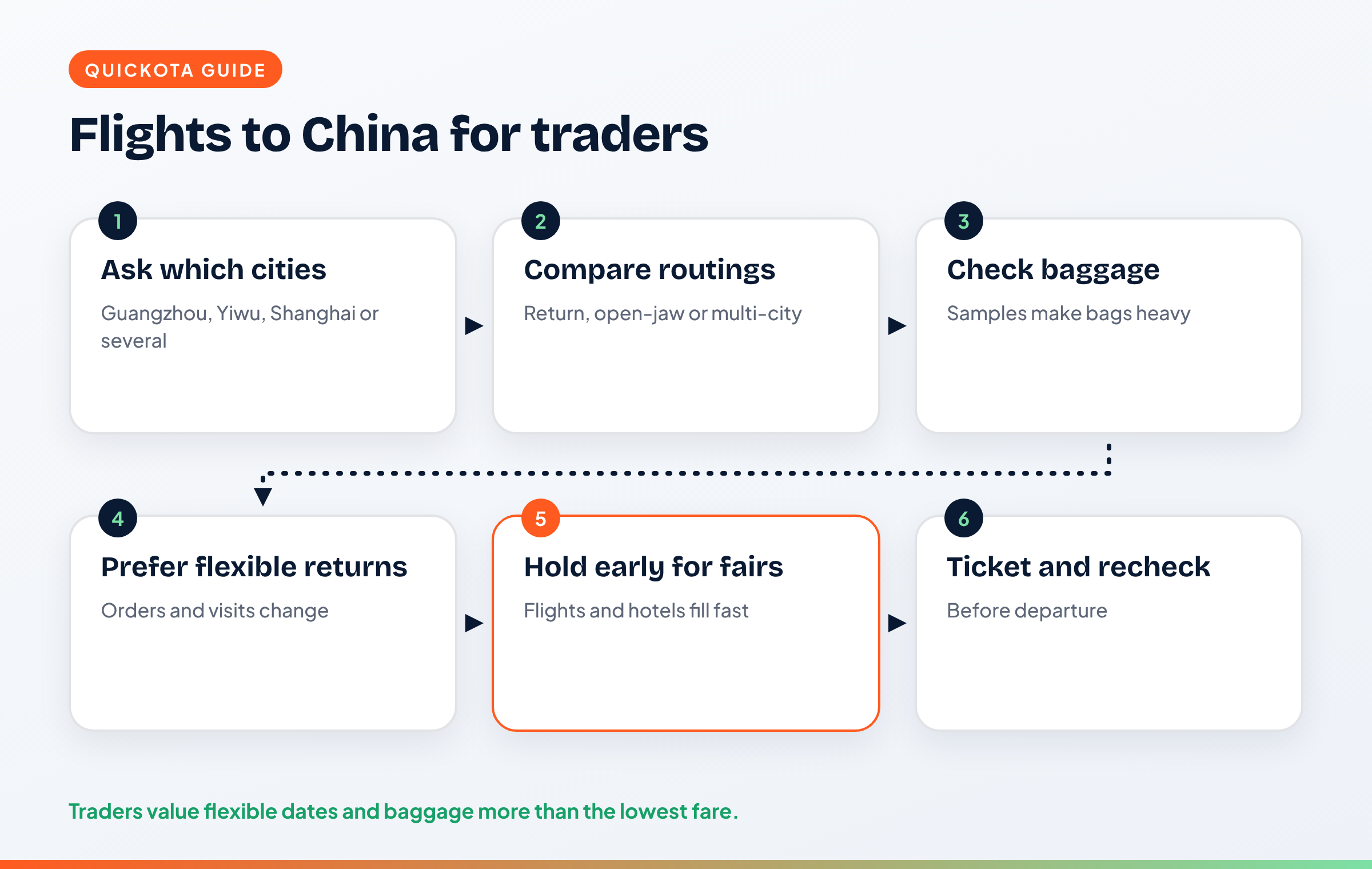
- Ask where the trader is going: Guangzhou, Yiwu, Shanghai, Shenzhen or several cities.
- Multi-city or open-jaw trips can save a day of travel. Compare them with simple returns.
- Flexible return dates are often worth more to traders than the lowest fare.
- Check checked baggage carefully. Samples and goods make bags heavy.
- Plan around the big trade fairs, when flights and hotels fill early.
Why do traders from the Gulf and Africa fly to China?
Traders fly to China to choose suppliers, check quality, order goods and visit trade fairs. Many import clothing, electronics, building materials, furniture, auto parts and household goods for shops at home. Trips are usually short and busy, and plans change when an order is delayed, so flexibility matters.
| City | Why traders go | What to ask |
|---|---|---|
| Guangzhou | Wholesale markets and the large trade fair held there | Fair dates, hotel area, length of stay |
| Yiwu | Small commodities markets | How they will reach Yiwu from the arrival city |
| Shanghai | Trade shows, offices of suppliers and agents | Which exhibition centre, onward travel |
| Shenzhen | Electronics suppliers | Arrival via Shenzhen or a nearby city |
| Several cities | Factory visits across regions | Multi-city routing and domestic legs |
Which cities and routes should you quote?
Start from the cities the trader must visit, then compare a simple return with a multi-city or open-jaw ticket, for example arriving in one city and leaving from another. Many routes involve a connection. Compare total travel time, the connection airport, baggage on each flight and the change rules before you recommend one option.
Points to check: - Arrival city. Yiwu has a small airport. Many traders reach it by train or road from a larger city such as Shanghai or Hangzhou, but routes and schedules change, so check what suits the trip. - Open-jaw. Arriving in Guangzhou and leaving from Shanghai, or the reverse, can save a domestic flight or a long train ride. - Connection. One ticket with a connection is usually protected if the first flight is late. Separate tickets are not. - Domestic legs. If the trader needs flights inside China, ask whether you should book them or whether the trader's local agent will.
Airline names traders often search for include China Southern Airlines, Emirates, Qatar Airways, Etihad, Ethiopian Airlines, Kenya Airways and Saudia. Do not promise an airline, a direct flight or a connection until you have seen it in your search on the day.
How do trade fairs change demand?
The big trade fairs bring many traders to the same city in the same weeks, so flights and hotels fill early and fares rise. Guangzhou hosts a very large import and export fair in spring and autumn, and Shanghai hosts many trade shows through the year. Ask your traders which fair they plan to visit and hold early.
- Check the official dates on the fair organiser's website before you quote. Our events calendar lists some trade shows in China with dates taken from official sources.
- Hold early with passport names once the trader confirms.
- Plan the return around the fair's phases if the trader is visiting more than one.
- Remind traders that hotels near fair venues also fill early.
What do traders need from a ticket?
Traders usually value flexibility and baggage more than the lowest fare. Orders get delayed, factories ask for another visit, and samples add weight. Quote a fare with a change rule that suits the trip, write the baggage on every flight, and explain the cost of changing the return before the trader pays.
A trader's quote should show: - Route and dates, including any open-jaw or multi-city legs. - Checked baggage per flight, and whether extra baggage can be added. - The change rule and an example of what a date change may involve. - The refund rule. - Your deadline to hold the price.
Illustrative message:
Dubai → Guangzhou on [date], Shanghai → Dubai on [date]. Checked baggage: [allowance] on each flight. Date changes: allowed with a fee plus any fare difference. Refund: [rule]. Held until [time]. Total: [amount].
How do you handle baggage, samples and goods?
Read the checked allowance on the fare for each flight, write it in the quote, and remind traders that heavy samples can cost more at the airport than adding baggage in advance. Goods for sale usually travel as cargo, not baggage. Do not advise on customs rules: send traders to the official customs authority in their country.
- Compare a fare that includes more baggage with buying extra baggage, where the airline allows it.
- Warn traders that the two flights of a connection can have different allowances.
- Tell traders to check the airline's rules on batteries, electronics and liquids before packing samples.
Our guide to checked baggage explains how to present allowances to customers.
How do you manage repeat traders?
Traders often travel several times a year. Keep a simple file for each one: passport names exactly as printed, preferred cities and airlines, baggage needs, and how they like to pay. Reply fast when they message, because many book with the agent who answers first.
- Save passport details securely and ask the trader to confirm them before each booking.
- Note the expiry date of each passport.
- Keep a short list of each trader's usual routes and fair dates.
- Recheck tickets a few days before departure and after any schedule change.
How to sell flights to China with QuickOTA
QuickOTA is a B2B travel platform. In the B2B Panel you search, hold and ticket flights and check the fare rules before you book. You can search and compare fares before you top up, and service fees are itemised and shown before you book and in your booking details. You request changes, cancellations and refunds from your panel and see the quote before you accept, and approved refunds are credited back to your QuickOTA wallet.
QuickOTA works with travel agencies in any country that meet the eligibility rules: a registered company or a valid travel agency (tourism) licence from your country. QuickOTA does not require IATA accreditation: QuickOTA issues the ticket for your booking. For trade delegations travelling together, send a group request and get a quote from our team. B2B Panel access is free, with no setup fee and no minimum deposit.
Common mistakes when selling China trips to traders
- Quoting the lowest fare without checking the change rule a trader will need.
- Ignoring open-jaw options that save a day of travel.
- Assuming baggage is the same on every flight of the journey.
- Waiting to hold during fair seasons.
- Booking Yiwu trips without checking how the trader will reach Yiwu.
- Giving visa or customs advice. Send traders to the official sources.
Frequently asked questions
Which city should traders fly into for the Guangzhou fair?
Usually Guangzhou, but compare nearby airports if fares or schedules suit better. Check the official fair dates and hold early, because flights and hotels fill fast.
How do traders get to Yiwu?
Many fly into a larger city such as Shanghai or Hangzhou and continue by train or road. Check the current options and quote the flight to the city that suits the trader's plan.
Is an open-jaw ticket better for China trips?
Often, if the trader visits more than one city. Arriving in one city and leaving from another can save time and a domestic flight. Compare it with a simple return on price, baggage and rules.
Should traders buy flexible tickets?
For many traders, yes. Orders and factory visits often change. A fare with a reasonable change rule can cost less overall than a cheaper fare that is expensive to change.
Can I book a trade delegation as a group?
Yes. For larger groups travelling together, send a group request with the dates, route and number of travellers, and get a quote from the QuickOTA team.
Where do traders check visa rules for China?
On the official Chinese government and embassy websites. Do not give visa advice yourself.