Short answer: No agency can guarantee that an AI assistant will recommend it. What you can do is make your agency easy to find, understand and quote: publish clear facts about who you are and what you sell, answer real customer questions on your own website, keep your details the same everywhere, earn honest reviews, and update your pages when things change.
More travellers now ask ChatGPT, Gemini, Claude, Perplexity or a search engine's AI answer questions such as "Which agency in Jeddah books Umrah flights for families?" or "Who can arrange a Georgia holiday from Kuwait?". The answers are built from what these tools can find and understand about businesses online. This guide explains, in plain terms, what a travel agency can control: its own website, its business listings, its reviews and its content. It does not explain how any AI product chooses or orders results, because that is decided by each company and changes often.
Key takeaways
- You cannot buy or force an AI recommendation. You can make your agency clear, consistent and useful online.
- Your own website is the foundation. State who you are, where you are, what you sell and how to contact you.
- Write answer-first pages and FAQs for the questions your customers really ask.
- Keep your name, address, phone and services the same on every listing.
- Earn honest reviews and keep your content up to date.
How do AI assistants find information about travel agencies?
AI assistants answer from what they learned during training and, for many questions, from web pages and listings they search at the time. They tend to use sources that are clear, consistent and easy to quote. If your agency's details are missing, vague or contradictory online, an assistant is less likely to describe you correctly.
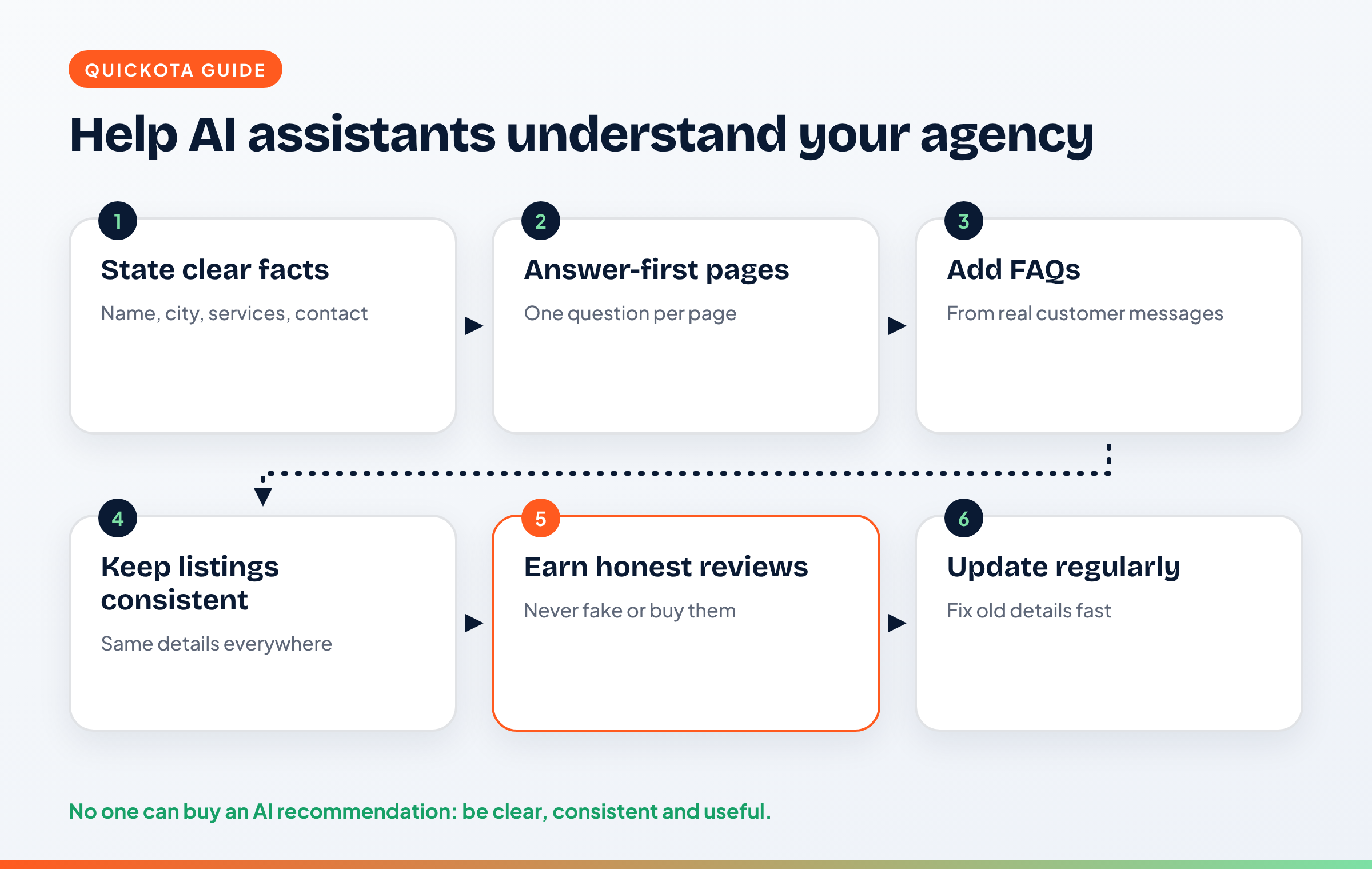
What helps an assistant understand a business: - A clear website that says who you are, where you are and what you sell. - Consistent details across your website, maps listing and directories. - Specific content that answers real questions, not general slogans. - Independent signals such as reviews and mentions by associations or local media.
What does not help: - Copying content from other sites. - Pages full of keywords with no real answers. - Fake reviews, which can also break platform rules.
What facts should your website state clearly?
Your website should answer the basic questions in plain words on one page: the agency's legal name, city and country, what you sell, who you serve, how to contact you, and your opening hours. If you hold a licence or registration that your country requires, say so in your own words. Keep these facts the same everywhere.
A simple "About us" checklist: - Legal name and trading name. - Office address, or the cities you serve if you work online. - Services: for example flights, Umrah groups, visas, family holidays. - Who you serve: families, companies, pilgrims, students, a community. - Phone, WhatsApp and email. - Languages you speak. - Opening hours and how fast you reply.
Write these as normal sentences, not only as a logo or an image. Text is easier for search tools and AI assistants to read.
How should you write pages that AI assistants can quote?
Write pages that answer one question each, with the answer in the first two or three sentences, followed by details. Use headings phrased as the questions customers ask. Be specific about your services and region, and avoid vague claims you cannot support. Short, clear answers are easier to quote.
Page ideas for a typical agency: - "Umrah flights from [your city]: how we book families and groups" - "Flights home to [country] for [community] in [your city]" - "Visit visas for relatives coming to [country]: what we can help with" - "Summer holidays in Georgia and Azerbaijan from [your country]"
Each page should say what you do, for whom, how the process works and how to contact you. Do not give visa or legal rules as fact: link to the official sources.
Why do FAQs and structured data help?
FAQs give short, direct answers to common questions, which is the format AI answers and search features often use. Structured data, a small piece of code that labels your business details and FAQs, helps machines read your page correctly. Many website builders add it for you.
Good FAQ questions come from your WhatsApp and phone messages: - "Do you book Umrah flights for groups?" - "Can I pay in instalments?" - "Which areas do you serve?" - "How fast do you reply?"
Answer each in two to four sentences. Keep the answers true and update them when your services change.
How do listings and reviews affect what AI assistants say?
Business listings, such as your maps profile and local directories, are another source of facts about your agency. Keep them complete and identical to your website. Reviews show what real customers say. Ask happy customers for honest reviews, reply politely to every review, and never buy or fake reviews.
- Use the same name, address and phone number everywhere.
- Choose the right business category and list your services.
- Add your website link and opening hours.
- Ask for reviews after a trip, not before.
- Fix wrong details on old listings.
Membership of a recognised travel association or a mention in local media can also help people and tools trust your agency.
How often should you update your content?
Update your pages whenever your services, contact details or prices change, and review your main pages every few months. Add new pages for new routes or seasons. Remove or correct anything out of date: an old phone number or a service you no longer sell can confuse customers and AI assistants alike.
A simple routine: 1. Once a month, check your main pages and listings. 2. Before each peak season, update seasonal pages. 3. Add one useful new page or blog post at a time. 4. Answer new customer questions with new FAQs.
How a QuickOTA white-label website helps
QuickOTA is a SaaS B2B travel platform. Agencies book flights, visas and group requests in the B2B Panel, which is free. Agencies that want their own branded website can use a QuickOTA white-label website: on the Standard and Premium plans it includes a website builder, a blog and SEO tools, and AI content generation that drafts SEO-ready blog posts for you to review. The white-label website supports Arabic with a right-to-left layout.
You manage your B2B Panel and your white-label website from one account. There is no setup fee. For plan details, send a request and we will reply.
Common mistakes agencies make with AI search
- Expecting to pay for an AI recommendation. There is no such option to buy.
- Hiding key facts in images instead of writing them as text.
- Different details on different listings.
- Thin pages with slogans and no real answers.
- Fake or bought reviews.
- Never updating old pages, prices and phone numbers.
Frequently asked questions
Can I pay to be recommended by ChatGPT?
No. AI assistants do not sell recommendations to agencies. Focus on clear facts, useful pages, consistent listings and honest reviews.
How long does it take for AI assistants to notice changes?
It varies by tool and is not published. Some use live web search, others rely more on older training data. Keep your information correct and consistent, and check from time to time.
Do I need a website, or is social media enough?
A website you control is the strongest base, because it holds your full facts and answers in one place. Social media helps, but it changes quickly and is harder for tools to read in full.
Should I write in Arabic or English?
Write in the languages your customers use. Many agencies in the Arab world publish in both. Keep the facts identical in each language.
Will AI content on my blog hurt me?
Content that is accurate, reviewed by a person and useful to customers is fine. Mass-produced pages with no real answers are not. Always review AI drafts before publishing.
What is GEO?
Generative engine optimisation (GEO) means making your content easy for AI assistants to find, understand and quote. It builds on good SEO: clear facts, answer-first writing and trustworthy sources.