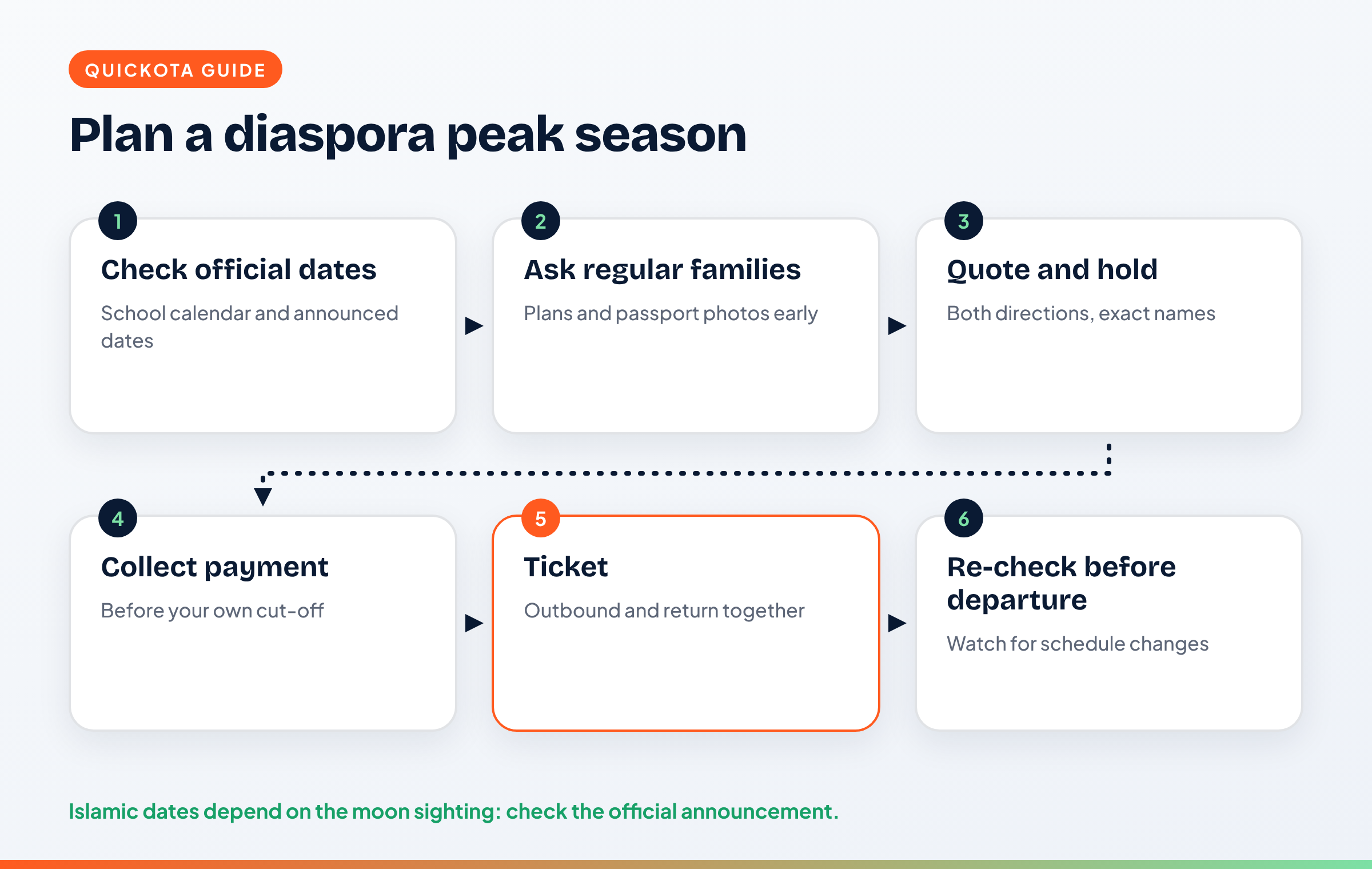
Short answer: Plan each peak backwards from its start, not from the day customers call. Note when your region's school holidays begin and when Ramadan and the two Eids are announced. Ask regular families for their plans months ahead, hold only with passport names, set your own payment cut-off before each ticketing deadline, and ticket the outbound and the return together.
This guide is for agencies in Germany, the Netherlands, Italy, Spain, France and Belgium that sell trips home to Morocco, Algeria, Tunisia and Egypt. Our guide to selling diaspora flights from Europe covers routes, pricing and the basics of peak seasons. This one is the working planner: a calendar pattern, lead times, a daily hold routine, family and one-way bookings, payments, changes and message templates. For rules on selling travel in your country, see our Europe page.
Key takeaways
- North African diaspora demand has three kinds of peak: the summer school holidays, Ramadan and the two Eids. In some years they overlap.
- Islamic dates move about 11 days earlier each year. Take them from official announcements, never from last year's diary.
- School holidays differ by state, region or zone. Use your own region's official calendar.
- Keep one deadline sheet. Collect money before your own cut-off, not on the airline's deadline.
- Send the same clear messages every season: early plans, hold, reminder, ticket, change.
When are the peaks on Europe to North Africa routes?
The busiest periods are the summer school holidays, the end of Ramadan with Eid al-Fitr, and Eid al-Adha. The end-of-year holidays and spring breaks bring smaller waves. Summer is fixed by your school calendar. Ramadan and the Eids follow the Islamic calendar, so they move each year and can fall inside or outside summer.
What drives each peak:
- Summer. Families leave when schools close. The first and last weekends of the holidays usually fill first.
- Ramadan. Some customers spend the whole month at home; others fly for the last days and stay for Eid.
- The two Eids. Short trips. The flights just before Eid and the return soon after fill first.
- Weddings. These cluster in summer and around the Eids, with many guests on the same dates.
About the Islamic dates. Ramadan, Eid al-Fitr and Eid al-Adha move about 11 days earlier each year in the Gregorian calendar, and the exact days depend on the moon sighting. Check the official announcement in your community and in the destination country. Each destination country announces its own dates, and your community may follow one of them. Keep a day or two of margin until they are confirmed.
What does a month-by-month peak calendar look like?
Use the same pattern for every peak and count backwards from its first day. The months below are a planning pattern, not dates: shift them each year to match the school calendar and the announced Islamic dates. Start earlier for large families, weddings and the weeks when two peaks overlap.
| Time before the peak | What to do |
|---|---|
| 6 months or more | Mark the peak in your diary from official calendars. Message regular families and ask for their plans |
| 4 to 5 months | Search the outbound and the return together for firm families. Quote with fare rules and baggage |
| 3 months | Hold for firm travellers with passport names. Agree your payment cut-off in writing |
| 2 months | Take payment and ticket. Chase missing names. Flag weddings and groups |
| 1 month | Ticket the last firm bookings. Send e-tickets and travel details. Expect late, one-way requests |
| Peak weeks | Re-check bookings for schedule changes. Answer change requests quickly |
| After the peak | Note who travelled and when. Add them to next year's early list |
How early should you start for each peak?
Start summer planning as soon as your region publishes its school calendar, and Ramadan and Eid planning as soon as you know roughly where they fall this year. Then tighten the plan when the official dates are announced. The later you start, the fewer dates, airports and fare choices your customers will have.
| Peak | When to start | Main risk |
|---|---|---|
| Summer holidays | When the school calendar is out, often many months ahead | The first and last weekends sell out; families wait for leave dates |
| Ramadan | Several months before; confirm dates when announced | Customers unsure whether they will stay for Eid |
| Eid al-Fitr | With Ramadan; book the return at the same time | Return seats a few days after Eid |
| Eid al-Adha | Several months before; earlier if it falls in summer | Overlap with summer and wedding travel |
| End of year | Early autumn | Short trips with fixed dates |
Customers often ask for airlines by name, such as Royal Air Maroc, Air Algérie, Tunisair, EgyptAir or Transavia. Treat the name as a starting point. What you can sell is what your booking system shows on the day you search.
Where do you find the school holiday dates?
Use the official school calendar for your customer's state, region or zone, and ask which one their children's school follows. Families in the same country can be on different dates, so one national list is not enough. Copy the dates into your planning sheet once a year, from the official source only.
- Germany: the Kultusministerkonferenz agrees the summer holidays of the 16 states, and each state sets its other holidays. Use the state's own portal or the KMK overview.
- Netherlands: the government splits the country into three regions to spread school holidays. Check which region your customer's town is in.
- France: winter and spring holidays differ by zone (A, B, C); the official calendar lists them.
- Italy, Spain and Belgium: calendars are set at regional or community level. Use your region's or community's official calendar.
What hold and ticketing-deadline routine works in peak weeks?
Keep one deadline sheet for every held booking: names, booking reference, ticketing deadline, your own payment cut-off and who has paid. Check it every morning. Ticket as soon as money arrives, release unpaid holds before the deadline, and never let the airline cancel a booking you forgot.
A daily routine for peak weeks:
- Morning check. Sort holds by deadline. Anything due in the next day goes first.
- Set your cut-off earlier than the deadline, so a late transfer does not cost the seat.
- Chase payment once, in writing, with the cut-off time.
- Ticket, then tick it off. A hold is not a ticket, and the fare can change until the ticket is issued.
- Release what is unpaid before the deadline and tell the customer.
- Re-check ticketed bookings a few days before departure for schedule changes.
How holds and deadlines work is explained in your first flight booking: PNR, hold and ticketing.
How do you handle families and groups?
Book each household on its own booking where you can, so one late payer or missing passport does not block everyone. Keep related bookings together in your sheet. For a wedding party or a community trip with many travellers on the same dates, a group request often suits better than many small bookings.
Points for family bookings:
- Ages. Check each child's and infant's age on the travel dates, not on the booking date. The fare type can depend on it.
- One payer, many travellers. Write down who pays for whom, and send one total per household.
- Split by date. Relatives who stay all summer should not wait for those who fly home after a week.
- Large groups. Send a group request early, with the dates and the approximate number of travellers.
When should you use open-jaw or one-way tickets?
Use an open-jaw ticket when the family arrives in one city and leaves from another, and one-way tickets when the return date is truly unknown. Both are common on diaspora routes. Compare them with a simple return before you sell, and explain the rules for each part in writing.
- Open-jaw. A family may fly into Casablanca and home from Marrakech, or into Algiers and home from Oran. On one ticket, the fare rules cover both flights. Check baggage and change rules for each direction.
- One-way. Useful for long stays, students and emergencies. Two one-way tickets, possibly on different airlines, each have their own rules and baggage. If one flight changes, the other ticket does not move with it.
- No-shows. On many return fares, missing the outbound cancels the return. Tell customers before they pay.
- Baggage. Families going home in summer carry gifts. Check the allowance on every flight; see checked baggage explained.
How do you keep names right in a rush?
Copy every name from a clear photo of the passport page the traveller will use, and read the list back before you ticket. In peak weeks there may be no seat on the next flight if a name is wrong. Ask dual nationals which passport they will travel on, and book that spelling.
The peak-season rule is simple: no passport photo, no hold. Our Algeria route guide covers Latin spellings of North African names.
When should you collect payment?
Collect payment before your own cut-off, well ahead of the ticketing deadline, and only ticket once the money is with you. Bank transfers can take time, especially across borders, so ask customers to pay early. Agree in writing what happens if the fare changes before payment arrives.
- Fund your own account early. If you pay your supplier from a prepaid balance, top it up before the peak weeks.
- Never ticket on trust for someone you do not know. Once the ticket is issued, the money is spent.
How do you handle changes after the sale in peak weeks?
Expect more change requests in peak weeks, and fewer seats to move people to. Before you promise anything, check the fare rules and seat availability, then quote the cost, including any fee and fare difference. Answer schedule changes the day you hear about them, before the customer reaches the airport.
Quote before you change anything, and get the customer's approval in writing. Refunds take time, so never promise a date.
See how flight changes, cancellations and refunds work on a B2B platform and refunds and date changes.
What messages should you send customers?
Send the same short messages each season, in the customer's language, so families know what happens next. The templates below are illustrative: replace the brackets with what the booking shows. Prices are left out on purpose. The full quote layout is in our WhatsApp quote guide.
Illustrative message 1: early plans
Hello [name], summer and Eid seats home fill early. Are you travelling this year? Send me the dates, who is travelling and the passport photos, and I will check options for you.
Illustrative message 2: hold confirmation
Your seats [city] → [city] on [date] and back on [date] are held for [names, as in the passports]. Checked baggage: [allowance]. Changes: [rule]. Please pay by [time, day] so I can issue the tickets. After that, the price or the seats may change.
Illustrative message 3: payment reminder
Reminder: your held seats need payment by [time, day]. If I do not receive it, I will release them so you are not charged.
Illustrative message 4: ticket issued
Your tickets are issued. E-ticket numbers: [numbers]. Please check names and dates now. I will tell you if the airline changes the schedule.
Illustrative message 5: change request
I can check a new date for you. Changes depend on seats and the fare rules. I will send you the cost first, and change nothing until you agree.
How to plan peak season with QuickOTA
QuickOTA is a B2B travel platform. In the B2B Panel you search, hold and ticket flights and check the fare rules before you book. You can search and compare fares before you top up, so you can quote families early. Service fees are itemised and shown before you book and in your booking details. You request changes, cancellations and refunds from your panel and see the quote before you accept. Approved refunds are credited back to your QuickOTA wallet.
For weddings and community trips, send group requests and get a quote from our team, pay in instalments from your wallet and manage the passenger list in the panel. The prepaid wallet can be topped up online or by bank deposit, with low-balance alerts. QuickOTA does not require IATA accreditation: QuickOTA issues the ticket for your booking. B2B Panel access is free, with no setup fee and no minimum deposit. To open an agency account you need a registered company or a valid travel agency (tourism) licence from your country. You are responsible for meeting your own country's rules for selling travel.
Common mistakes in diaspora peak seasons
- Copying last year's Eid dates. They move each year. Wait for the official announcement.
- Using one national school calendar when your customers live in different states, regions or zones.
- Booking the outbound and leaving the return open for summer or Eid.
- Taking payment on the deadline day. Set your own cut-off earlier.
- Selling two one-way tickets without explaining that each has its own rules.
Frequently asked questions
When should I start selling summer flights to Morocco, Algeria, Tunisia or Egypt?
As soon as your region's school calendar is published, ask regular families for their plans. Hold for firm travellers with passport names and ticket once they pay. The first and last weekends of the holidays usually go first.
What are the dates of Ramadan and Eid next year?
Check the official announcement in your community and in the destination country, because the dates depend on the moon sighting. They move about 11 days earlier each year. Keep a day or two of margin in your plan until they are confirmed.
Should I book families on one booking or several?
Usually one booking per household. Then one late payment or missing passport does not hold up everyone. For many travellers on the same dates, such as a wedding, a group request may suit better.
Is an open-jaw ticket better than two one-way tickets?
It depends on the fares and rules on the day. One open-jaw ticket keeps both flights under one set of rules. Two one-way tickets can give more choice, but each has its own rules and baggage. Compare both and explain the difference.
How long can I hold a peak-season seat?
Until the ticketing deadline on that booking, which the fare sets. In peak weeks it can be short, and the fare can change before ticketing. Check the deadline on every booking and ticket as soon as the customer pays.
Can I change a ticket in the middle of summer?
Only if the fare rules allow it and there is a seat on the new date. Quote the cost first, including any fee and fare difference, and change nothing until the customer agrees.