
Short answer: Agencies selling UK flights serve three main groups: students starting or returning to their courses, families on holiday or visiting relatives, and patients travelling for treatment with companions. Ask the purpose first, because each group needs different fares, baggage, flexibility and assistance. Choose the right UK airport, hold early for peaks, and send customers to the official UK government site for entry rules.
The UK is a steady destination for agencies in the Gulf, Egypt, Iraq and East and West Africa. Students fly out at the start of each term, Gulf families spend the summer in London, and patients travel for treatment with relatives. Each trip looks simple, a return flight to London, but the details differ a lot. This guide explains how to sell to each group, which airports and connections to compare, when the peaks are, and how to quote, hold and change these bookings. Entry rules are not covered: customers should check the official UK government site, GOV.UK.
Key takeaways
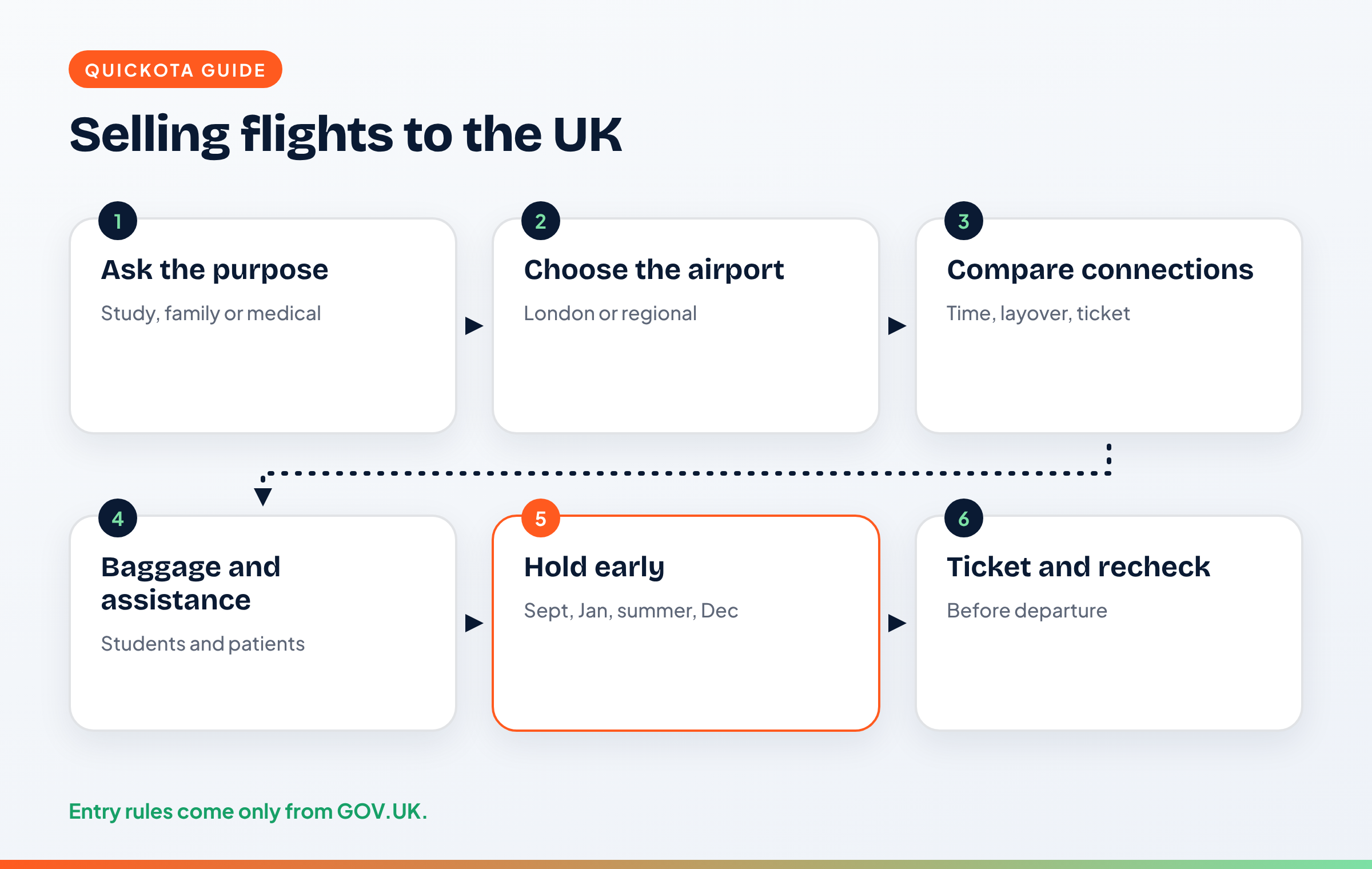
- Ask the purpose: study, family trip, or medical travel.
- Students need baggage and flexible dates; patients need assistance and flexible returns.
- Compare London Heathrow, Gatwick and the regional airports against where the customer is going.
- Hold early for September, January, summer and the December holidays.
- Entry rules come only from GOV.UK. Do not advise on them yourself.
Who books flights to the UK?
Most UK bookings from the Gulf and Africa fall into three groups: students, families and patients. Students often book one-way or open-return trips around term dates. Families book summer holidays or visits to relatives. Patients book with one or more companions and often need flexible return dates and special assistance at the airport.
| Traveller | Typical trip | What matters most |
|---|---|---|
| Student | One-way or return around term dates | Baggage, date changes, arrival airport |
| Family on holiday | Two to six weeks in summer | Children's fares, baggage, school holidays |
| Family visiting relatives | December or summer | Regional airports, long stays |
| Patient with companions | Open-ended stay for treatment | Assistance, flexible returns, seating |
| Business traveller | Short trip | Timing, flexible returns |
How do you sell flights to students?
Start from the date the student must arrive, which is set by the university or college. Book a flight that lands a day or two before, at the airport closest to the campus. Students usually travel with a lot of luggage, so compare checked baggage carefully, and choose fares with reasonable change rules in case dates move.
What to check for students: - Arrival date: confirm it from the student's offer or enrolment letter, not from memory. - Arrival airport: a regional airport may be closer than London. - Baggage: compare checked allowances, and the cost of extra bags, before the student pays. - Changes: term dates and exam timetables can move, so explain the change rule clearly. - Return trips: many students fly home for the summer or December holidays; offer to plan these early.
Some airlines offer student fares or extra baggage for students. Check the airline's official site for its own terms before you mention it to a customer. Students should check entry and study rules on GOV.UK and with their university.
How do you sell flights to families?
For families, start with the school holidays and the length of the stay. Gulf families often spend several weeks in London in summer, while families visiting relatives may prefer a regional airport near where they stay. Book children by date of birth, check baggage on every flight, and hold early for peak weeks.
- Long stays: check that the fare allows the length of stay the family wants.
- Large families: for many travellers on the same dates, a group request can help.
- Shopping: families often fly home with more luggage, so write the return allowance in the quote.
- Infants: check the infant allowance and age on the return date.
How do you sell flights for medical travel?
For medical travel, the hospital arranges the treatment; your job is the journey. Ask whether the patient needs a wheelchair, help at the airport, or special seating, and request it from the airline when you book. Airlines may ask for medical information before they accept some passengers, so ask the customer to check with their doctor and the airline early.
What to check for patients and companions: 1. Assistance: wheelchair or help at the airport, requested at booking and confirmed before departure. 2. Medical clearance: some airlines ask for a medical form for passengers with certain conditions. The airline decides; do not give medical advice. 3. Companions: book them on the same booking where possible, so they sit together. 4. Flexible returns: treatment dates often change, so explain the change rule and consider flexible fares. 5. Connections: shorter journeys and fewer stops are easier for patients.
Treat medical details with care and share them only as needed for the booking.
Which UK airports and connections should you compare?
Compare London Heathrow (LHR) and London Gatwick (LGW) with regional airports such as Manchester (MAN), Birmingham (BHX), Edinburgh (EDI) and Glasgow (GLA). The right airport depends on where the customer is going, not only on the cheapest fare. Compare total travel time, connections, baggage and change rules.
Airline names customers often search for include British Airways, Virgin Atlantic, Emirates, Qatar Airways, Etihad, Saudia, Kuwait Airways, Gulf Air, Oman Air, EgyptAir, Kenya Airways, Ethiopian Airlines, Royal Air Maroc and Turkish Airlines. Do not promise an airline, a direct flight or a route until you have seen it in your search on the day.
From many cities in Africa and Iraq, trips to the UK connect through a hub. Check the layover time and whether the whole trip is on one ticket, especially for students with heavy baggage and for patients.
When are the peaks?
UK demand peaks around the start of the academic year in September, the January intake, the summer school holidays, and the December holidays. Gulf summer holidays and the days around Eid also fill flights from the region. Islamic dates move about 11 days earlier each year. Hold early with passport names once dates are firm.
- September and January: students arriving for new terms.
- Summer: Gulf families and students going home.
- December: students going home and families visiting relatives.
How do you quote, hold and change UK bookings?
Quote the total price with baggage, change and refund rules and your deadline. Hold with names exactly as in the passports, collect payment before your own cut-off, and ticket when the money has arrived. For changes, ask your supplier for a quote first and change nothing until the customer agrees.
Illustrative message:
Riyadh → London Heathrow on [date], one way, for a student starting on [date]. Checked baggage: [allowance]. Extra bag: [price if offered]. Changes: [rule]. Held until [time]. Total: [amount].
For medical travel, add a line confirming the assistance you requested, and ask the customer to tell you as soon as the treatment dates move.
How to sell UK flights with QuickOTA
QuickOTA is a B2B travel platform. In the B2B Panel you search, hold and ticket flights and check the fare rules before you book. You can search and compare fares before you top up, and service fees are itemised and shown before you book and in your booking details. You request changes, cancellations and refunds from your panel and see the quote before you accept, and approved refunds are credited back to your QuickOTA wallet.
For student groups or large families travelling together, send a group request and get a quote from our team, then pay in instalments from your wallet. QuickOTA does not require IATA accreditation: QuickOTA issues the ticket for your booking. B2B Panel access is free, with no setup fee and no minimum deposit.
Common mistakes when selling UK flights
- Booking before confirming the term start date from the student's documents.
- Assuming baggage for students with heavy luggage.
- Forgetting to request assistance for patients.
- Selling non-flexible fares for medical travel with uncertain dates.
- Choosing London by default when a regional airport is closer.
- Giving entry or study advice yourself. Send customers to GOV.UK.
Frequently asked questions
Where do customers check UK entry rules?
On the official UK government site, GOV.UK. Students should also check with their university. Do not give entry advice yourself.
Should students book one-way or return tickets?
It depends on the student's plans and the fare rules. Compare both, explain the change rules, and check the return date against the course dates.
How do I request a wheelchair for a patient?
Request special assistance when you book, and confirm it with the airline before departure. Ask the customer about any medical forms the airline needs.
Which London airport should I book?
The one that suits the customer's destination and flights. Compare Heathrow, Gatwick and regional airports such as Manchester or Birmingham on total travel time.
Can I book a group of students travelling together?
Yes. Send a group request with the dates, route and number of travellers, and get a quote from the QuickOTA team.
What fares suit medical travel?
Fares with flexible change rules, because treatment dates often move. Explain the rule clearly in the quote.