Short answer: Most costly mistakes on Umrah and Gulf flights happen before ticketing: a name that does not match the passport, a hold that expires, the wrong passenger type, a one-way ticket sold without explaining its rules, or a baggage promise the fare does not include. Check names, deadlines, ages, fare rules and baggage on every booking, and recheck tickets near Ramadan and Eid.
Umrah trips and Gulf travel are the daily work of many agencies in Egypt, Sudan, Iraq, Jordan, North Africa and the Gulf itself. The bookings look simple, but small errors turn into change fees, refused boarding or angry families at the airport. This guide lists the mistakes new agencies make most often, explains why each one costs money, and gives a simple check to stop it. It does not cover visa or entry rules: for those, see our visa pages and the official government sources.
Key takeaways
- Copy names from the passport, letter by letter, and send them back to the customer to confirm before you hold.
- A hold is not a ticket. Note the ticketing deadline and set your own payment cut-off earlier.
- Book infants and children by their age on the travel date, not their age today.
- One-way and return tickets have different rules. Explain them, especially to workers.
- Never promise baggage, changes or refunds that the fare rules do not show.
Why do small mistakes cost so much on Umrah and Gulf routes?
These routes have busy peaks, strict fare rules on many low fares, and travellers who often fly with large families or on fixed work dates. A mistake that takes minutes to fix in a quiet month can cost a change fee, a new fare or a lost seat in Ramadan or around Eid, when seats are scarce.
Three things make these routes less forgiving: - Peaks fill fast. Ramadan, the Eid holidays, school holidays and the end of the year bring many travellers at once. - Many low fares have tight rules. Changes may cost a fee plus any fare difference, and some fares cannot be refunded. - Bookings are often for families or groups. One wrong detail can hold up everyone on the booking.
Mistake 1: names that do not match the passport
Airlines expect the name on the ticket to match the passport used for travel. Spelling differences, a missing middle name, swapped first and last names, or a nickname can lead to a name correction fee or trouble at check-in. Copy names from the passport's data page, not from a message or an ID card.
How to avoid it: - Ask the customer for a clear photo of the passport data page. - Copy the surname and given names exactly as printed in the Latin characters on the passport. - Do not translate or "correct" Arabic names yourself. Use the passport spelling, even if the family usually writes it differently. - Send the names back to the customer before you hold: "Please confirm these names match your passports." - Check that the passport is valid for the trip. Entry rules on validity differ by country, so send the customer to the official source.
Name correction rules depend on the airline and the fare. Some airlines allow small corrections, others treat a name change as a new ticket. Ask your supplier before you promise anything.
Mistake 2: letting a hold expire
A hold reserves seats until the ticketing deadline set by the fare. If you do not ticket in time, the airline cancels the booking and the fare may be gone. In Umrah and Eid peaks, deadlines can be short and the fare can change before you ticket.
How to avoid it: - Note the ticketing time limit on every booking as soon as you hold. - Set your own payment cut-off a few hours earlier, so you have time to confirm the money. - Keep one list of all open holds and their deadlines, and check it every morning. - Tell the customer clearly: "This price is held until [time]. After that it can change."
Our guide to PNRs, holds and ticketing deadlines explains holds step by step.
Mistake 3: the wrong passenger type
Infant, child and adult fares depend on the passenger's age, usually on the date of travel. A baby who turns two during the trip, or a child who turns twelve before the return, may need a different fare for part of the journey. Booking the wrong type can mean a new fare at check-in.
How to avoid it: - Ask for the date of birth of every traveller, not their age. - Check the age on the outbound and the return date. - Remember that an infant usually travels on an adult's lap and is linked to that adult on the booking. - For large families, count adults and infants: airlines limit infants to one per adult. - If you are unsure, check the airline's own rules or ask your supplier before you ticket.
Mistake 4: selling one-way tickets without explaining the rules
Many workers going to the Gulf travel one way, and many families buy two one-way tickets. That can be the right choice, but each one-way ticket has its own fare rules and baggage. A return ticket keeps both flights under one set of rules. Explain the difference before the customer chooses.
How to avoid it: - Ask whether the traveller knows the return date. If not, a one-way ticket may suit better. - Compare a return ticket and two one-way tickets on the day, with their change rules and baggage. - On a return ticket, explain that missing the outbound flight can cancel the return on many fares. - For workers, ask whether the employer or recruiting agency is buying the ticket or has rules about the travel date. Do not advise on work or residence documents: send the traveller to the official source.
Mistake 5: promising baggage the fare does not include
Baggage depends on the airline, the route and the fare. Low fares on some airlines include only cabin baggage, while others include a checked bag. Umrah travellers often return with Zamzam water and gifts, and workers often travel with heavy bags, so a wrong promise ends in extra charges at the airport.
How to avoid it: - Read the baggage allowance on the fare you are selling, for each flight. - Write it in the quote: "Checked baggage: [allowance] per person." - Tell Umrah travellers to check the airline's rules on Zamzam water before the return flight. - If the traveller needs more baggage, compare a fare that includes it with buying extra baggage, and check what your supplier can add.
Our guide to checked baggage on Gulf and Egyptian airlines explains how to present baggage to customers.
Mistake 6: not rechecking tickets before Ramadan and Eid travel
Airlines sometimes change schedules after ticketing, and peak periods bring extra flights and retimings. If you do not recheck, a family can arrive for a flight that now leaves earlier, or miss a connection that no longer works. Recheck every ticket a few days before departure.
How to avoid it: - Keep a list of tickets by departure date and check each one before travel. - If a time changes, tell the customer at once and offer the options the airline or your supplier gives. - For Umrah groups, check connection times again after any change. - Remind travellers to arrive at the airport early in peak periods.
Mistake 7: promising a refund before you know the amount
Refunds depend on the fare rules. Some fares are refundable, some only partly, and some not at all, though certain taxes may still be returned. Telling a customer "you will get your money back" before you have a refund quote turns into a loss or a dispute when the amount is lower.
How to avoid it: - Read the refund rule in the fare before you sell, and write it in the quote. - When a customer cancels, ask your supplier for a refund quote first. - Tell the customer the amount and the deductions, then submit. - Pay the customer after your supplier credits you.
Our guide to refunds and date changes on Gulf and Egyptian airline tickets goes further.
How to avoid booking mistakes with QuickOTA
QuickOTA is a B2B travel platform. In the B2B Panel you search, hold and ticket flights, and check the fare rules before you book. Service fees are itemised and shown before you book and in your booking details. You request changes, cancellations and refunds from your panel and see the quote before you accept, and approved refunds are credited back to your QuickOTA wallet.
For Umrah groups, send a group request with the dates, route and number of passengers, get a quote from our team, pay in instalments from your wallet and manage the passenger list in the panel. Hajj quotas, permits and Hajj visas come only from the national Hajj authority and the official Saudi system. QuickOTA does not require IATA accreditation: QuickOTA issues the ticket for your booking. B2B Panel access is free, with no setup fee and no minimum deposit.
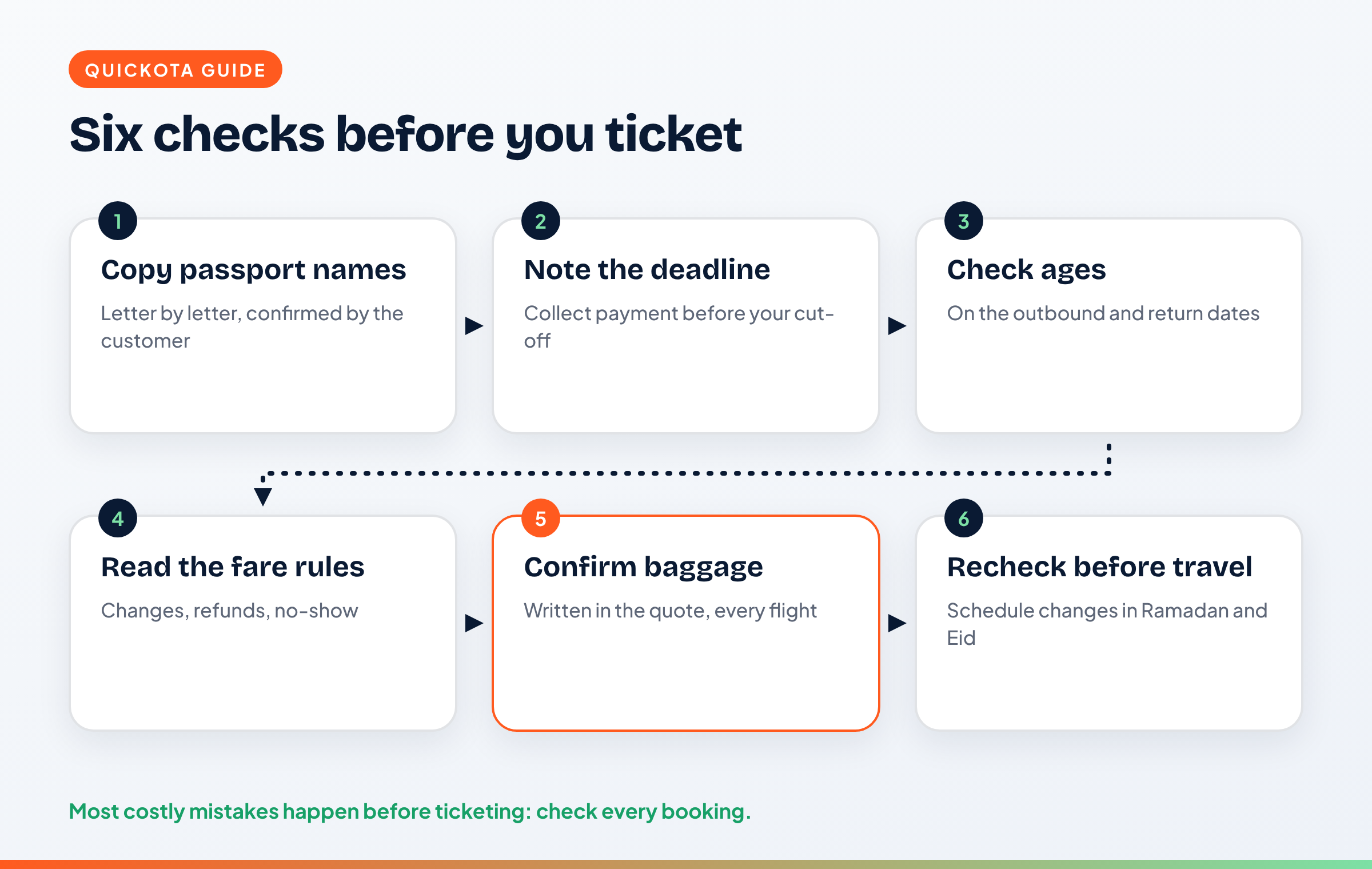
A quick checklist before you ticket
- Names copied from the passports and confirmed by the customer.
- Dates of birth checked against the travel dates.
- Ticketing deadline noted, payment received before your cut-off.
- Fare rules read: changes, refunds, no-show.
- Baggage written in the quote for every flight.
- One-way or return choice explained.
- Ticket numbers sent to the customer, and a reminder set to recheck before departure.
Frequently asked questions
What happens if the name on the ticket does not match the passport?
The traveller may face a name correction fee or problems at check-in. The rules depend on the airline and the fare. Fix it before ticketing if you can, and ask your supplier how the airline handles corrections.
How long can I hold an Umrah flight?
Until the ticketing deadline set by the fare. In peak periods it can be short and the fare can change. Note the deadline when you hold and collect payment before your own earlier cut-off.
Should workers going to the Gulf buy one-way or return tickets?
It depends on whether they know their return date and on the fares and rules on the day. Compare both, explain the rules of each, and check whether the employer or recruiting agency has its own requirements.
How do I book a baby on an Umrah flight?
Book the baby as an infant linked to an adult, using the date of birth. If the baby turns two before the return flight, the return may need a child fare. Check the airline's rules before ticketing.
Can I carry Zamzam water on the return flight?
Rules depend on the airline and can change. Ask travellers to check the airline's official information before they fly, and never promise extra baggage the fare does not include.
Where do I check visa rules for Umrah or Gulf travel?
Use official government sources. Our Saudi Arabia visa page and UAE visa page explain what QuickOTA offers agencies and link to the official sources.