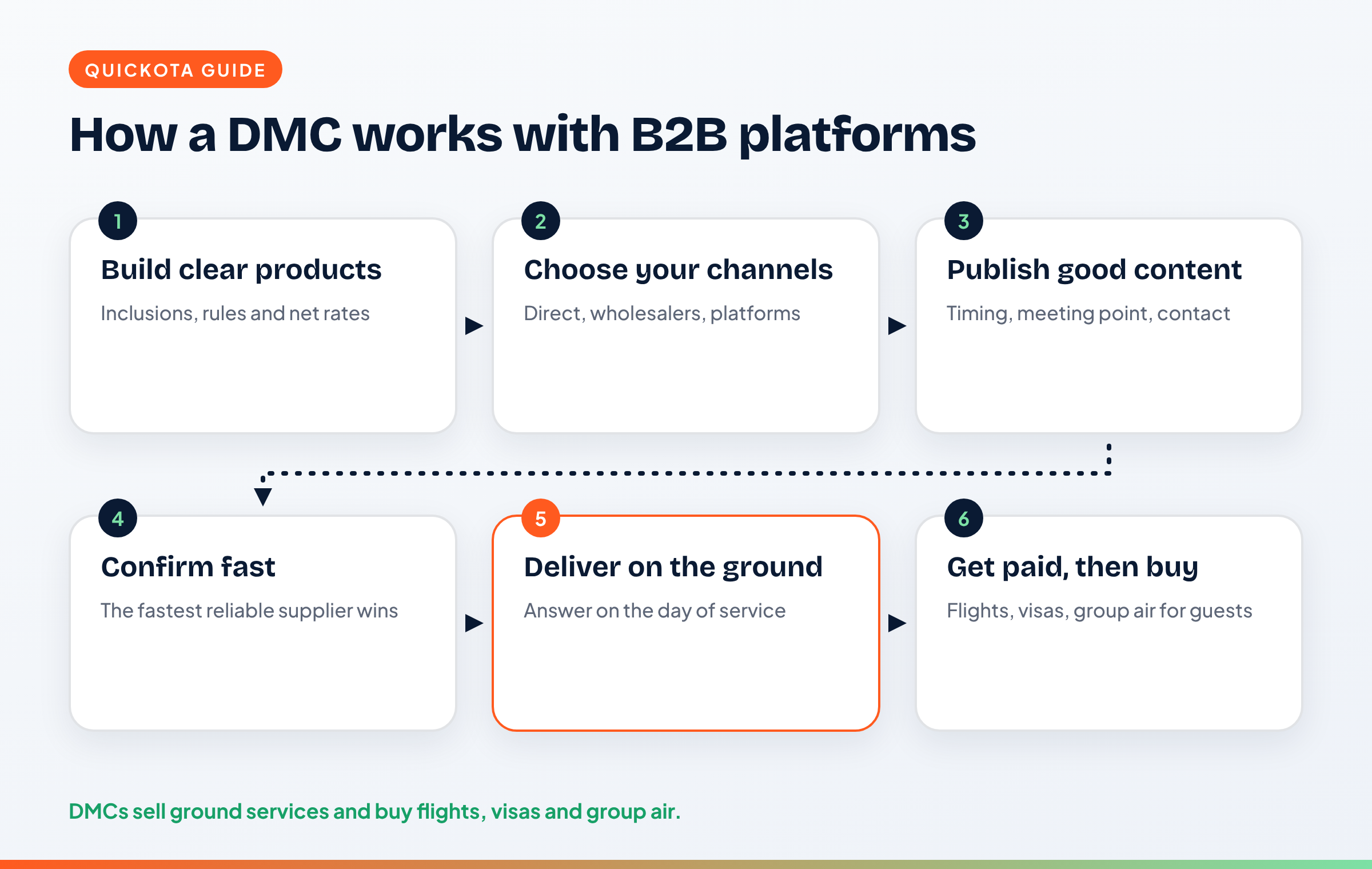
Short answer: DMCs and local tour operators use B2B travel platforms in two directions. They sell: their transfers, tours and packages reach agencies through wholesalers, marketplaces and direct agency contracts at net rates. They buy: flights, visas, hotels and group air for their own guests. The best platforms make both sides simpler, with clear rates, fast confirmations and prepaid or agreed payment terms.
A destination management company (DMC) or local tour operator knows its destination: the guides, drivers, hotels, sites and seasons. What it often lacks is reach, because the travellers are booked by agencies in other countries. B2B platforms connect the two. This guide explains how that works in plain words: the roles in the chain, how DMCs sell to agencies, what they buy, how rates and payments usually work, and what to check before joining a platform. It is written for DMCs and inbound operators in the Gulf, Egypt, Jordan, Morocco, Turkey, the Caucasus, Southeast Asia and East Africa.
Key takeaways
- A DMC sells local services (transfers, tours, guides, events, hotels) to agencies, usually at net rates.
- B2B platforms, wholesalers and marketplaces carry DMC products to agencies in other countries.
- DMCs also buy: flights for guests and staff, visas, group air and hotels in other cities.
- Clear content, fast confirmation and fair cancellation rules matter more than the lowest rate.
- Check who holds the contract, who collects the money, and when you are paid.
What is a DMC, and how is it different from a tour operator or wholesaler?
A DMC is a local company that designs and runs services in its own destination: airport transfers, tours, guides, events, meetings and often hotel contracts. A tour operator packages services into trips, sometimes across several destinations. A wholesaler or bedbank buys in volume and resells to agencies. In practice, many companies do more than one role.
| Role | What it sells | Who it sells to |
|---|---|---|
| DMC / inbound operator | Ground services in one destination | Agencies, tour operators, MICE planners |
| Outbound tour operator | Packages abroad, often with flights | Travel agencies and the public |
| Wholesaler / bedbank | Hotels and services bought in volume | Travel agencies and online agencies |
| B2B travel platform | Flights, hotels, visas, tours and more in one panel | Travel agencies |
| Travel agency | Trips to the traveller | The public and companies |
Our guide to what a B2B travel portal is explains the platform side in more detail.
How do DMCs sell to agencies through B2B channels?
DMCs reach agencies in three main ways: direct contracts with agencies and tour operators, wholesalers and bedbanks that resell their services, and B2B platforms or marketplaces where agencies book online. Each channel takes a margin or a fee, and each has its own rules for content, confirmation and payment.
- Direct contracts. Highest margin and strongest relationship, but slow to build and harder to scale.
- Wholesalers and bedbanks. Wide reach to many agencies, but less control over how your product is shown and sold.
- B2B platforms and marketplaces. Agencies book online with instant or fast confirmation. You need clear content and quick replies.
Most DMCs use a mix. Start with the channel that reaches the agencies already sending you guests, and add others as your products and team grow.
What do agencies expect from a DMC's products?
Agencies want products they can sell without long email chains: a clear description, what is included and not included, the meeting point, the duration, the minimum and maximum group size, the cancellation rules, and a net rate. They also expect fast confirmation and someone who answers on the day of service.
A good product sheet includes: - Name and short description in plain English. - Inclusions and exclusions: transport, guide, entrance fees, meals. - Timing: start time, duration, pickup window. - Rules: cancellation, no-show, child policy, minimum numbers. - Net rate and the currency, with validity dates. - Emergency contact on the day.
Illustrative example: a DMC in Amman offers a full-day Petra trip from the capital. The product sheet states the pickup window, the driver and guide, what the entrance arrangements are, the return time, and a 48-hour cancellation rule. An agency in Kuwait can sell it in minutes because nothing is missing.
How do rates, payments and cancellations usually work?
Most DMCs sell at net rates and let the agency add its own margin. Payment terms vary: prepaid before service, a deposit with the balance before arrival, or credit for trusted partners. Cancellation rules should match the DMC's own costs with hotels, guides and transport, and be written into every confirmation.
| Topic | Common practice | Watch out for |
|---|---|---|
| Rates | Net rate per person or per vehicle, valid for a season | Currency changes, peak-season supplements |
| Payment | Prepaid, deposit plus balance, or credit for trusted partners | Late payers, unpaid no-shows |
| Cancellation | Free until a set number of days, then a charge | Rules that do not match your hotel and supplier rules |
| Confirmation | Instant for simple products, on request for complex ones | Slow replies lose the booking |
Our guide to B2B, net and selling rates explains the rate vocabulary.
What do DMCs buy from B2B platforms?
DMCs also buy. They book flights for incoming groups, guides and staff, order visas for guests where the destination allows it, request group air for conferences and incentive trips, and book hotels in other cities on multi-centre tours. Buying these from one B2B platform saves time and keeps costs visible.
Common purchases: - Flights for groups arriving from a feeder market, or domestic and regional legs inside a tour. - Group air for incentive trips, conferences and pilgrimages. - Visas for guests, where the DMC handles the paperwork for its agency partners. - Hotels outside the DMC's own contracted properties.
Illustrative example: a DMC in Dubai runs an incentive programme for a company group from Egypt. It requests group air for the group, orders UAE visas for the guests through its B2B supplier, and runs transfers, tours and the gala dinner itself.
What should a DMC check before joining a B2B platform?
Check who holds the contract with the agency, who collects the money and when you are paid, what fee or margin the platform takes, how your product content is shown, and how cancellations and disputes are handled. Ask for the terms in writing and test with a few bookings before you load your full range.
- Who is the seller of record to the agency?
- How and when do you receive payment?
- Can you set your own rates, availability and cancellation rules?
- How fast must you confirm?
- Who handles complaints and refunds?
Our guide to checking a supplier has a checklist that works in both directions.
How DMCs work with QuickOTA
QuickOTA is a SaaS B2B travel platform. Agencies and DMCs use the B2B Panel to search, hold and ticket flights, book hotels and tours, and send group requests to the QuickOTA team: you get a quote, pay in instalments from your wallet and manage the passenger list in the panel. Visas for UAE, Saudi Arabia, Qatar, Kuwait, Bahrain, Oman, Jordan, Lebanon, Egypt, Iraq, Azerbaijan, Georgia, Turkey, Malaysia, Thailand, Indonesia, Singapore, Kenya (eTA) and Cuba are available for approved agencies at B2B rates.
Service fees are itemised and shown before you book and in your booking details. You pay from a prepaid wallet with no minimum deposit. QuickOTA does not require IATA accreditation: QuickOTA issues the ticket for your booking. B2B Panel access is free, with no setup fee. For DMCs with their own brand, white-label plans start at $29 a month (see pricing). For DMCs with their own systems, the Services API has no setup fee. It is free for every agency, with or without a white-label plan.
Common mistakes DMCs make with B2B channels
- Thin product content. Agencies skip products they cannot explain to a customer.
- Slow confirmations. On B2B platforms, the fastest reliable supplier usually wins.
- Cancellation rules that do not match your own costs.
- One rate for every channel without checking each channel's margin or fee.
- No day-of-service contact. Problems on the ground hurt the agency's trust in you.
- Ignoring the buying side. Flights, visas and group air can be simpler to manage from one platform.
Frequently asked questions
What is the difference between a DMC and a travel agency?
A DMC designs and runs services in its own destination for visitors arriving from elsewhere. A travel agency sells trips to its own customers, often to other destinations, and books DMC services as part of those trips.
Should a DMC sell through wholesalers or directly to agencies?
Most use both. Direct contracts give better margins and relationships. Wholesalers and B2B platforms give reach. Choose by where your guests come from and how much sales work your team can handle.
Do DMCs sell at net rates?
Usually yes. The DMC quotes a net rate and the agency adds its own margin. Some channels take a commission instead. Write the model into every contract.
Can a DMC use QuickOTA to book flights for its guests?
Yes. QuickOTA works with travel agencies in any country that meet the eligibility rules: a registered company or a valid travel agency (tourism) licence from your country. You search, hold and ticket flights in the B2B Panel.
Can I sell my tours on QuickOTA?
Agencies can book tours in the QuickOTA panel. If you have your own website with QuickOTA, the Standard and Premium white-label plans let you add your own tours and packages and sell them to your customers.
What should be in a DMC's cancellation policy?
The days before arrival when charges start, the charge at each stage, no-show rules, and how refunds are paid. Match it to your own hotel, guide and transport costs.